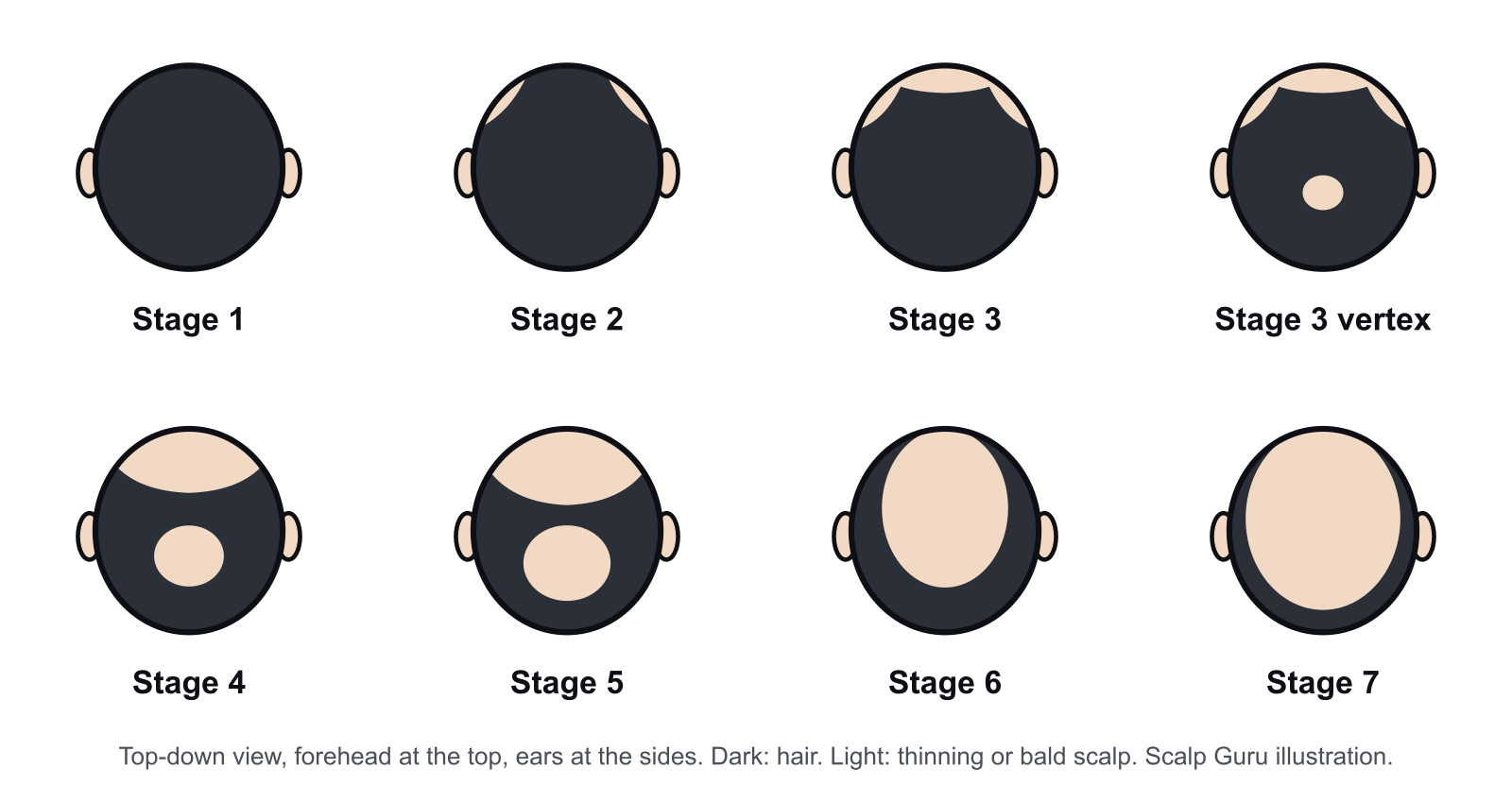
Most men meet the Norwood scale as a grid of little cartoon heads on a hair loss forum, and then spend an evening deciding which one they are. I have spent 17 years in scalp micropigmentation and permanent makeup, where your stage shapes almost every hairline conversation. I am not a doctor, so every medical point below comes from the published sources I cite. Here is the version I would give anyone who asked me in person: where it came from, what each stage really means, how to rate yourself without fooling yourself, and what your stage changes about treatment and scalp micropigmentation.
Where the Norwood scale came from
The scale you see online is two pieces of work stacked together. The first came from James Hamilton in 1951, the second from O'Tar Norwood in 1975, which is why clinicians usually call it the Hamilton-Norwood classification.
Hamilton, 1951
Hamilton was an anatomist. His paper, Patterned loss of hair in man; types and incidence, was published in the Annals of the New York Academy of Sciences in March 1951. Reviews describe him studying more than 300 men with hair loss, within a wider group of more than 700 people of different sexes, ages and ethnic backgrounds (Gupta and Mysore, 2016; Wirya and colleagues, 2017).
He sorted scalps into eight types. Types I to III were "not bald" and types IV to VIII were "bald". His type III was a catch-all for borderline cases, scars and odd asymmetry, which made it awkward to use. He set an actual measurement for recession too: at type II, the triangles at the temples stop at a point 3 cm in front of a line drawn over the top of the head between the ear canals.
Norwood, 1975
Norwood was a dermatologist and hair transplant surgeon. His paper, Male pattern baldness: classification and incidence, appeared in the Southern Medical Journal in November 1975. In the abstract he says the growth of hair transplant surgery made a reproducible classification necessary, because good surgical results depend on choosing patients well.
He studied 1,000 white adult men, kept Hamilton's logic, dropped the confusing catch-all type, and added the patterns Hamilton had missed: the type A variants and the vertex type. The result has seven main stages. Both reviews above describe it as the most widely used hair loss classification in the world.
| Feature | Hamilton 1951 | Norwood 1975 |
|---|---|---|
| Main types | I to VIII | 1 to 7 |
| Who was studied | 300+ men with hair loss, 700+ people in total | 1,000 white adult men |
| First "bald" type | Type IV | Type 3 |
| Variant types | IA, IVA, VIA | 2A to 5A |
| Crown pattern | Not separate | Type 3 vertex |
The seven Norwood stages, one by one
Below is each stage as the reviews describe Norwood's definitions, plus what I take it to mean in practice. I have not put an age range on each stage. The age data I could verify is grouped across several stages, so a per-stage age would be a guess.
| Stage | What you see | What it means |
|---|---|---|
| 1 | Minimal or no recession of the hairline | No pattern loss visible yet |
| 2 | Small triangular, usually symmetrical recession at both temples | Can be a settled adult hairline or the start of loss; time tells |
| 3 | Deep temple recession, bare or thinly covered | Norwood's first "bald" stage |
| 3 vertex | Loss mainly at the crown, temples no worse than stage 3 | Crown first pattern, easy to miss in a mirror |
| 4 | Deeper temples plus thin or bare crown, with a dense band of hair between them | Two separate zones of loss |
| 5 | Same two zones, bigger, with a narrower and sparser band | The bridge is failing |
| 6 | Bridge gone, front and crown joined, only sparse hair on top | One large area of loss |
| 7 | Only a narrow horseshoe of hair on the sides and back, often fine | The most advanced stage |
Stage 2 and the "mature hairline" question
Stage 2 causes more worry than any other stage, because it overlaps with the normal change in a hairline between the teens and adulthood. Many people call it a mature hairline. In my judgment, the shape alone cannot tell you which one you have. What tells you is whether it keeps moving, and whether the hairs at the edge are getting finer and shorter.
Stage 3 vertex: the one people miss
At 3 vertex the front can look almost untouched while the crown thins. You cannot see your own crown without a second mirror or a camera, so this is the stage people most often discover from a photo someone else took. Gupta and Mysore also point out that Norwood's scale does not list some unusual patterns, such as a bald patch on the crown or the back of the head with the front hairline fully kept.
Stages 4 to 7: watching the bridge
From stage 4 onward, the thing to watch is the band of hair running across the top between the front and the crown. At stage 4 it is moderately dense and joins the full fringe at the sides. At stage 5 it is narrower and thinner. At stage 6 it is gone, and at stage 7 only the horseshoe at the sides and back remains.
The type A variants and front to back loss
Some men never form two separate zones. Instead, the hairline simply marches backward from the front. Norwood called this the type A variant, and he defined it by two major features (Gupta and Mysore, 2016).
The two major features of a type A pattern
- The hairline moves back across the whole front without leaving an island of hair in the middle of the forehead.
- No separate bald area forms at the crown at the same time; the front simply keeps receding toward the back.
Two minor features often go with them: sparse hairs that persist scattered through the area of loss, and a horseshoe fringe that sits wider and higher on the head than in the standard pattern.
| Variant | Where the hairline has reached |
|---|---|
| 2A | Still in front of a line 2 cm ahead of the ear canals |
| 3A | Between the 2A limit and the level of the ear canals |
| 4A | Beyond the ear canals, but not yet at the crown |
| 5A | The bald area now includes the crown |
Past 5A, Norwood said, you cannot tell a type A from a standard stage 6 or 7. How common is it? Wirya and colleagues report that type A made up about 3% of the men Norwood studied. A later community study of men aged 18 to 49 found that 12% had mainly frontal baldness classed as type A (Rhodes and colleagues, 1998). Different samples, different answers, but it is not rare.
How common each stage is, by age
Pattern hair loss is common, and it is strongly linked to age. These are the most reliable figures I could find and read in full or in abstract.
| Group | Finding | Source |
|---|---|---|
| Men 18 to 29 | 16% at type III or above | Rhodes 1998 |
| Men 40 to 49 | 53% at type III or above | Rhodes 1998 |
| Men 18 to 49 overall | 42% at type III or above | Rhodes 1998 |
| White men by 50 | More than half show a visible sign | AAD |
| Men by 80 | Up to 80% affected | ISHRS |
The American Academy of Dermatology notes that it can begin in the late teens or early twenties but usually appears later. MedlinePlus Genetics puts the number of affected people in the US at about 50 million men and 30 million women. Norwood's own abstract makes a point worth holding onto: time keeps having an effect, even in later years.
How to self-assess your Norwood stage
A self-rating is a useful starting point if you do it carefully and repeat it the same way each time. The goal is a consistent record, not a perfect label on day one.
How to rate yourself, step by step
- Wash and fully dry your hair, with no product, fibers or concealer in it.
- Take the photo set below in the same spot, with the same light, every time.
- Compare the front views with stages 1 to 3 and the type A variants first.
- Then compare the crown photo with 3 vertex and stages 4 to 6.
- Pick the stage your worst area matches, not your best, and note the date.
- Repeat every six months and lay the sets side by side.
The photo angles that matter
- Front, face straight to the camera, hair pushed back off the forehead.
- Front, chin tucked down, so the camera looks across the top of the head.
- Left and right temples, each in profile, hair pushed back.
- Top-down, camera held above the head, looking down at the part line.
- Crown from behind and above, taken by someone else or with a timer.
Light changes everything. Bright overhead light makes thinning look worse and soft side light hides it. A 2026 opinion paper in Frontiers in Medicine notes that differences in lighting, camera, magnification and viewing angle change what an image shows, even for computer analysis (Sánchez-Dueñas and colleagues, 2026). Use one window or one lamp, and stand in the same place.
Where self-assessment goes wrong
Here is the uncomfortable fact: even specialists disagree on Norwood ratings. In one study, 7 dermatologists and 16 dermatology residents rated 43 photographs, and their agreement was described as unsatisfactory, with intra-class correlation coefficients of 0.63 to 0.68. When a smaller group rated the same images again three months later, their consistency with themselves was poor too (Guarrera and colleagues, 2009).
Self-ratings are weaker still. The same paper describes an earlier study in which trained raters agreed with each other well (kappa 0.83), but men's ratings of their own pattern matched the trained raters only at 0.39 to 0.46, and that was after the scale had been squeezed down to four classes. Another study it cites found agreement of only 0.47 between men's own reports and an interviewer.
The most common misreads
- Rating the front and forgetting the crown, which hides a 3 vertex or stage 4.
- Judging under bathroom downlights, which makes every stage look one step worse.
- Wet or freshly styled hair, which can open or close gaps on top.
- Long hair combed forward, which hides recession at the temples.
- Treating a settled stage 2 as the start of a slide without any dated comparison.
- Assuming any thinning is pattern loss, when shedding from another cause can look similar.
There is a deeper limit too. The scale only describes the surface pattern. The Frontiers paper notes that magnified scalp examination (trichoscopy) can show signs such as variation in hair thickness and more fine vellus hairs before someone reaches a higher visual stage. It also reports that the Norwood-Hamilton system has shown lower agreement than the newer BASP system, and that crown-only thinning and ethnic variation often fall outside it.
The scale was built on white men
Hamilton's and Norwood's work drew mainly on white men. Gupta and Mysore describe a 1970 study by Setty of 300 white and 300 Black men, which found the fully covered "totopilose" pattern more than four times as common in the Black men. They also describe Ogata's 1953 classification of Japanese men, which differed from the systems built on white men. If your pattern does not fit the cartoon heads, that is not proof something unusual is going on; the cartoons simply were not drawn from everyone.
What drives progression up the scale
The Norwood scale grades one condition: androgenetic alopecia, also called male pattern hair loss. It is a progressive, non-scarring hair loss in which follicles in a typical pattern shrink over time, a process called miniaturization (Tamashunas and Bergfeld, Cleveland Clinic Journal of Medicine, 2021).
DHT and the follicle
Dihydrotestosterone (DHT) is made from testosterone by the enzyme 5-alpha reductase. The Cleveland Clinic review explains that androgens are considered necessary for male pattern loss, that affected men show higher androgen receptor and 5-alpha reductase activity in the scalp, and that the condition does not occur in men born with 5-alpha reductase deficiency. MedlinePlus adds that too much androgen signaling shortens the hair's growth phase, so strands come back thinner and regrow more slowly.
That explains the shape of the Norwood pattern. The front and crown are the androgen-sensitive zones, while the back and sides are usually spared. The ISHRS describes the back of the head as a DHT-resistant donor area, which is why the horseshoe survives even at stage 7 (ISHRS).
Genes, and why your brother may differ
MedlinePlus says the inheritance pattern is unclear because many genes and environmental factors are involved, and that variations in the androgen receptor (AR) gene are the only ones confirmed so far. It does tend to run in families, and the NHS describes pattern baldness as permanent and usually inherited. The ISHRS adds that family history does not always predict severity, and that even identical twins can differ.
The ISHRS also warns that testosterone or other added male hormones can speed progression. If you use them, tell whoever assesses your hair.
Treatment options by stage
This part is general information, not medical advice. Prescription treatment needs a doctor, who will check whether it suits you. What I can do is explain where the evidence sits and how stage changes the conversation.
| Stage | Main aim | Options usually discussed |
|---|---|---|
| 1 to 2 | Confirm whether it is moving | Dated photos; early medical advice if it is changing |
| 3 and 3 vertex | Hold and regain thinning hair | Minoxidil, finasteride, sometimes PRP or laser |
| 4 to 5 | Protect what remains, plan coverage | Medication plus transplant consult or SMP |
| 6 to 7 | Cosmetic coverage | Transplant if donor supply allows, SMP, hairpieces, shaving |
Minoxidil
The AAD calls topical minoxidil the most commonly used treatment. In trials it reduced loss and stimulated some growth, though full regrowth is unlikely. Results can take 6 to 12 months, some men do not respond, and the benefit is lost if you stop. Side effects include scalp irritation and itch. The NHS notes that minoxidil can also be used by women. The ISHRS lists oral minoxidil among the other options doctors use.
Finasteride and other DHT blockers
Finasteride is a daily prescription tablet. The AAD says it slows further loss in about 80% to 90% of men who take it, that results show in about six months if it works, and that hair loss returns when it is stopped. Reported side effects include lower libido, erection problems, breast tenderness and depression; the Cleveland Clinic review puts the added risk of erectile dysfunction at about 1.5%. The NHS says women should not use finasteride. Dutasteride, which blocks two forms of 5-alpha reductase, is used off-label for hair loss.
PRP, lasers and why early matters
The AAD describes platelet-rich plasma (PRP) as injections given monthly for three months, then every three to six months, with results that need maintenance. Some home laser devices are FDA cleared, which the AAD points out is a less demanding review than FDA approval. The AAD also notes that the men who tend to see the best results start treatment soon after noticing loss.
Transplants and stage
The ISHRS says surgery is the only effective option for areas that are completely bald, and that medical therapy works better when started before baldness sets in. The Cleveland Clinic review calls young patients and those with crown involvement poor candidates, because the loss is likely to keep progressing. The ISHRS also notes that every transplant leaves marks in the donor area. If you are weighing surgery against pigment, our SMP vs hair transplant comparison lays out the trade-offs, and SMP for scars covers camouflaging donor marks.
When to see a doctor
The NHS suggests seeing a GP if you are worried, and seeing one first to understand the cause before going to a commercial hair clinic. The AAD makes the same point about dermatologists: different types of hair loss need different treatments, so the type has to be identified first.
Pattern hair loss is common, but it is not the only thing that thins hair, and some of the others need prompt care.
Signs that point away from simple pattern loss
- Redness, scaling, tenderness or scarring on the scalp.
- Smooth, round bald patches that appear suddenly.
- Loss from the eyebrows, beard or body as well as the scalp.
- Nail changes such as pitting or ridging.
- Sudden heavy shedding a few months after illness, stress or weight loss.
- A band of loss along the front hairline with redness around the follicles.
These come from the Cleveland Clinic review, which lists telogen effluvium, alopecia areata, traction alopecia and scarring conditions such as frontal fibrosing alopecia among the things that can mimic or sit alongside pattern loss. It also recommends checking thyroid function and iron levels, since correcting a deficiency can improve treatment results.
Women: the Ludwig and Savin scales
The Norwood scale is for men. Women with pattern loss usually keep their front hairline and thin across the top, with a widening part, and the Cleveland Clinic review notes that women rarely progress to baldness. MedlinePlus says the same.
Ludwig published the first common female scale in 1977 after studying 468 women. It has three grades: thinning on the crown that starts 1 to 3 cm behind the front hairline, pronounced thinning in the same area, and full baldness within it (Gupta and Mysore, 2016). Savin's 1992 scale used nine computer images: eight stages of increasing crown thinning plus a separate category for frontal recession, giving finer steps than Ludwig. Olsen later added the "Christmas tree" pattern, where thinning widens toward the front along a center part.
According to the ISHRS, about 12% of women are affected by age 30 and 25% by age 49. A woman with a male type, receding pattern should see a doctor, as the Cleveland Clinic review links some female hair loss to hormonal conditions such as polycystic ovary syndrome. Our guide to SMP for women covers how pigment is used for diffuse thinning rather than a shaved look.
What each Norwood stage means for SMP
Scalp micropigmentation is a cosmetic tattoo that places tiny dots of pigment to look like hair follicles or to add shadow under thin hair. A 2015 paper in the Journal of Clinical and Aesthetic Dermatology describes it as a non-medical cover-up that can hide scalp conditions and create the illusion of thicker hair (Rassman and colleagues, 2015). It does not stop hair loss, so your stage now and your likely stage later both matter. Our complete guide to scalp micropigmentation covers the full process.
| Stage | Usual SMP approach | Hairline design point |
|---|---|---|
| 1 to 2 | Rarely needed | Do not lower a young hairline |
| 3, 3A, 3 vertex | Density under existing hair, or temples | Soft, irregular edge at the temples |
| 4 to 5 | Density if hair is kept, or full shave look | Plan for the pattern ahead |
| 6 to 7 | Full shaved, buzz cut look | Age-appropriate line, blended into the fringe |
Density work at the early stages
At stages 3 and 3 vertex, many people still want to wear their hair longer. Here SMP is placed between existing hairs to reduce the contrast between pale scalp and dark hair, so thinning reads as fuller. In my judgment it suits people who are also managing their loss medically, because the pigment cannot replace hair that keeps falling out.
The full shave decision at stages 4 and 5
These are the stages where people choose. If the bridge is still strong and you are happy keeping some length, density work can carry you a long way. Once the bridge is failing, most people find the shaved look more convincing, and that means the remaining hair has to be kept clipped short so the pigment and real hair match.
Hairline design at stages 6 and 7
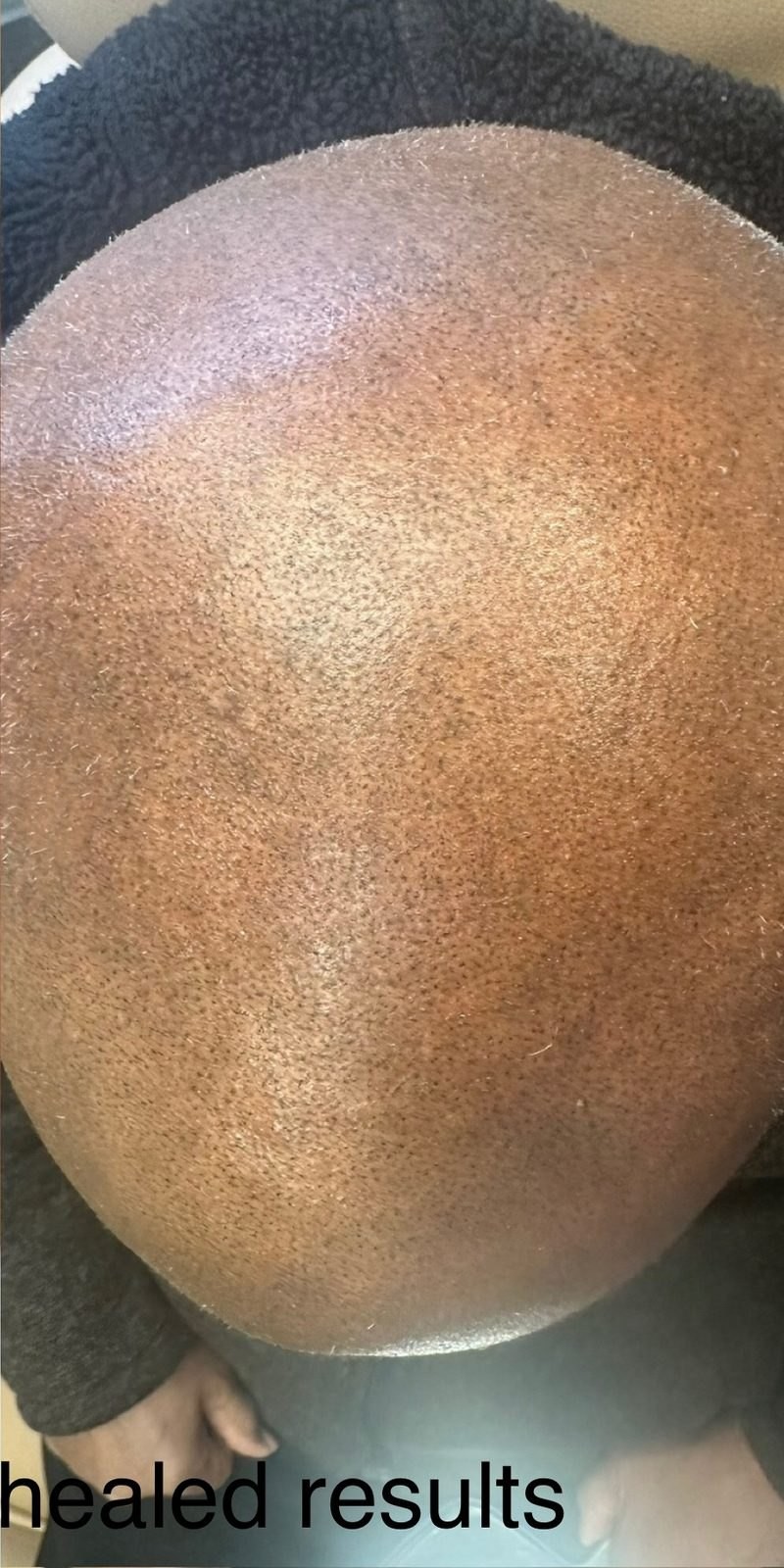
At the top of the scale the hairline is everything. A line that is too low, too straight or too sharp is the most common giveaway in SMP, and it ages badly. I prefer a hairline that suits the face and the age, with a soft, slightly uneven front edge and a gradual blend into the natural fringe at the sides. Our guide to SMP for a receding hairline goes deeper on shape and placement, and how to choose an SMP artist covers what to look for in their healed work.
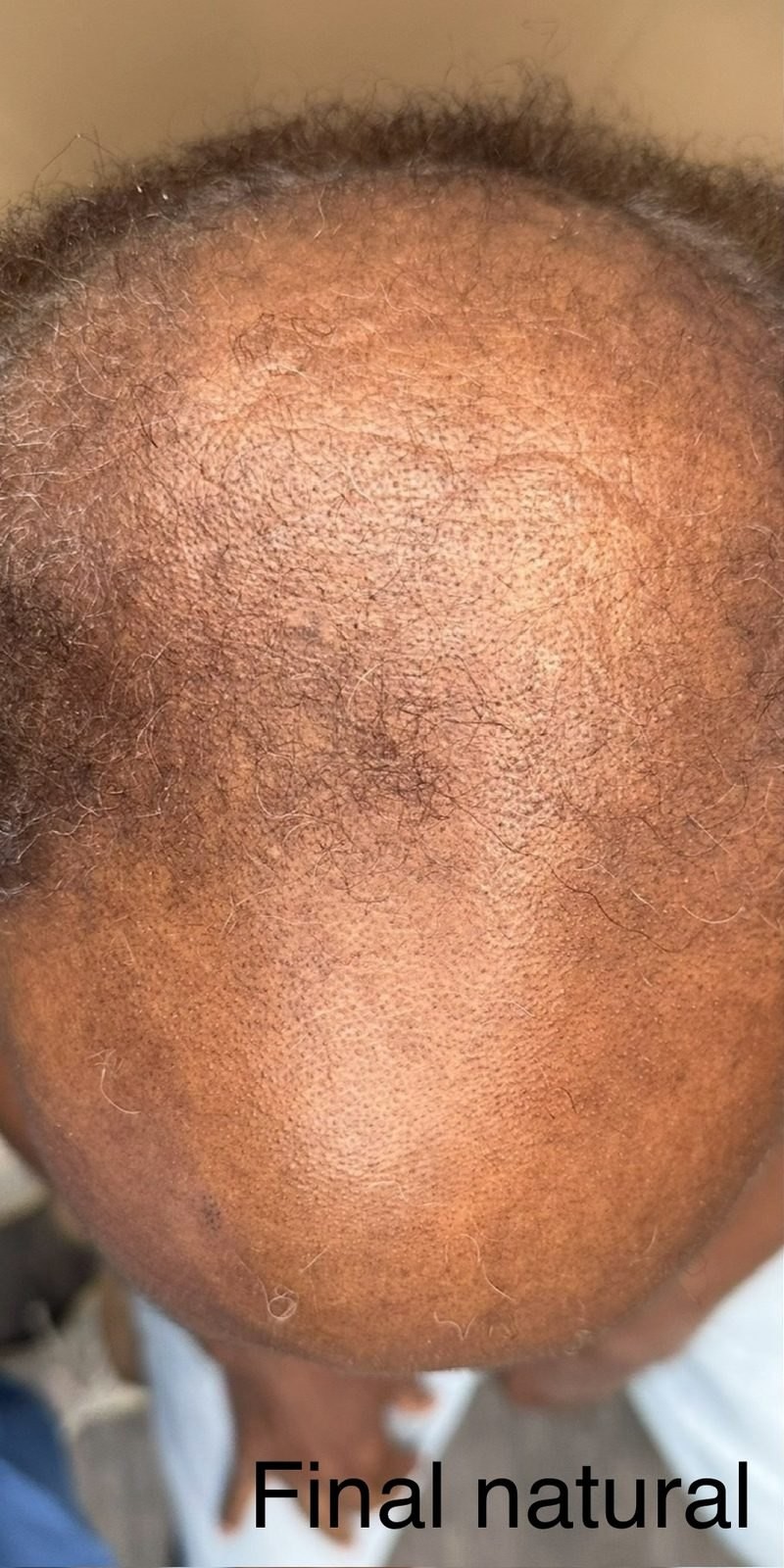
Why your future stage matters
Pattern loss keeps moving for many people, so a design that only covers today's bald area can leave a gap later. If you are young and still progressing, I would rather see the plan cover the zone you are likely to lose, or allow for it to be extended at a later touch-up. Our guide to SMP touch-ups explains how that maintenance works, and how long SMP lasts covers fading over the years.