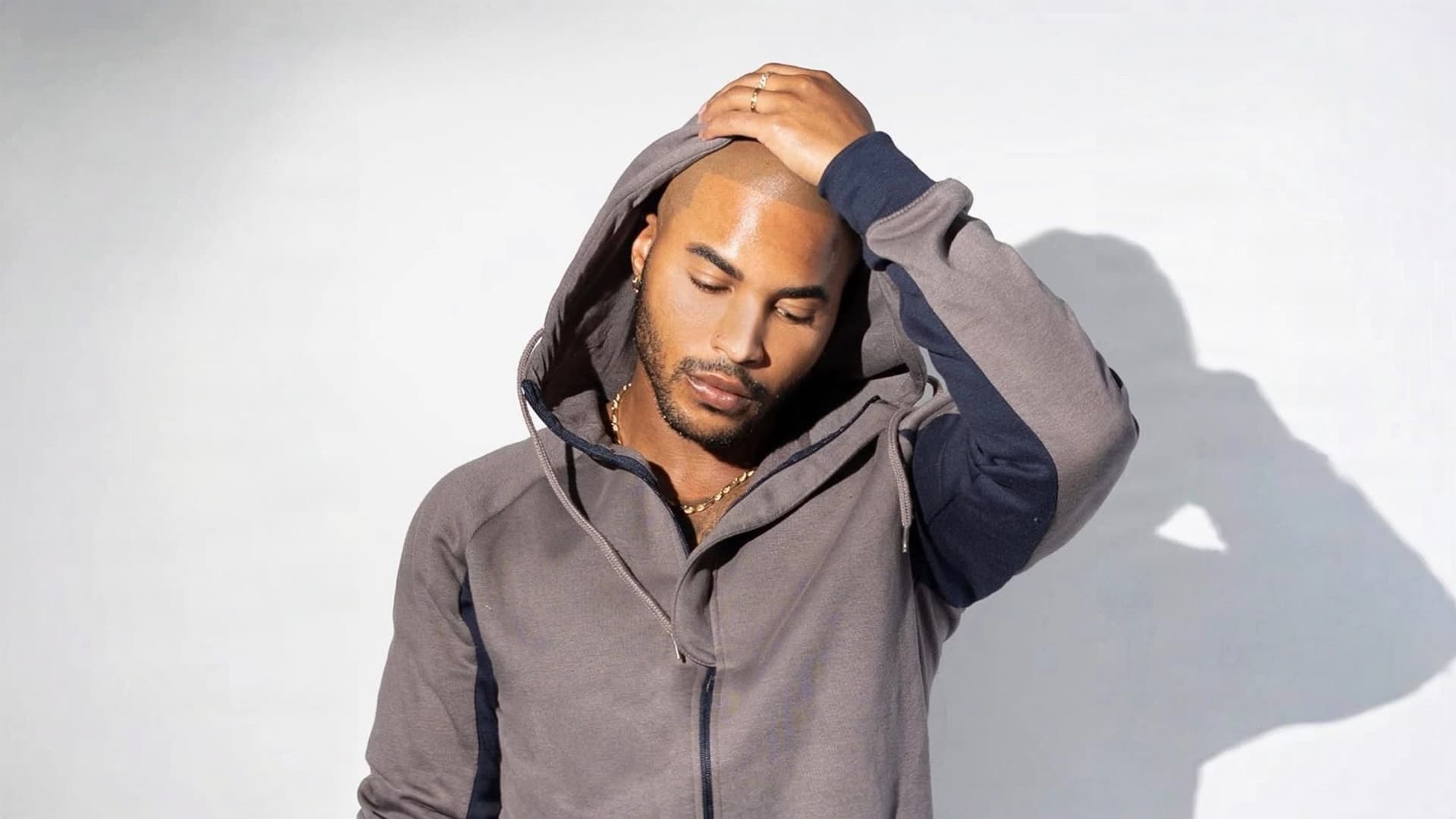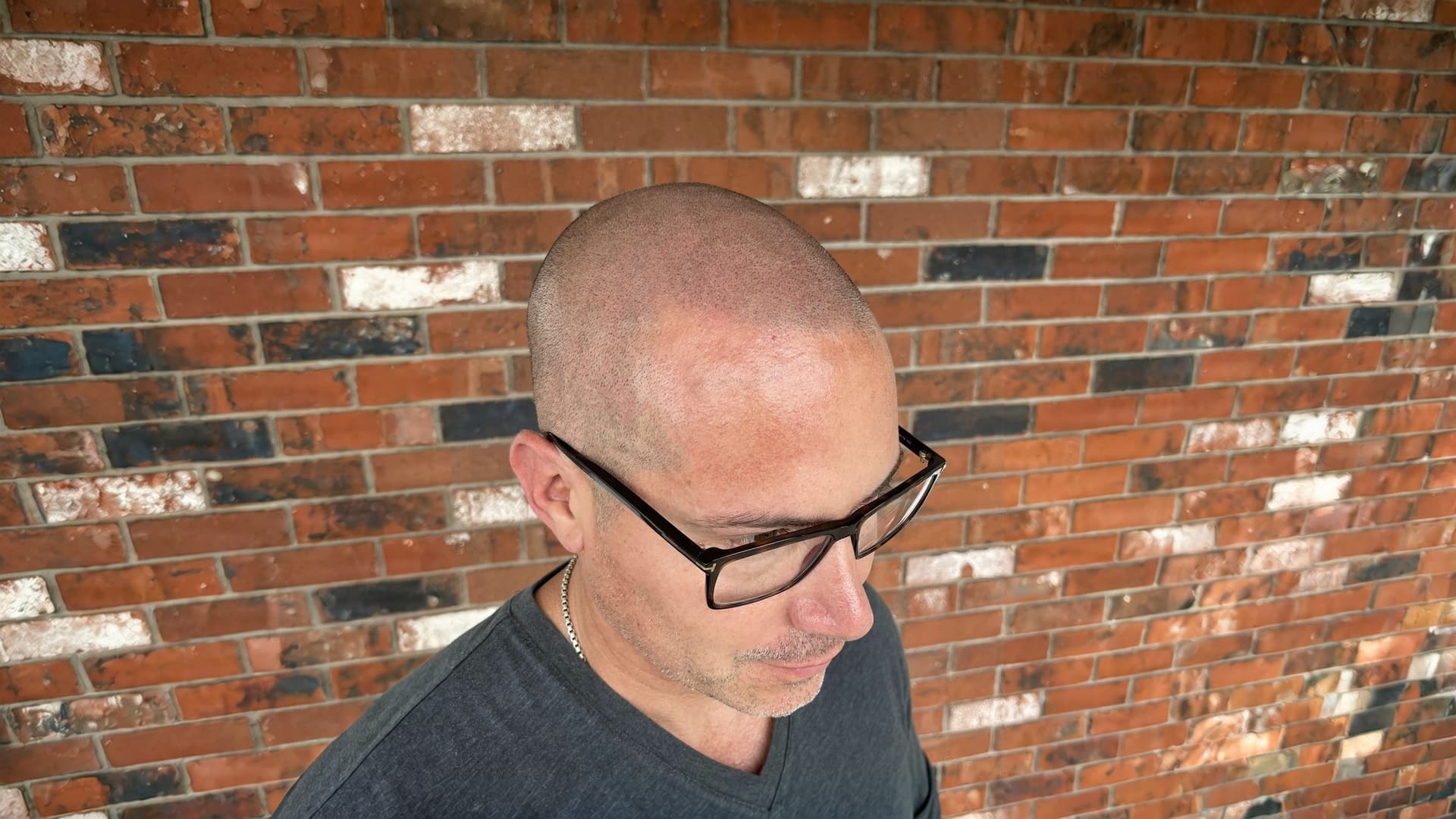
People ask me which is better, scalp micropigmentation or a hair transplant, as if one of them has to win. It is the wrong question. A transplant moves living hair; SMP tattoos the look of hair. They solve different problems, cost different amounts, heal on different clocks and fail in different ways. I have spent 17 years in scalp micropigmentation and permanent makeup, so I have a side in this, which is exactly why every number below is sourced. Here is the honest comparison.
What a hair transplant actually does
A hair transplant takes follicles from an area that keeps its hair and moves them to an area that is thinning. Cleveland Clinic explains the principle as "donor dominance": hair from the back and sides of the head is genetically programmed not to fall out, and it keeps that behavior after it is moved. That is why transplanted hair grows, gets cut, goes gray and behaves like the rest of your hair.
The American Academy of Dermatology (AAD) says surgery takes about four to eight hours, most patients stay awake under local numbing, and large cases may need a return visit the next day. Hairs are removed either as a strip of scalp or one at a time.
FUE and FUT
Those two harvesting methods have names. In FUE (follicular unit extraction, also called excision), the surgeon removes individual follicular units, natural groups of one to four hairs. In FUT (follicular unit transplantation, the strip method), a strip of hair-bearing skin is removed and divided into individual grafts. Once the grafts are harvested, Cleveland Clinic notes, the placing technique is the same.
FUE now dominates. In the ISHRS 2025 Practice Census, members reported that 85.4% of male procedures and 68.2% of female procedures used FUE harvesting, against 12.5% and 30.0% for strip harvesting.
| Point | FUE | FUT (strip) |
|---|---|---|
| How grafts are taken | One at a time with a small punch | A strip of scalp, then divided |
| Donor scar | Tiny white dot scars, can show with very short hair | A long, fine line, usually hidden by hair |
| Stitches | None in the donor area | Usually removed about 10 days after surgery |
| Share of male cases, 2024 | 85.4% | 12.5% |
| Average grafts per case | 2,262 | 2,100 |
The donor area is a budget, not a well
This is the single most important fact in the whole comparison. You only have so much donor hair, and every graft spent is gone from the back of your head. A 2026 review of FUE complications in Frontiers in Medicine notes that many surgeons recommend limiting extraction to 10% to 20% of the donor follicle density per session, though no standard limit exists, and warns that overharvesting is increasingly seen in sessions above 3,000 to 4,000 grafts. The same review notes that the "safe donor area" has no fixed boundary, especially in younger patients.
Cleveland Clinic puts it plainly: candidacy depends on having enough naturally growing hair in the donor area. If the bald area is large and the donor area is thin, the numbers simply do not add up to a full head.
What scalp micropigmentation actually does
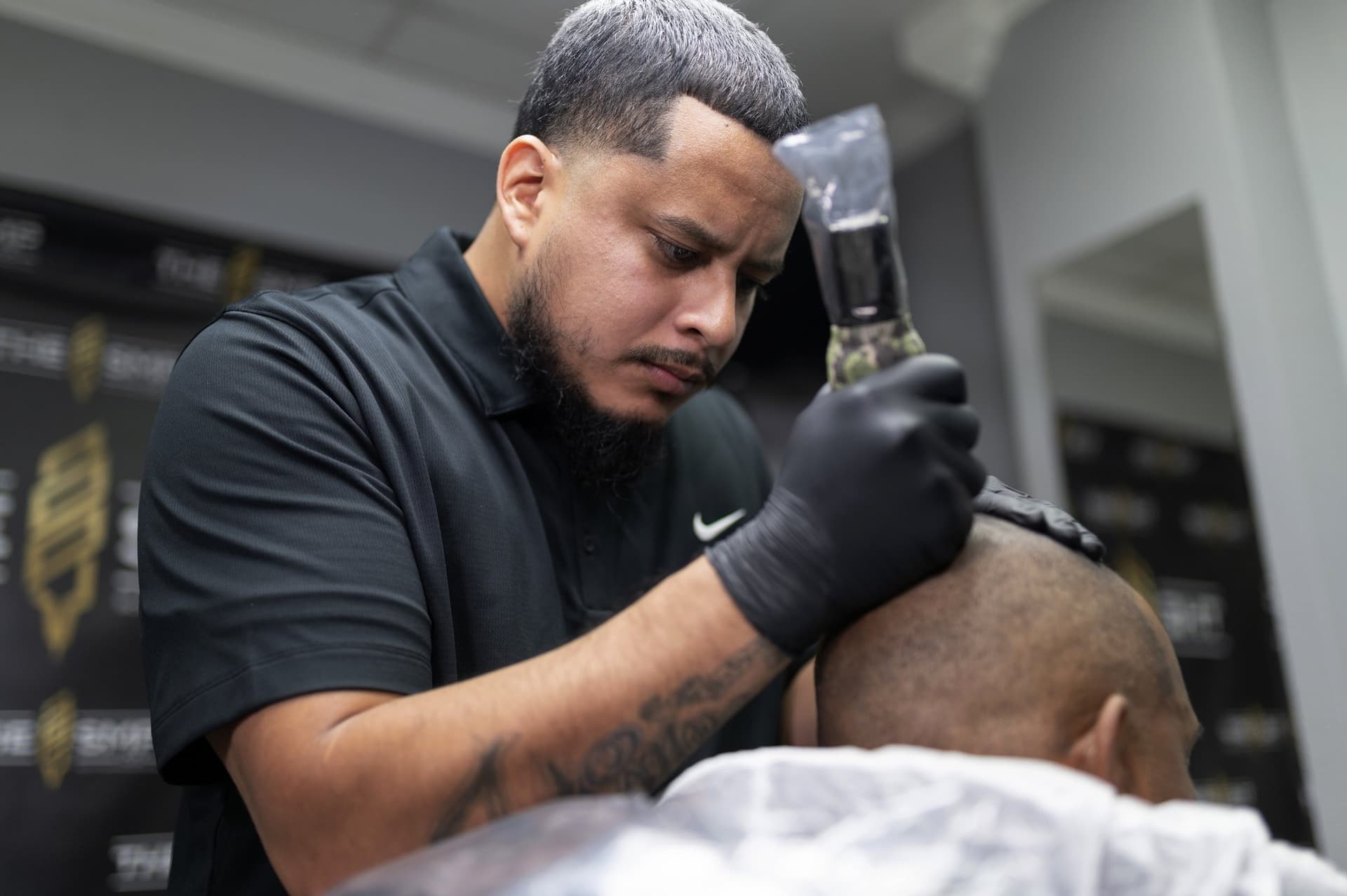
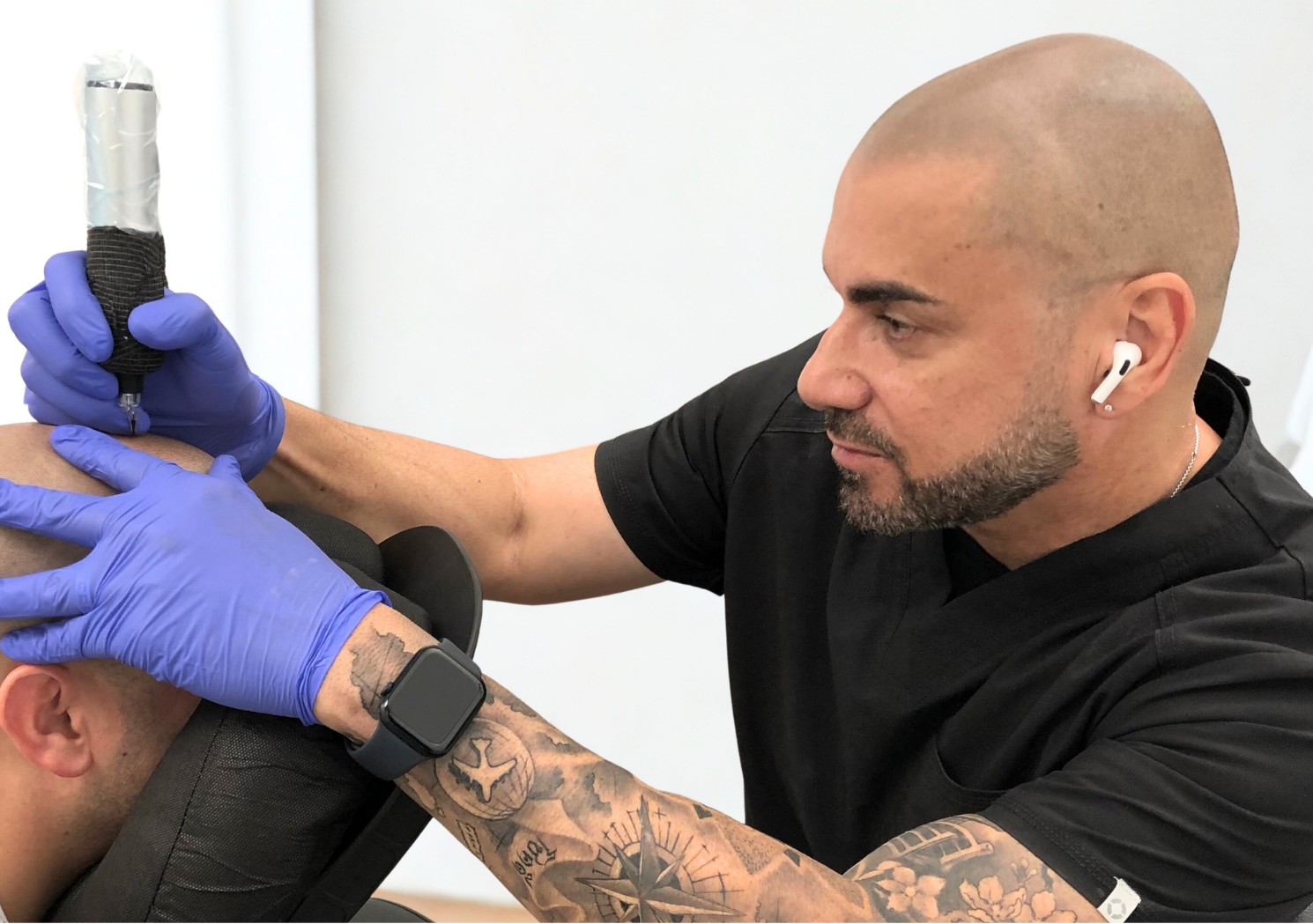
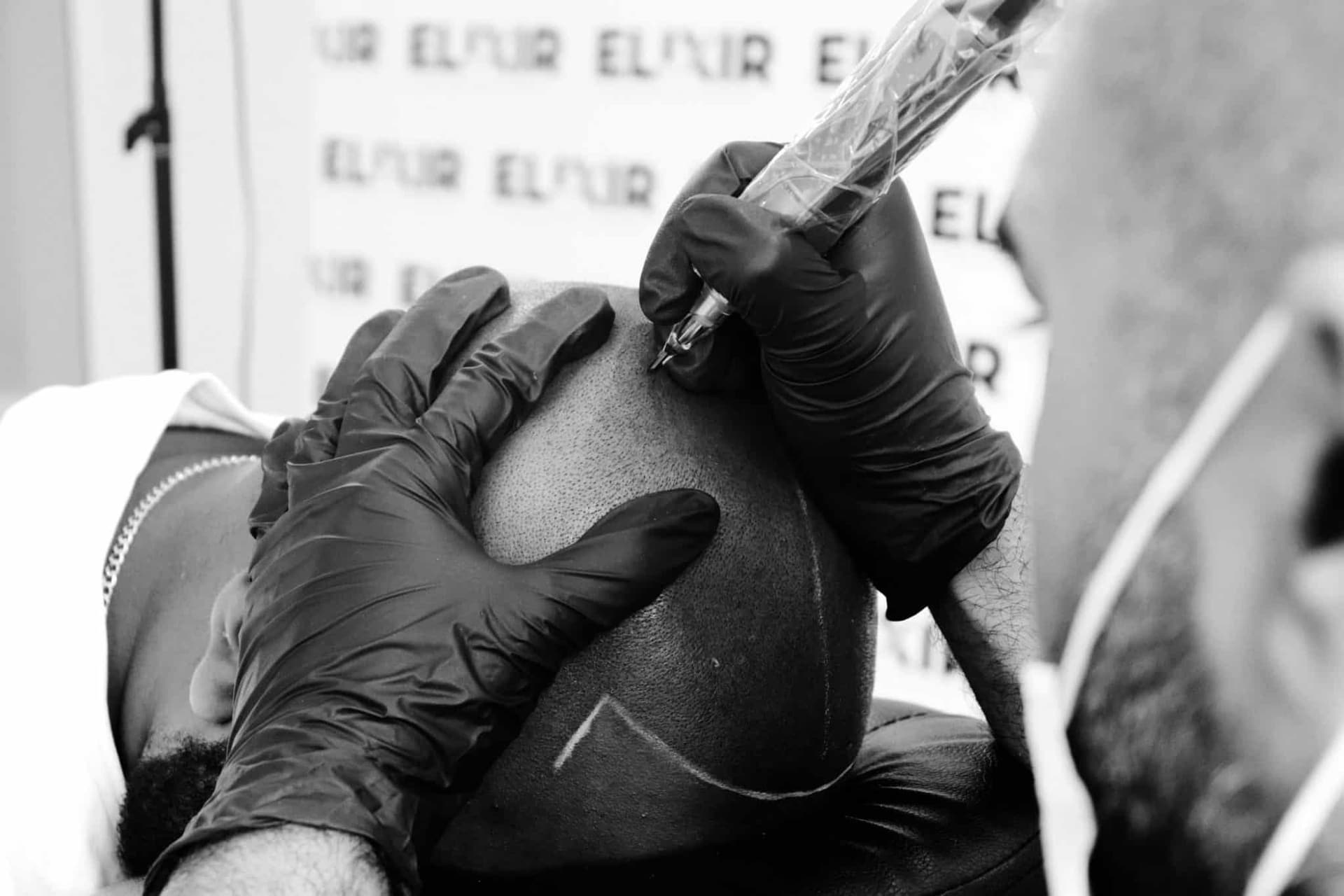
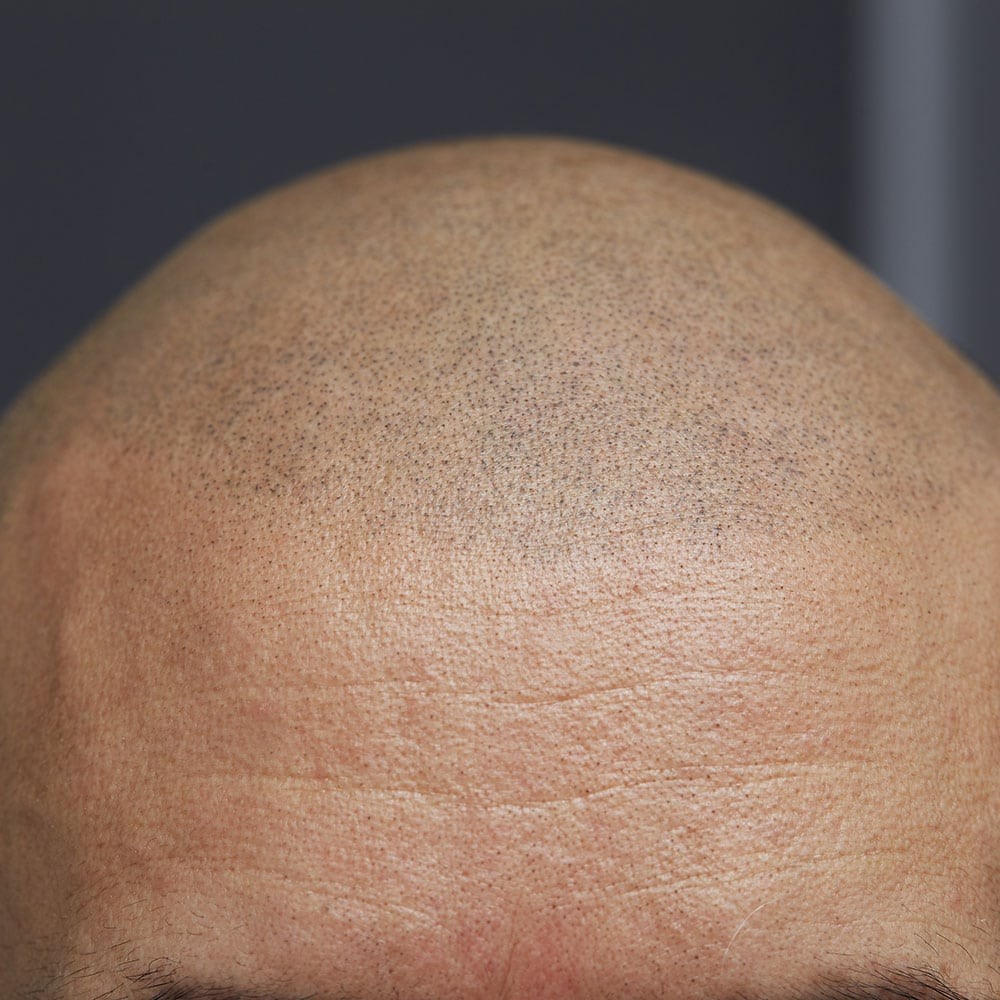
Scalp micropigmentation is a medical-style tattoo. The ISHRS describes it as placing tiny dots of grayscale pigment in the skin to mimic hair follicles, and it states plainly that any pigment put into skin with a needle qualifies as a tattoo. No hair grows. What you get is the look of a freshly shaved head, or extra visual density under short hair.
Because nothing is moved, SMP does not touch your donor supply. That is its biggest structural advantage over surgery: it works the same whether you have a Norwood 3 or a Norwood 7, as long as you are happy with the look it creates. For the full background on how it works, see our complete guide to scalp micropigmentation.
The peer-reviewed description from Rassman and colleagues in the Journal of Clinical and Aesthetic Dermatology (2015) says most patients need two to four sessions to complete the process, that a session can run up to eight hours, and that a single session can place more than 40,000 points. Treatment-day redness typically fades within one to two days.
The pigment and depth matter enormously. The ISHRS says carbon-only pigment is preferred, and warns that pigment placed too deep spreads and causes blotchy discoloration. Rassman's paper adds that black or gray pigment can look blue or green in the skin. That look comes from the wrong product, such as tattoo ink, or from pigment placed too deep, where the skin scatters light (the Tyndall effect); a proper carbon SMP pigment does not change color over time.
Who is a candidate for each
The first job is always the cause, not the cosmetic fix. The NHS advises seeing a doctor to understand the cause of hair loss before going to a commercial hair clinic, and I agree. Pattern hair loss, alopecia areata, scarring alopecia and thyroid-related shedding call for different plans, and a doctor is the person to tell them apart. Neither a transplant nor SMP treats the underlying condition.
Transplant candidates
The AAD lists two requirements: enough healthy scalp hair that can be moved, and the ability to grow hair in the thinning area. Cleveland Clinic adds that restoration is generally done once hair loss has stabilized with medical treatment, and that most women are not candidates because female pattern loss tends to be diffuse, with no stable donor zone. A smaller group of women, such as those with traction alopecia or loss after trauma or burns, may qualify.
Signs a transplant consultation makes sense
- Your loss is mostly at the front or crown, with a dense band at the back and sides.
- Your loss has slowed or stabilized, ideally on medication your doctor has prescribed.
- You want hair you can grow long, style and part.
- You accept that most people need medication afterward to protect the hair that was not moved.
- You are past your early 20s, or your surgeon has a clear long-term plan if you are not.
Age deserves its own line. The AAD says men in their 20s may be asked to wait and start a hair loss medicine first. In the ISHRS 2025 Practice Census, 73.0% of surgeons reported having a minimum age for surgery, averaging 22, and 57.6% said their typical first-time patient was 26 to 35.
SMP candidates
The ISHRS lists the best fits as people with a shaved or closely cropped head, people with low density spread across a head that still has hair, people wanting to hide transplant scars, and people with healed scarring or burn alopecia. It flags the poor fits too: bald patches sitting next to longer, denser hair (where it suggests transplanting instead), oily or flaky scalps that may not hold pigment, and active inflammatory conditions, which it says should be stable and disease-free for two to three years first.
Signs SMP may suit you better
- Your loss is extensive (think Norwood 5 to 7) and your donor area could not cover it.
- You already like, or could like, a shaved head.
- You want the change in weeks, not a year.
- Your donor area is thin, or you have had a transplant that used most of it.
- You want to avoid surgery, or a doctor has advised against it.
If you are not sure where you sit, our guide to the Norwood scale explains the stages and what each one usually means for treatment.
Cost and recovery, side by side
This is the table I would want in front of me if I were deciding. Every cell comes from a named source, and prices are US figures as of 2026. Prices vary by city, by case size and by practitioner, so treat these as ranges, not quotes.
| Factor | Hair transplant | SMP |
|---|---|---|
| Typical US cost, 2026 | $4,000 to $15,000 (WebMD) | $2,000 to $5,000 (ThePricer) |
| Sessions | Average 1.5 procedures (ISHRS census) | Usually 2 to 4 |
| Time in the chair | About 4 to 8 hours | Up to 8 hours per session |
| Back to work | Usually 2 to 5 days | Redness fades in 1 to 2 days |
| Final result | 6 to 9 months, some 12 | Builds over the 2 to 4 sessions |
| Main risks | Shock loss, folliculitis, numbness, scarring, poor growth | Pigment spread, color shift, fading, infection, poor artistry |
| Maintenance | Medication often advised for native hair | Touch-ups; lasts 5 to 10 years |
| Reversibility | Permanent; donor grafts used up | Laser removal possible, usually all or nothing |
| Look | Real hair at any length | Shaved stubble or density under short hair |
What a hair transplant costs in 2026
WebMD, in a page medically reviewed in June 2026, puts a hair transplant in the US at generally $4,000 to $15,000, driven mainly by how much hair is moved. A January 2026 cost roundup by ThePricer reports an average FUE total of $10,564 from RealSelf data and a US shopping range of about $3 to $8 per graft, averaging around $5.
To put graft pricing in context, the ISHRS 2025 Practice Census found the average first procedure used 2,347 grafts, so per-graft pricing adds up quickly on a large case. Cleveland Clinic notes that insurance rarely covers elective cosmetic procedures, so most people pay out of pocket.
What SMP costs in 2026
ThePricer's September 2026 update puts a complete SMP treatment in the US at about $2,000 to $5,000, with most full treatments landing between $2,500 and $4,000. ThePricer also lists hairline or temple work from about $800 to $1,500 and scar camouflage at about $600 to $2,000 for small to moderate scars, with touch-ups from a few hundred dollars to more than $1,000 (September 2026). Our SMP costs guide breaks these down further.
Recovery, week by week
The two treatments recover on very different clocks. With SMP, what you see a few days after the session is broadly what you get, then you build on it. With a transplant, the result disappears before it arrives, which catches a lot of people off guard.
| When | Hair transplant | SMP |
|---|---|---|
| Days 1 to 2 | Bandage, possible facial swelling | Redness fading |
| Days 2 to 5 | Most return to work; scalp tender | Some surface pigment washes out |
| Day 10 | Strip stitches usually removed (FUT) | Skin heals before the next session |
| Weeks 2 to 8 | Transplanted hairs shed | Further sessions build density |
| Month 3 | May look thinner than before surgery | Course of 2 to 4 sessions |
| Months 6 to 12 | Most see results at 6 to 9 months | Touch-ups only as needed |
The transplant "ugly duckling" phase
The AAD says transplanted hair falls out between two and eight weeks after surgery, and that by the third month the area may look thinner than before. Both are normal. Cleveland Clinic says the hairs usually do not regrow for approximately three months. WebMD notes that about 60% of new growth is visible at six to nine months.
That gap matters for your life. If you have a wedding, a job interview or a holiday in the first few months, you will be in the in-between stage. Book surgery with that window in mind, rather than discover it afterward.
SMP healing
SMP has no shedding phase, but it does have a settling phase. Rassman's paper explains that pigment in the outermost layer of skin is eventually shed, and that some surface pigment washes out at the first wash, typically within two to three days. That is one reason SMP is built in layers across sessions rather than in one long sitting. For what to do and avoid in those first days, read our SMP aftercare guide.
Results: how each one looks
A transplant gives you real hair. It moves in the wind, it can be grown, cut and styled, and it ages with you. What it cannot do is create more hair than your donor area holds. The AAD frames the realistic goal as a fuller head of hair rather than a full one, and says results depend largely on the surgeon you choose.
Cleveland Clinic makes a point worth hearing before any consultation: coarse, gray or light-colored hair gives better coverage than fine, dark hair. If you have fine dark hair on pale skin, the same number of grafts can look thinner, because the contrast shows every gap.
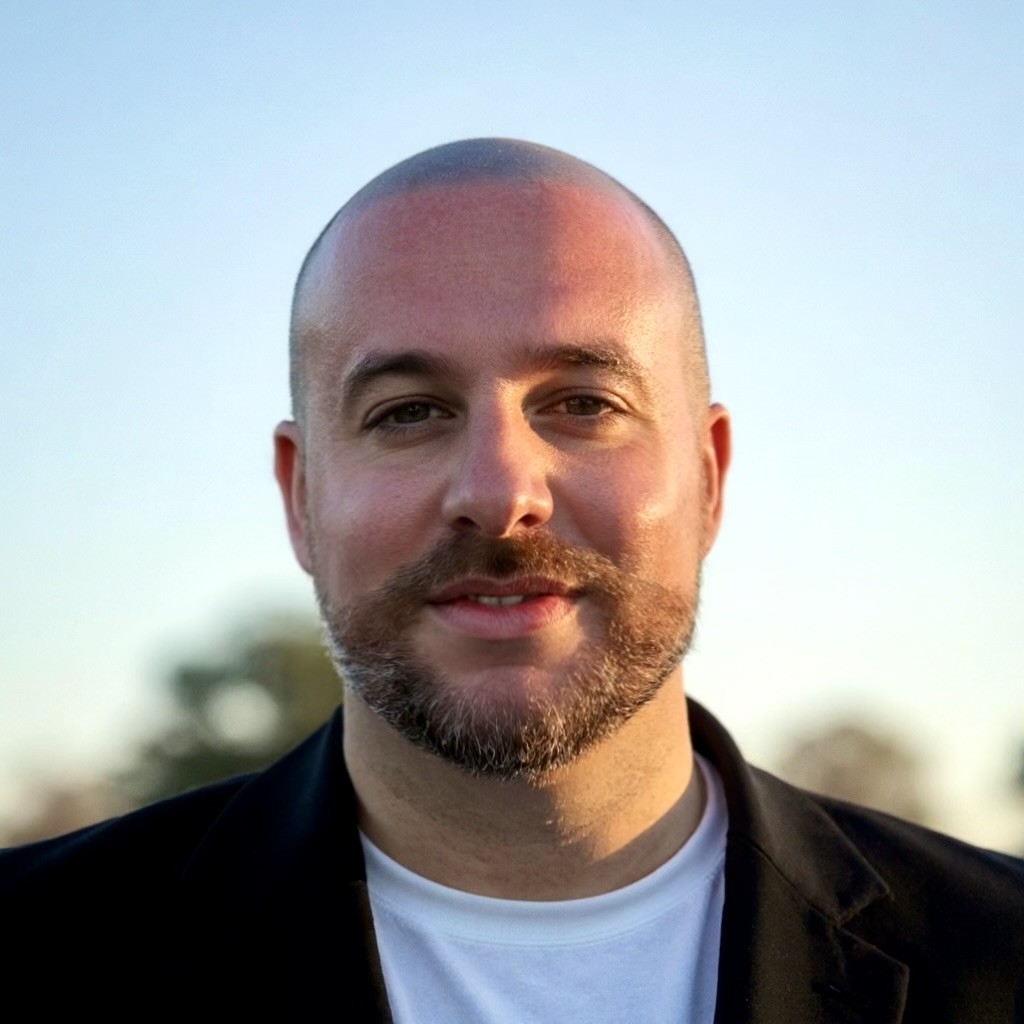
SMP gives you the look of hair at one length, about a day or two after a close shave. Up close and in good light, a well-done result reads as stubble. It does not move or grow, and it only works if you keep the real hair around it very short. If you treat SMP as a density layer under longer hair, the ISHRS says it can help people with low density across the whole scalp, but the effect depends on the contrast between your hair color and skin tone.
What to look for in result photos, for either treatment
- Healed photos, not same-day ones. A transplant needs nine to twelve months; SMP needs the swelling and redness gone.
- Natural daylight, not studio lighting that flattens texture.
- The same angles before and after, including the crown and the temples.
- Cases like yours: similar stage of loss, hair color and skin tone.
- For SMP, close-ups that show crisp, separate dots with no blurring.
Our before and after guide covers how to read SMP photos in more depth.
The risks you should weigh
Both are generally safe in skilled hands, and both go wrong in unskilled ones. The risks are just different in kind: a transplant carries surgical risks, SMP carries tattoo risks.
Transplant risks
Cleveland Clinic lists bleeding, infection, temporary numbness or tightness, pain, swelling of the forehead or face, scarring at the donor or recipient site, poor graft growth and an unnatural appearance. The 2026 Frontiers in Medicine review of FUE gives some useful numbers from the literature: shock loss (temporary shedding of existing hair near the grafts) reported at 0.15% to 15%, folliculitis at about 12%, long-term numbness at about 2% in one large series, infection usually below 1%, and frontal swelling in nearly half of patients.
The same review notes that small white dot scars in the donor area are common after FUE, and are more visible on dark hair, darker skin and very short haircuts. That last point matters if you think you might shave your head one day.
There is also the black market problem. In the ISHRS 2025 Practice Census, surgeons said that on average 10% of their cases were repairs of a previous black market hair transplant, and 59.4% said such clinics operate in their city.
SMP risks
Rassman's paper lists pigment spreading from incorrect depth (which may need laser treatment before any redo), infection, allergic reactions and granulomas, and color changes from poor pigment choices. It also warns that unsterile equipment can transmit infections such as hepatitis and HIV. The ISHRS adds that conventional tattoo ink can turn unnatural shades over time, and that UV light fades SMP faster.
The biggest SMP risk, in my view, is the artist. The ISHRS notes there is no international licensing body for SMP practitioners. Our guides to choosing an SMP artist and fixing botched SMP are worth reading before you book.
The long game: progression, medication and maintenance
This is where the comparison usually gets glossed over. A transplant moves resistant hair, but it does nothing to the native hair around it. The AAD says hair loss and thinning can continue after a transplant, and that a hair loss medicine can help prevent or slow new loss. The 2026 FUE review goes further: alopecia may keep evolving, future procedures or ongoing medical therapy may be needed, and failing to anticipate progression is a known cause of poor outcomes.
The ISHRS census shows how normal medication is around surgery. Finasteride topped the list of treatments members reported prescribing always or often, at 72.3%, followed by oral minoxidil. Medication decisions belong with your doctor; they have side effects to discuss, and I will not tell you what to take. But you should go into surgery knowing it is usually part of the plan.
What a transplant can leave you with years later if loss continues
- A strong transplanted hairline with thinning behind it.
- A need for a second procedure, drawing on a smaller donor supply.
- A choice between medication, more surgery or a shorter haircut.
SMP has its own long game. The ISHRS says well-placed SMP lasts five to ten years, and that sun protection is essential. Some people choose a yearly touch-up. If your loss progresses, SMP can simply be extended into the newly bald area at the next visit, which is one of its quiet strengths. Read more in how long SMP lasts and our guide to SMP touch-ups.
| Commitment | Hair transplant | SMP |
|---|---|---|
| Ongoing medication | Often advised to protect native hair | Not part of SMP itself |
| Further procedures | Possible if loss progresses | Extend into new areas at a touch-up |
| Refresh cycle | None for the grafts themselves | Lasts 5 to 10 years; some refresh yearly |
| Touch-up cost | Depends on graft count | A few hundred dollars to over $1,000 (ThePricer, 2026) |
| Haircut commitment | None | Real hair kept very short |
Combining them: when SMP and a transplant work together
This is not always an either-or decision. The ISHRS describes several ways the two fit together, and in my view the combination is underused by people who assume they must pick a side.
SMP to add density after a transplant
Rassman's paper names transplant patients who did not get the fullness they hoped for, and patients with a depleted donor area, as SMP candidates. The ISHRS says that when there is no room for more grafts without damaging existing hair, SMP may be the next step. Pigment behind the transplanted hair reduces the contrast between hair and scalp, so the same hair looks thicker.
Timing is the key rule. The ISHRS advises avoiding SMP for at least a year after a hair transplant so the newly transplanted hairs have time to grow. That fits the AAD's results timeline of six to twelve months.
Grafts to add texture under SMP
It works the other way too. The ISHRS suggests that for a shaved look, 10 to 20 grafts per square centimeter of real hair in the hairline or crown can add texture, and that patients may feel more satisfied when there is some real hair to touch.
SMP over FUE and FUT scars
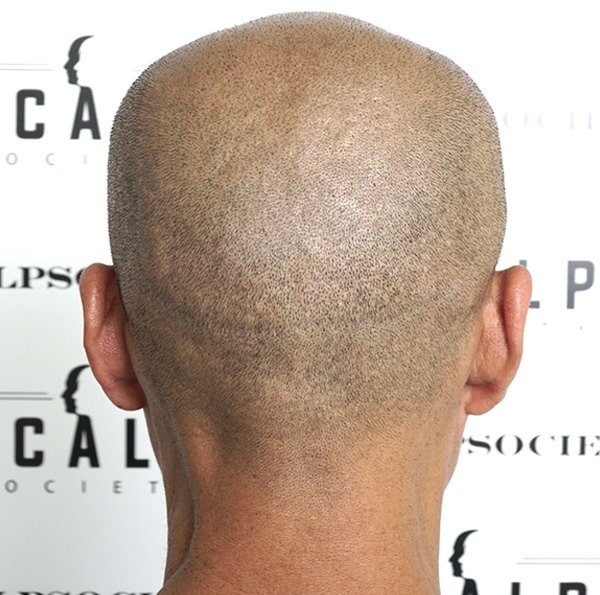
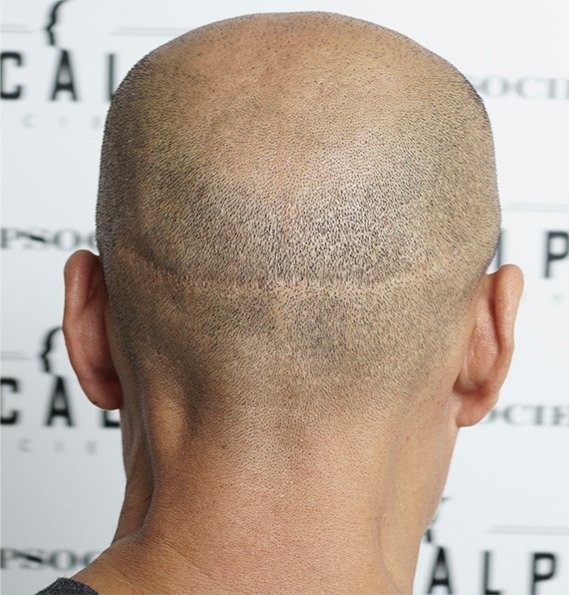
The ISHRS says SMP can visually reduce both the linear scar from strip harvesting and the scattered dots from FUE, and in some cases nearly erase them. It also calls scars the most demanding surface for SMP. If you are thinking of shaving your head after an old strip procedure, read our full guide to SMP over scars first.
How to decide: a decision table by situation
This table is my summary of the guidance above, organized by common situations. It is a starting point for a conversation with a doctor and a practitioner, not a diagnosis.
| Your situation | Usually worth exploring | Why |
|---|---|---|
| In your early 20s, still shedding | Medical assessment first | AAD: may be asked to wait and start medicine |
| Receding hairline, good donor, want longer hair | Transplant consultation | Moves real hair you can style |
| Extensive loss, thin donor, fine with shaved | SMP | Does not depend on donor supply |
| Diffuse thinning, long hair (often women) | Medical care, then density SMP | Diffuse loss often lacks a stable donor zone |
| Past transplant, still see-through | SMP after at least a year | ISHRS timing rule |
| Visible FUT or FUE scar | SMP scar camouflage | ISHRS: can reduce both scar types |
| Active scalp condition | Medical care first | ISHRS: SMP only after 2 to 3 years stable; ask a dermatologist about surgery |
Women's options deserve a separate look, because the patterns and the candidacy rules differ. Our guide to SMP for women covers that in detail.
Questions to ask a surgeon and an SMP artist
Whichever way you lean, consult before you commit, and ideally speak to both kinds of practitioner. A good one of either will tell you when the other option suits you better.
Questions to ask a hair transplant surgeon
- Who exactly will perform each step of my surgery, including graft extraction?
- How many grafts do you estimate, and how much of my donor area will that use?
- What is your plan if my hair loss keeps progressing over the next 10 to 20 years?
- Do you recommend medication alongside surgery, and why for my case?
- What is your approach to reducing shock loss?
- Will I be able to wear my hair very short afterward without visible scars?
- What is included in the price, and what does a second procedure cost?
Questions to ask an SMP artist
- Can I see healed results, at least six months old, on cases like mine?
- What pigment do you use, and how do you choose the shade for my skin tone?
- How many sessions do you expect, and how far apart?
- How will you design my hairline for my age and face shape?
- What does a touch-up cost, and how often do your clients need one?
- Have you worked over transplant scars before, and can I see those results?
- What happens if I am unhappy with the result?
If pain is part of your decision, our guide to whether SMP hurts covers what to expect in the chair. And if you are weighing up SMP against the other tattoo-based option, read SMP vs tricopigmentation.
This guide explains the options; it is not medical advice. Hair loss has many causes, and the right plan starts with a proper diagnosis from a doctor who has examined your scalp.