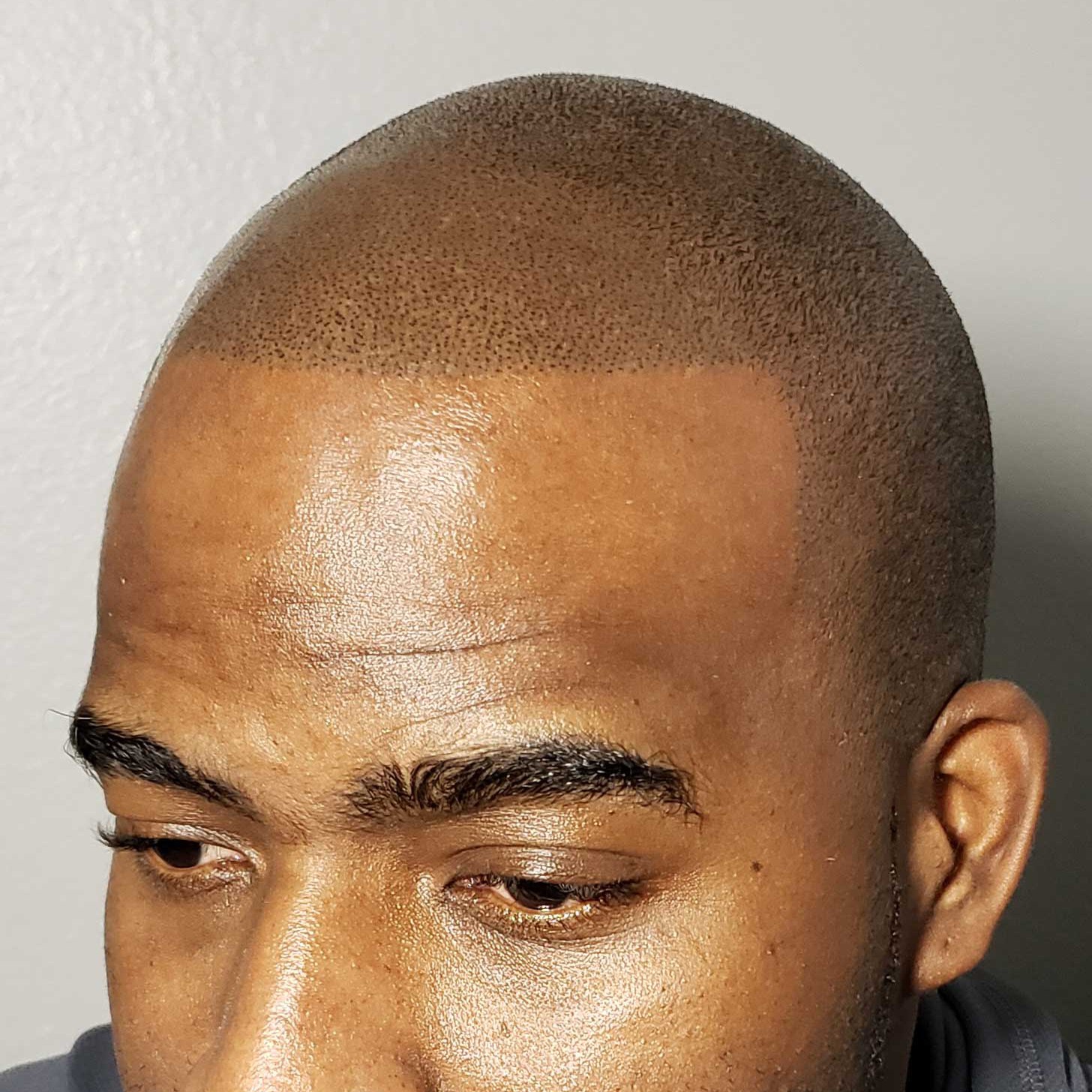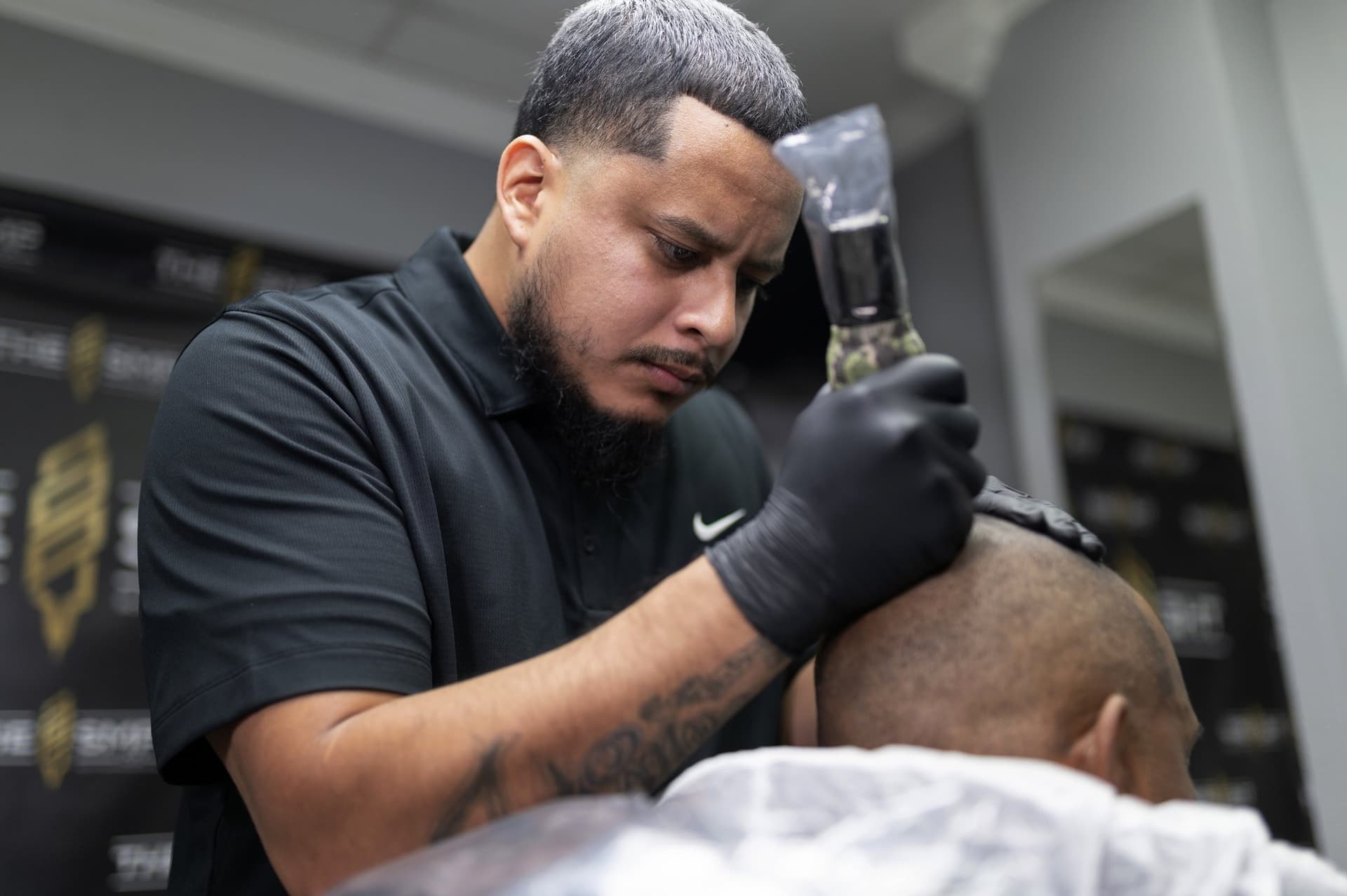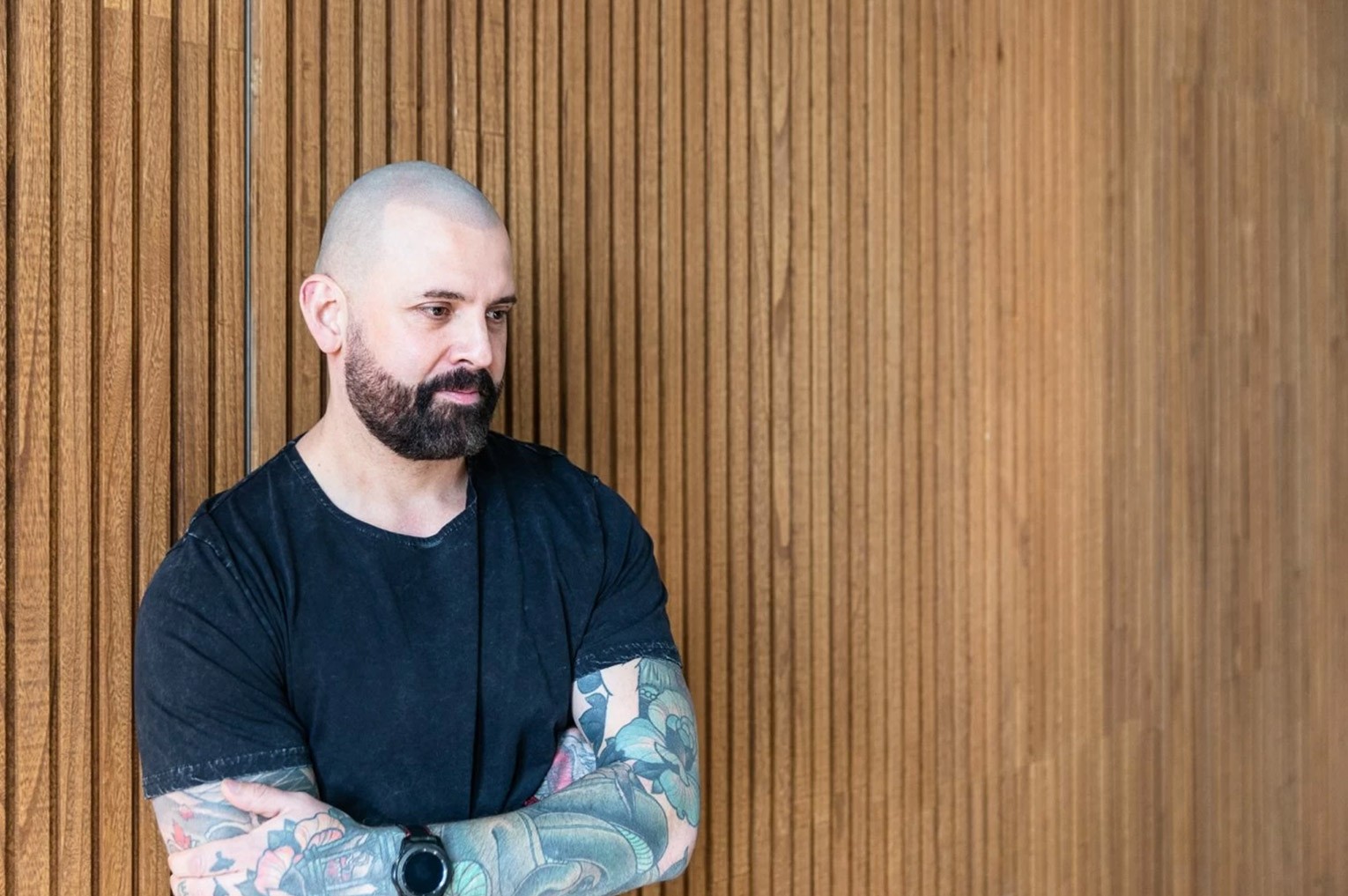
Type "hair tattoo" into a search bar and you get two different worlds. Half the results are hair stylists cutting lightning bolts and parallel lines into fades. The other half are people with shaved heads that look like a full head of stubble, except there is no stubble, just pigment. I have spent 17 years in scalp micropigmentation and permanent makeup, so the second meaning is my world. This guide explains both meanings, then goes deep on the one that changes lives: the hair tattoo for hair loss.
Two things people mean by "hair tattoo"
The phrase gets used for two crafts that share a vocabulary and almost nothing else. One lives in the hair. The other lives in the skin.
| Meaning | What it is | How long it lasts |
|---|---|---|
| Hair design cut into hair | Lines or shapes cut into short hair with clippers and a trimmer | Until the hair grows back |
| Scalp micropigmentation (SMP) | Tiny pigment dots placed in the scalp to copy hair follicles | Years, with fading over time |
Hair tattoo designs: the haircut meaning
In a hair salon, a hair tattoo is a design. The stylist takes the hair down short with clippers, then etches lines, curves or shapes into it with a trimmer so the skin shows through as the pattern. BaBylissPRO, which makes professional hair tools, describes the same technique for longer hair too: the design goes into the underneath layer at the nape or side and only shows when the hair is tied up (BaBylissPRO).
There is no ink and no needle. The "tattoo" is the contrast between hair and skin. That means it is temporary by design: as the hair grows, the edges blur and the pattern disappears. Keeping a sharp design means going back to the chair regularly to have it recut.
Hair tattoo for hair loss: the SMP meaning
Scalp micropigmentation is a cosmetic tattoo. Cleveland Clinic describes it as a treatment for thinning hair and hair loss where a provider uses thin needles to place tiny dots of pigment that give the look of thicker hair, and it notes people also call it a hair tattoo (Cleveland Clinic). On a shaved head, those dots copy the look of follicles just below the surface. Under longer hair, they darken the scalp so thinning is less obvious.
The rest of this guide is about this second meaning. If you want the full technical picture, the complete guide to scalp micropigmentation covers the procedure from start to finish.
How a hair loss hair tattoo works
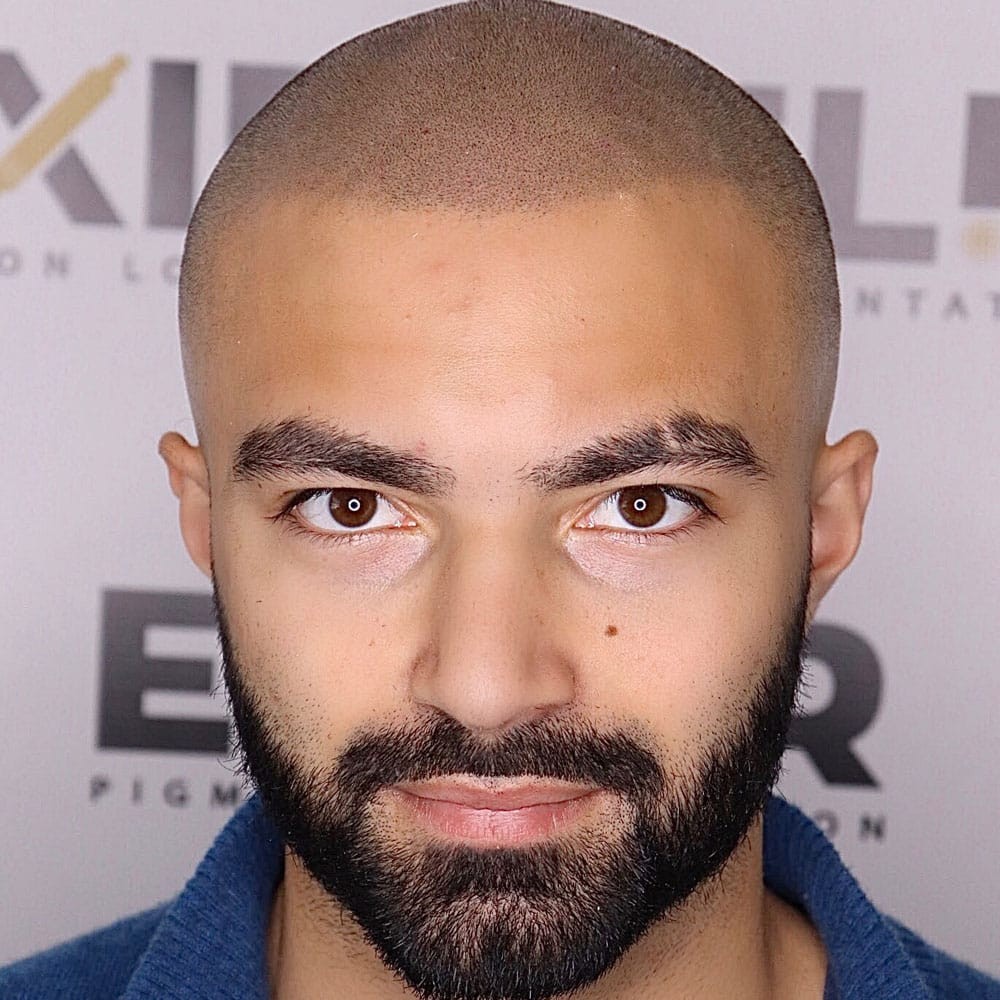
A hair follicle on a freshly shaved head shows as a small dark dot. SMP builds that pattern artificially, dot by dot, across the areas where hair is gone or thin. Done well, the brain reads the pattern as stubble.
Here is what is actually happening in the skin, based on the medical literature:
- Depth. The pigment goes into the upper dermis. A 2015 review in the Journal of Clinical and Aesthetic Dermatology explains that pigment left only in the top layer is lost within days, while pigment placed too deep spreads and blurs (Rassman et al., PMC). The ISHRS gives a usual depth of about 0.5 mm (ISHRS).
- Dot size and spacing. The same review says dot size controls how dark an area reads, and the density of the stippling is adjusted to the effect the client wants.
- Color. The ISHRS says the preferred pigment is carbon only, and that SMP is generally not meant to match your hair color. It creates gray tones that read as shadow, the way real stubble does.
- Volume of work. The review describes sessions of up to eight hours with more than 40,000 dots in a single session.
One thing a hair tattoo will never do is grow hair. Cleveland Clinic states that SMP does not grow hair, change your natural hair growth or treat hair loss, and it will not damage existing follicles either. It is camouflage, and a very good one when the plan fits the person.
Who a hair tattoo suits
The same haircut looks completely different on two heads, and SMP is no different. The question is never just "how much hair have I lost?" but "what look do I want to live with for the next ten years?"
| Situation | Fit | Why |
|---|---|---|
| Happy to keep a shaved head | Strong | The classic use: copies stubble across the whole scalp |
| Thinning but hair everywhere | Good | Density work darkens the scalp under existing hair |
| Transplant or other scalp scars | Good, harder | Can soften FUE and strip scars, but scars are the hardest skin to work on |
| Women with diffuse thinning | Good | Reduces scalp show-through along the part and crown |
| Wants long hair over bald patches | Poor | Dots copy stubble, not length |
Shaved heads
This is the classic hair tattoo. The ISHRS lists people with shaved heads who want a shaved look as a core candidate group (ISHRS). It works across most stages of male pattern loss, from a receding hairline to a fully bald crown, because the artist rebuilds the whole pattern and blends it into whatever hair you have at the sides and back. The deal you make is simple: you keep the head shaved for as long as you want the effect.
Density behind longer hair
If you still have hair across the top but the scalp shows through, SMP can go between the hairs. The ISHRS describes low-density hair as a candidate group, and notes that high contrast between hair and scalp, such as dark hair on light skin, is where the change shows most. You keep your length. The dots reduce the contrast so the thinning reads less.
Scars
Hair transplant scars are one of the most common reasons people come to SMP. The ISHRS says SMP can visually diminish FUE and strip scars and in some cases nearly erase them, while also warning that scars are the most demanding work because pigment behaves unpredictably in scar tissue. Cleveland Clinic lists scars and birthmarks on the scalp as uses too. Because scar tissue holds pigment less predictably, it is sensible to expect more sessions there than on normal scalp. The SMP for scars guide goes deeper.
Women
Cleveland Clinic lists hair loss in women among the uses for SMP. Women's work is almost always density work, because female pattern loss usually thins the top and widens the part rather than pushing the hairline back (MedlinePlus). The 2015 review describes SMP for women with pattern thinning who did not respond to minoxidil and were not transplant candidates. The SMP for women guide covers it in full.
Signs you are a strong candidate
- You already like how you look with a shaved or very short head.
- Your hair loss has been stable for a while, or you have a plan with a doctor to manage it.
- You want a result you do not have to apply every morning.
- You are fine with a touch-up visit every few years.
- You have no active scalp condition and no history of keloid scarring.
What it looks like up close and from a distance
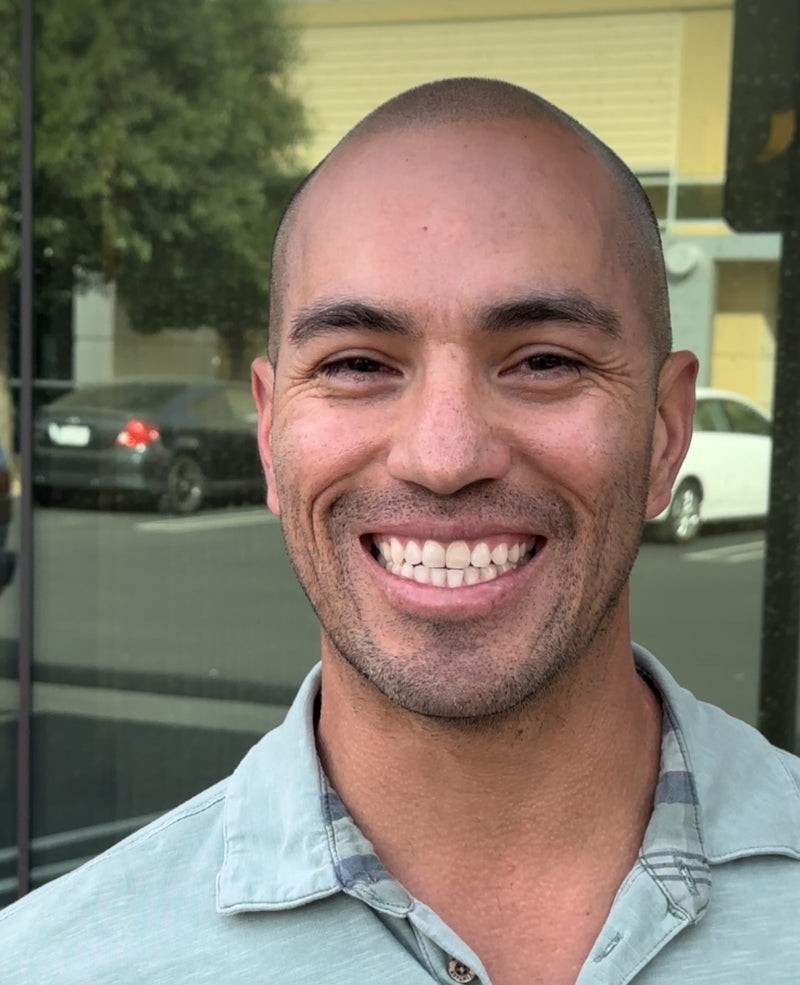
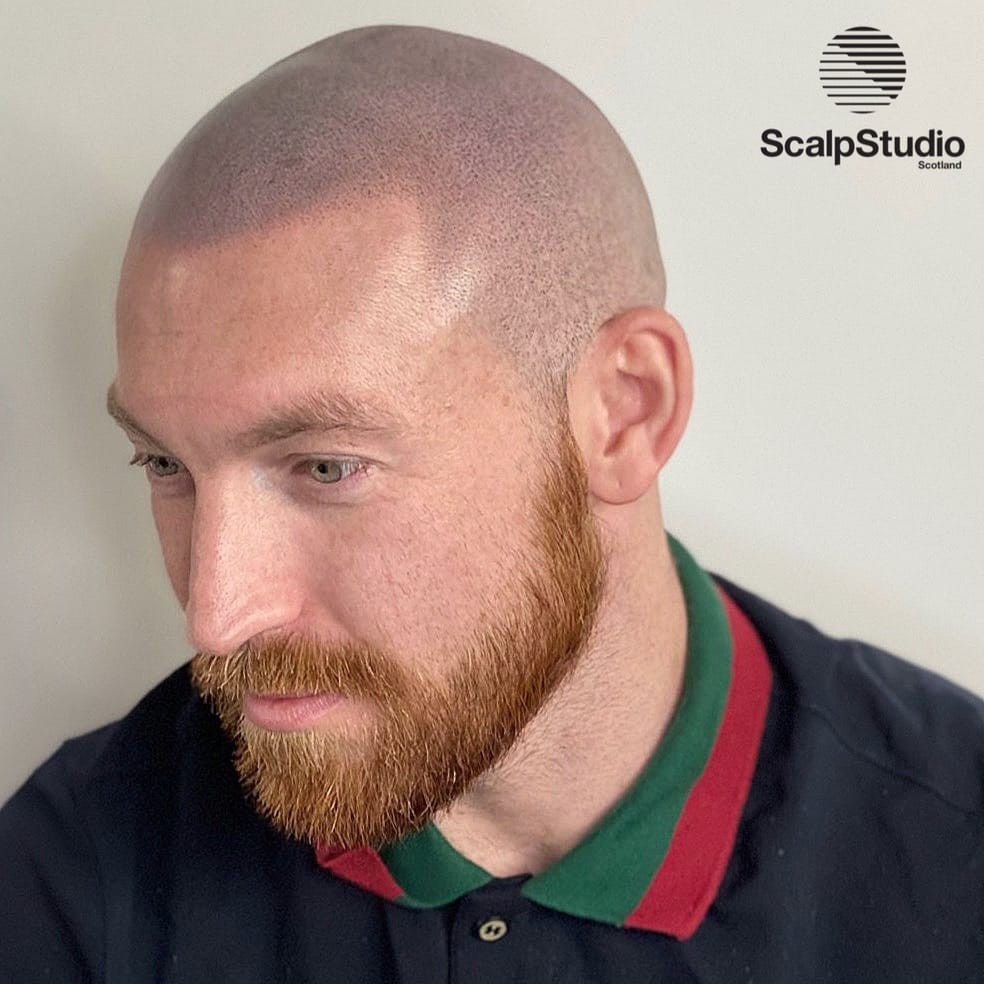
Distance is everything with a hair tattoo. At a normal talking distance, good work reads as a fresh shave. Across a room or in photos, it reads as a full head of short hair with a hairline. Up close, within a foot or so, a trained eye can sometimes tell, because a real follicle has a hair coming out of it and a pigment dot is flat.
That is not a flaw. It is just what the treatment is. The 2015 review advises that people who keep their hair longer should expect some visible scalp after SMP (Rassman et al., PMC). Real shaved heads show scalp too.
Fresh versus healed
What you see on the day is not what you live with. The review describes surface pigment washing out at the first hair wash, pigment in the upper layer clearing over the following months, and particles settling over the first two weeks. Fresh work looks darker and sharper than healed work, so fresh photos flatter an artist.
Light changes everything
Overhead light in a bathroom, direct sun and a camera flash all show different things. A good result holds up in all of them. A weak one looks fine in a studio light box and flat or patchy in daylight.
Pain, sessions and the first weeks
People expect a hair tattoo to hurt like a body tattoo. Cleveland Clinic says numbing medicine is applied first and that SMP is usually less painful than getting a tattoo, because the needles are thinner and smaller (Cleveland Clinic). The does SMP hurt guide breaks it down area by area.
You will not get a finished result in one sitting. Cleveland Clinic says most people need three or more treatments spaced several weeks apart, and that a session can take up to five hours. The 2015 review says many patients need two to four sessions. Each session layers more dots, adjusts the shade and fills gaps the previous one left.
What a typical treatment looks like
- Consultation: the artist looks at your loss pattern, your skin and your face, and you agree the hairline and the look.
- First session: the base layer of dots goes in, lighter than the final result.
- Healing: redness usually settles within a day or two, according to the 2015 review.
- Second session: more dots, more density, the hairline is refined.
- Further session if needed: shade and blending are fine-tuned once earlier work has settled.
Aftercare is simple but strict. Cleveland Clinic says to avoid getting the scalp wet, heavy exercise, steam, sun and sweating for several days, and not to wash the scalp until your provider says so. The aftercare guide has the day-by-day version.
How a hair tattoo ages
A hair tattoo is long-lasting, not frozen. The ISHRS says well-placed SMP lasts 5 to 10 years and that pigment fades over time, faster under UV light (ISHRS). Cleveland Clinic says it usually keeps its look for four years or longer.
| Stage | What to expect |
|---|---|
| First wash | Surface pigment washes out |
| First weeks | Particles settle, dots soften |
| First months | Pigment in the top layer clears, the healed shade shows |
| 4 years or more | Cleveland Clinic: look usually holds this long |
| 5 to 10 years | ISHRS: lifespan of well-placed SMP |
Fading and color shift
Fading on its own is not the enemy. A soft dot looks more natural than a sharp black one. The problems are color shift and spread. The 2015 review notes that UV can speed color change and that pigment placed too deep spreads and blurs. A proper SMP pigment is carbon based and does not change color over time; a blue or green tint comes from the wrong product, such as tattoo ink or permanent makeup pigment, or from carbon placed too deep. Those are the hair tattoos you see that look like a gray smudge rather than stubble.
Keeping it fresh
The usual way to keep a hair tattoo looking current is a touch-up session every few years. The ISHRS says a yearly touch-up is optional for some people. Sun protection on a shaved head does the most to slow fading. For the full picture, read how long SMP lasts.
What a hair tattoo costs
Prices vary a lot by city, artist and the size of the job, so treat any figure as a starting point. As of 2026, published US price ranges collected by ThePricer put a complete treatment at about $2,000 to $5,000 (ThePricer).
| Job | Published range |
|---|---|
| Complete treatment | $2,000 to $5,000 |
| Hairline or temples only | $800 to $1,500 |
| Partial scalp | $1,500 to $3,000 |
| Density work | $2,000 to $3,600 |
| Smaller scar camouflage | $600 to $2,000 |
| Touch-up session | A few hundred dollars to over $1,000 |
The same source warns that a per-session price can add up to more than a package, and that correcting poor work may need laser removal first, which raises the total. Insurance does not cover SMP, according to Cleveland Clinic, because it is elective. The SMP cost guide explains what drives a quote and how to compare them.
Hair tattoo vs other hair loss options
This is the comparison I wish everyone saw before they spent a cent. Each option solves a different problem. Some grow or keep real hair, some cover it, and they differ hugely in what you pay every month.
| Option | Typical cost | Upkeep |
|---|---|---|
| SMP (hair tattoo) | $2,000 to $5,000 complete | Shave regularly, touch-up every few years |
| Hair transplant | $3,919 to $10,640 | Often medication to protect native hair; some need a second procedure |
| Finasteride | $15 to $47 a month retail (Medfinder, 2026) | Taken as prescribed, for as long as you want the effect |
| Hair system | $300 to $2,000+ per unit; $2,000 to $5,000 a year with service | Maintenance every 3 to 5 weeks |
| Fibers and concealers | Retail product, reapplied | Apply daily, shampoos out |
| Tricopigmentation | Lower start cost than SMP (no dollar figure published) | Refresh roughly every year, per one London clinic |
| Option | What you get | Reversible? |
|---|---|---|
| SMP | The look of shaved hair or more density; no new hair | Laser lightening or removal, partial removal can leave patches |
| Hair transplant | Real, permanent hair moved from the back and sides | No, it is surgery |
| Medication | Slows loss, some regrowth for some people | Yes, but the benefit stops when you stop |
| Hair system | Full length hair any style | Yes, take it off |
| Fibers and concealers | Thicker look on thinning hair | Yes, washes out |
| Tricopigmentation | Similar look to SMP, temporary | Fades on its own in about 12 to 18 months, per one London clinic |
Hair transplant
A transplant moves your own follicles from the back and sides to the thin areas. The American Academy of Dermatology describes the result as permanent and natural-looking (AAD). As of 2026, CareCredit's national cost data puts it at $3,919 to $10,640, with FUE averaging $6,344 and FUT $5,675 (CareCredit). It is the only option on this list that gives you real hair you can grow long, but it depends on having enough donor hair. The two also combine: the ISHRS lists SMP for camouflaging transplant donor scars and for a hybrid hairline alongside transplanted hair. The SMP vs hair transplant guide compares them in depth.
Medication
Finasteride and minoxidil are the main medical treatments for male pattern loss, and the NHS notes minoxidil is also used for female pattern loss while women should not use finasteride (NHS). The AAD says finasteride slows further loss in about 80% to 90% of men who take it, that results show in about 6 months if it works, and that hair loss returns when you stop. It also lists reported side effects including reduced libido, erection problems, breast swelling or tenderness and depression, and notes reports of sexual side effects continuing after people stop. Discuss these with a doctor before starting. Minoxidil can take 6 to 12 months to show anything, and you lose the benefit if you stop.
As of September 2026, Medfinder lists generic finasteride at about $15 to $47 a month retail (Medfinder). Medication is a doctor's conversation, not a hair tattoo artist's, and it works alongside SMP rather than against it.
Hair systems
A hair system is a custom or stock hairpiece bonded to the scalp. HairClub's industry illustration (2026) puts stock pieces at $300 to $700, custom systems at $800 to $2,000 or more, and a system with ongoing service at $2,000 to $5,000 a year, with maintenance every 3 to 5 weeks (HairClub). It is the non-surgical option on this list that gets you long hair back. The trade is constant upkeep and the cost of replacing units.
Fibers and concealers
Fibers, sprays, powders and lotions reduce the contrast between scalp and hair. The ISHRS says they work best when there is still some hair in the area, and can only cover a fully bald patch if it is small and surrounded by normal hair (ISHRS). Fibers cling to hair by static and wash out with shampoo. Makers claim resistance to rain, wind and sweat, which the ISHRS reports without verifying. They are a good daily fix for early thinning and no use on a bald crown.
Tricopigmentation
Tricopigmentation is a version of scalp pigmentation designed to fade. One provider describes its pigments as made to fade over 12 to 18 months and to need refreshing every year, against top-ups every 3 to 5 years for standard SMP (WMG London). The same source says the lower starting price is offset by more frequent sessions. Terms are not used consistently, and the ISHRS treats TrichoPigmentation as another name for SMP, so always ask how long the pigment is meant to last. The SMP vs tricopigmentation guide unpacks the difference.
Styles: shaved, buzzed, defined or soft hairline
A hair tattoo is a haircut that does not grow, so the design rules of a good haircut apply to it, just with far higher stakes.
The shaved look
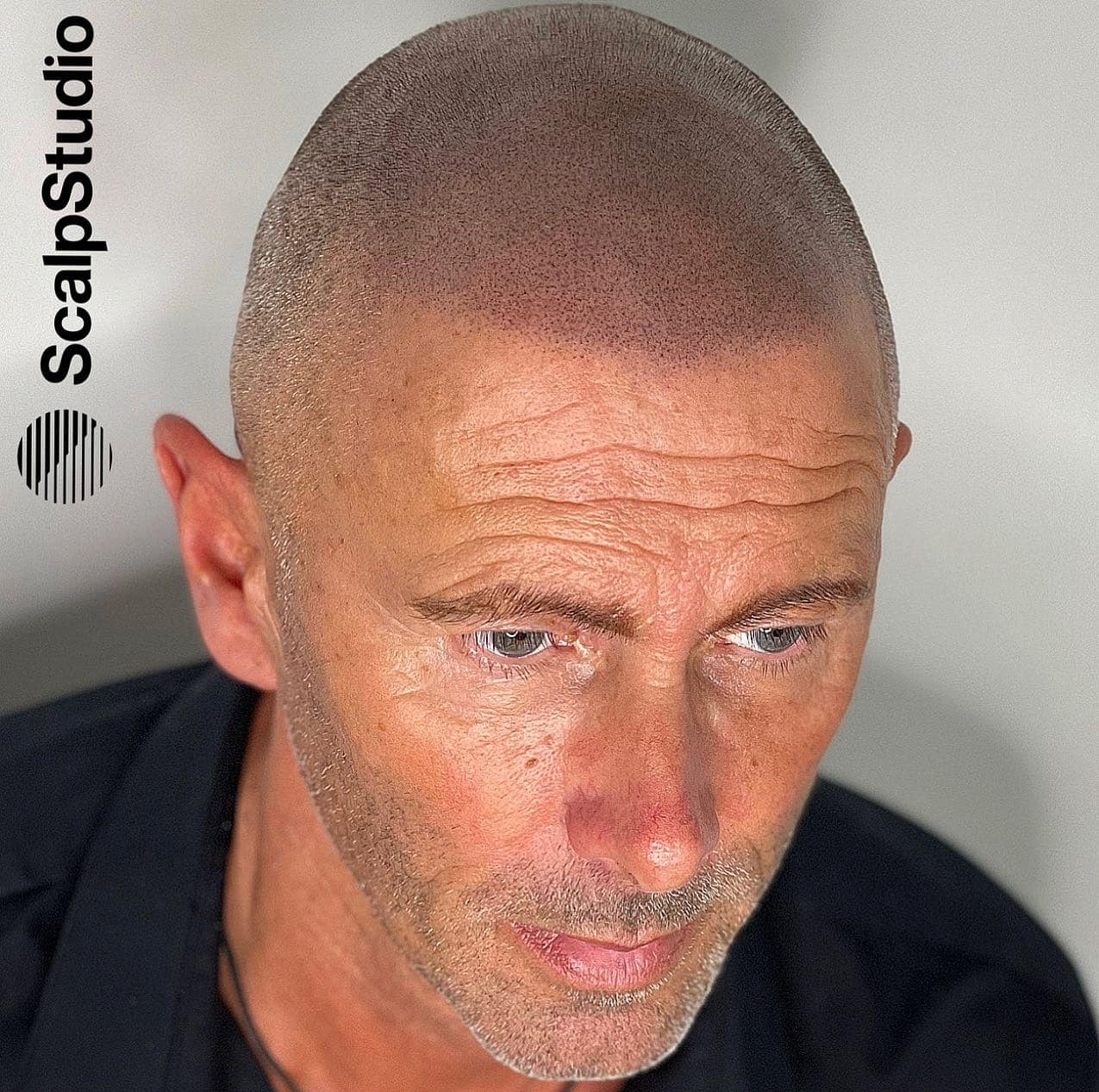
The full scalp is pigmented to match a head shaved down to the skin or very close to it. It is the cleanest, most forgiving style, and it hides the most loss. You commit to shaving often, because real hair at the sides and back growing past the dots breaks the illusion.
The buzzed look
Some people prefer to keep a little length at the sides, like a short buzz, with the top built to match. This needs tighter shade matching, because the pigment has to sit with real hair that casts a shadow. The ISHRS notes that bald patches next to hair longer than about 3 mm are harder to blend, so the closer you keep the real hair, the better the match (ISHRS).
Defined hairline
A defined hairline has a clear edge, like a fresh line-up. It looks sharp and youthful. Its risk is that a hard, straight line drawn too low can look like a sticker on the forehead, and it will look less natural as your face ages.
Soft hairline
A soft hairline fades in from scattered dots to full density over a short zone, the way a natural hairline does. I think it is the safer choice for most adults. It still frames the face, but it does not announce itself.
Questions I would settle before the hairline is drawn
- Where does your hairline sit if you raise your eyebrows and look for the top crease?
- Do you want to look like you did at 20, or like a man your age who kept his hair?
- How does the hairline frame your face from the side, not just the front?
- Will you keep the head shaved, or keep some length at the sides?
- How will this hairline look in 15 years, when your face has changed?
If your loss is still moving, check where you sit on the Norwood scale and plan the hairline for the pattern you will likely have, not just the one you have today.
Tips for keeping the look sharp
Your artist does the pigment. You do the haircut, every few days, for as long as you want the look. Good pigment can still look wrong if the real hair around it is left to grow out.
Shave often enough
On the shaved look, real hair at the sides and back grows quickly past the length of a dot. Once it does, the contrast between real stubble and flat pigment shows. My advice is to shave every day or every other day, and never let it go a week. A foil shaver or a close-cutting head shaver gets you closest. A blade gives the cleanest finish if your skin tolerates it.
Pick a guard and stick with it
If you prefer a buzz rather than a bare shave, choose one clipper guard length and use it every time. Switching between a zero, a half and a one changes how the real hair sits against the pigment, and the match your artist built is for one length. Tell your artist which guard you plan to use before the work starts.
| Look | Tool | How often |
|---|---|---|
| Shaved | Foil or head shaver, or a blade | Every 1 to 2 days |
| Buzzed | Clipper with one fixed guard | Every few days |
| Density under longer hair | Regular haircut, scissors on top | As your stylist advises |
Keep the hairline clean
With SMP, the hairline is pigment, so you never trim it. What you do trim is any real hair growing in front of or around it. Stray hairs below a defined hairline make it look smudged. Use a trimmer gently around the edges and do not press hard on pigmented skin in the weeks after a session.
Protect the scalp from sun
The ISHRS says UV light speeds fading, so sun protection is one of the simplest habits that helps the work last. A hat or a high-factor sunscreen on a shaved head is part of the routine now.
The maintenance routine I recommend for a shaved hair tattoo
- Shave every one to two days, the same way each time.
- Trim stray hairs around the hairline and ears after shaving.
- Moisturize so dry, flaky skin does not dull the look.
- Cover up or use sunscreen outdoors.
- Book a check with your artist when the dots look lighter than when they healed.
Who should not get a hair tattoo
A hair tattoo is not right for everyone, and a good artist turns people away. These are the situations where the sources say to wait or avoid it:
When to wait or think again
- Keloid scarring. Cleveland Clinic says people prone to keloids should not have SMP, because it can trigger them (Cleveland Clinic).
- Active scalp conditions. The ISHRS advises waiting until conditions like scarring alopecia, psoriasis or alopecia areata have been inactive for 2 to 3 years (ISHRS).
- A recent transplant. The ISHRS says to wait at least a year after a hair transplant.
- Very oily or flaky scalp. The ISHRS says pigment does not hold well on these scalps.
- Bald patches next to long, dense hair. The ISHRS lists this as a poor fit, because dots cannot copy length.
- You want to grow your hair long again. A shaved-look hair tattoo commits you to the shaved look.
Young men with progressing loss
Male pattern loss is progressive. MedlinePlus notes it can start in the teens and often advances toward partial or complete baldness over time (MedlinePlus). If you are early on and losing fast, a hairline drawn now may sit oddly against the pattern you have in ten years. That is not a reason to rule SMP out, but it is a reason to see a doctor about the cause first and to keep the design conservative.
Choosing who does it
The result depends almost entirely on the hands holding the needle. The 2015 review calls the procedure highly operator-dependent and lists pigment spreading, infection from unsterile equipment and allergic reactions among the possible complications (Rassman et al., PMC). Ask anyone you consider about their training, their healed work and how they handle corrections.
The how to choose an SMP artist guide has the questions to ask, and the botched SMP guide shows what goes wrong and what can be done about it. If you are still weighing whether this is for you, the SMP regrets guide covers what people wish they had known first.