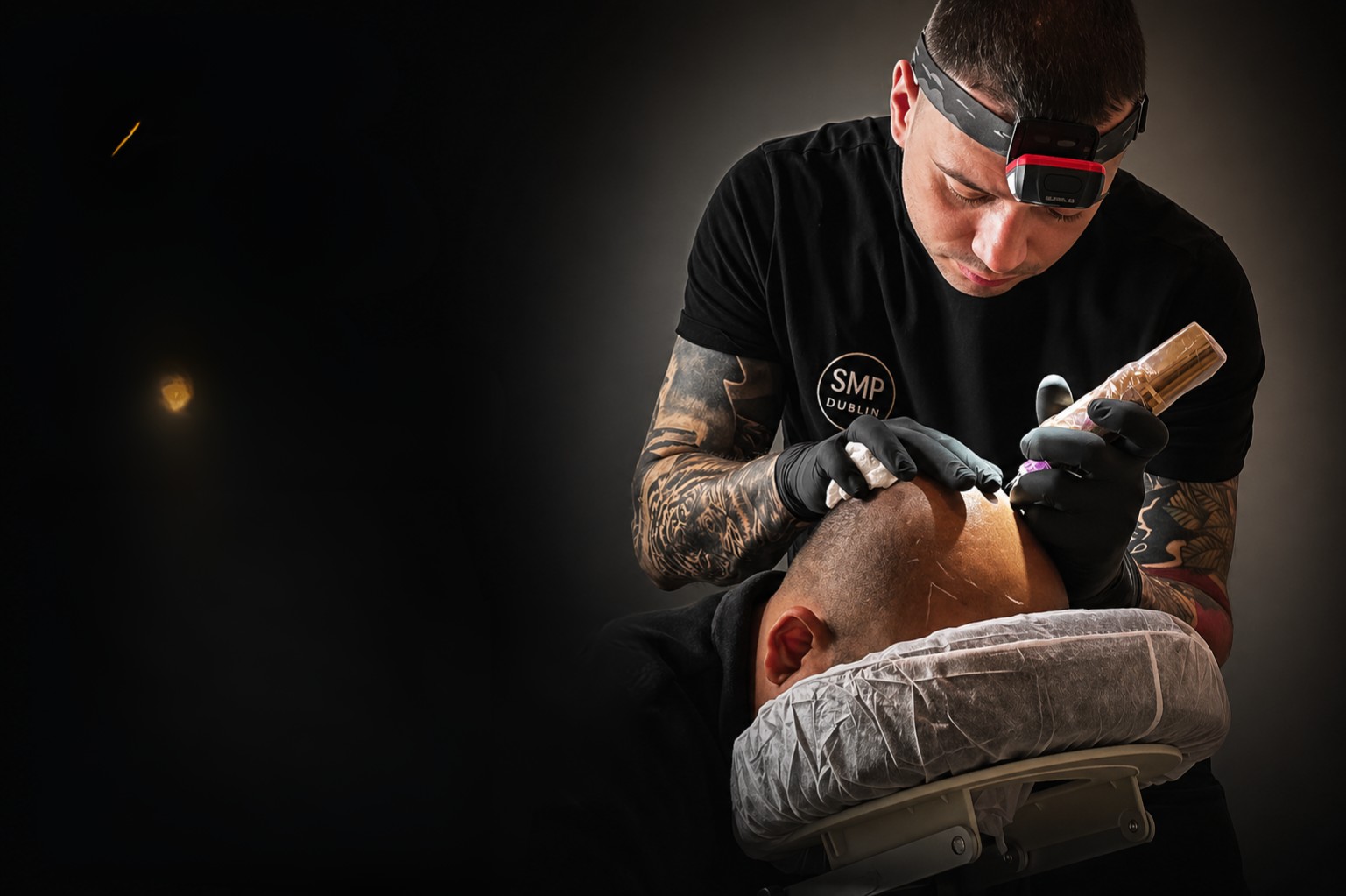
A transplant scar is a strange kind of problem. The surgery may have worked, the hair on top may look great, and yet the thing you notice in the mirror or at every haircut is a pale line across the back of your head, or a scatter of white dots that shows the moment the clippers come out. Scalp micropigmentation (SMP) is one of the most common ways to hide both. I have worked in scalp micropigmentation for 17 years, and this guide covers what actually happens when pigment meets scar tissue: what works, what takes longer, and what SMP cannot fix.
If you are new to SMP itself, start with the complete guide to scalp micropigmentation and come back here for the scar-specific detail.
Two kinds of transplant scar, and how each forms
Almost every hair transplant takes hair from the back and sides of the head, called the donor area, and moves it to where it is thinning. How that hair is taken decides the scar you are left with. There are two methods, and the International Society of Hair Restoration Surgery (ISHRS) treats both as current standard practice.
FUT: the strip scar
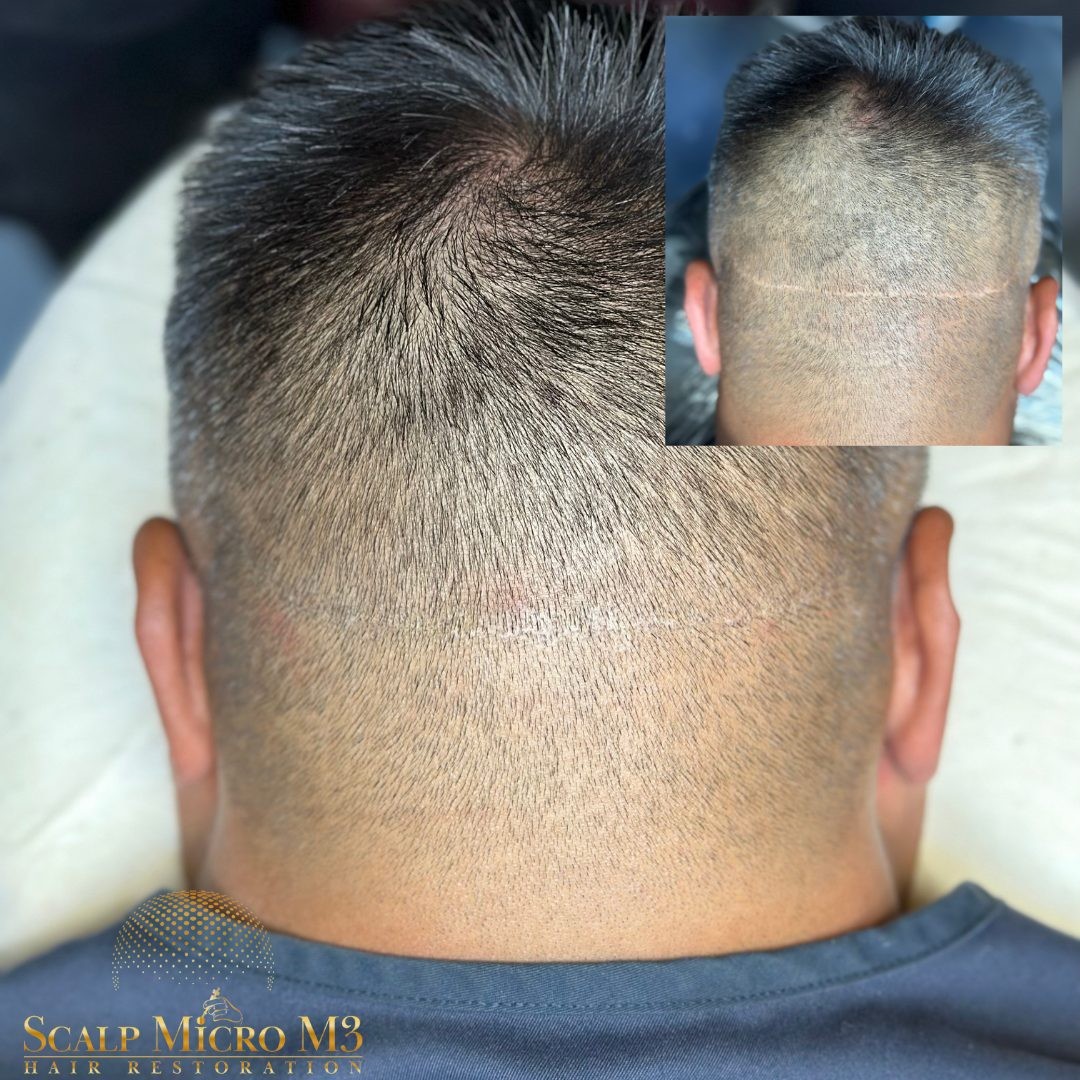
FUT (follicular unit transplantation, also called strip surgery) removes a strip of hair-bearing skin from the donor area. Technicians cut that strip into individual grafts under a microscope, and the surgeon stitches the wound closed. The result is a single linear scar running across the back of the head.
According to the ISHRS FUT guidelines (2024), these scars are usually well hidden under the surrounding hair, but removing the strip under tension can leave a widened scar that is "difficult to correct." The same guidelines say patients typically need to keep their hair at least 2 to 3 cm long for life to cover a strip scar. That is the whole problem in one sentence: if you want to go short, the line shows.
FUE: the dot scars
FUE (follicular unit excision, often called follicular unit extraction) takes grafts one at a time with a tiny round punch. There is no line, but there is a scar at every extraction site. The ISHRS FUT guidelines describe the trade as "more than 2,000 tiny 0.9mm diameter punctuate scars" instead of one linear scar.
The ISHRS FUE guidelines (2019) are blunt about it: surgeons should tell patients that FUE "is not a scarless surgery." The dots can heal as white, slightly sunken (atrophic) marks, often up to 1.5 mm across. They are more prominent on darker skin, more visible with short hair, and worse when the donor area has been overharvested, which can give the back of the head a patchy, "moth-eaten" look.
| Feature | FUT (strip) | FUE (dots) |
|---|---|---|
| Shape | One horizontal line | Many small round dots |
| Typical size | Thin line, can widen under tension | Around 0.9 mm punches, white dots up to 1.5 mm |
| When it shows | Hair shorter than about 2 to 3 cm | Short or shaved hair, overharvested areas |
| Main SMP job | Break up a continuous line | Fill pale dots and even out density |
Why a transplant scar stands out
A scar is not just a different color. It is different skin. Scar tissue lacks the hair follicles and pigment-producing cells that normal skin has, and mature scars are typically lighter than the skin around them (MedicineNet, medically reviewed 2026). On a scalp, that combination is what the eye picks up.
What makes a donor scar visible
- No hair: scar tissue grows no follicles, so the scar is a bald gap in an area that is otherwise covered.
- No pigment: the ISHRS FUE guidelines explain that FUE dots go white because the melanin-bearing follicle is removed and the wound heals in from the edges.
- Different texture: the same guidelines note that FUE scarring "will reflect light differently" from the surrounding skin. A smooth, shiny scar catches overhead light.
- Short hair: every one of the above gets worse as hair gets shorter, which is why so many people only notice their scar when they change haircut.
The giveaway is contrast. A clean skin fade over a strip scar draws a bright line exactly where the eye goes first. SMP works by taking away that contrast.
How SMP camouflages a transplant scar
SMP places tiny dots of pigment in the upper dermis to mimic the shadow of a hair follicle cut at skin level. Over a scar, the job is to carry that pattern of dots across the scar so it matches the stubble on either side. The scar is still there, but it stops reading as a gap.
The 2015 review by Rassman and colleagues in the Journal of Clinical and Aesthetic Dermatology describes SMP as "very effective in camouflaging scars," including strip scars and the punctate scars FUE can leave. The ISHRS FUE guidelines list SMP as a management option for hypopigmented FUE scars, and the 2024 FUT guidelines describe SMP, "in experienced hands," as a way to camouflage a widened strip scar.
Stippling across the scar, not just on it
Good scar work is blending, not coloring in. Rassman and colleagues note that a white scar has to blend into the surrounding skin, which usually means the artist works past the edges of the scar and into normal scalp. If you only pigment the scar itself, you get a darker stripe where the pale stripe used to be.
On an FUE donor area, the dots go between and over the white marks so the whole zone has one even density. On a strip scar, the artist breaks up the straight edge so there is no clean line for the eye to follow.
Why scar tissue needs more care, and often more sessions
Scar tissue does not behave like normal scalp. Rassman and colleagues write that scars "retain pigment very differently" from normal skin, and that the operator has to adjust depth because scarred scalp feels different under the needle. The ISHRS page on scalp micropigmentation goes further: scars are "the most demanding and difficult situation" for SMP, and pigment in scar tissue can spread and fade unpredictably.
The best numbers I could find come from a 2026 study in the Journal of Cutaneous and Aesthetic Surgery. It followed 18 people who had SMP over scarring hair loss, not transplant scars, but the tissue problem is similar. Only half kept pigment over more than 50% of the treated area at six months, every patient showed some fading by one month, and touch-ups were needed in every case.
When is a scar ready for SMP?
Timing matters more with scars than with almost anything else in SMP. A scar that is still red, raised or changing will keep changing under the pigment, and you can end up chasing a moving target.
After a hair transplant
The ISHRS SMP page advises avoiding SMP for at least a year after a transplant, because transplanted hair takes around 11 to 12 months to grow in and grows at uneven rates. Starting early risks premature fading and an uneven look. That advice is written about the recipient area, but the donor scar is healing on the same clock.
How long a scar takes to settle
Scars keep remodeling long after the skin has closed. MedicineNet says scars generally improve over the first year and continue to remodel for about two years. Surgeons follow the same logic before revising a scar: a plastic surgeon quoted by the American Society of Plastic Surgeons (2024) says they usually wait up to a full year after surgery, and MedStar Health recommends waiting a year or more after an injury or surgery before deciding on revision.
There is one exception worth knowing. The ISHRS describes SMP being applied during a new FUE procedure on someone with an old strip scar, to hide the scar and the shaved donor area for the 1 to 2 weeks it takes the hair to grow back. That is a short-term cover, and further sessions can follow once everything has healed.
Is my scar ready? Five checks
- It has been at least 12 months since the surgery or injury.
- The scar is flat or close to flat, not raised or growing.
- It has faded from red or purple to a stable pale color.
- There is no itching, tenderness or open skin along it.
- Your surgeon or doctor has no further procedure planned on that area.
Scar types and what SMP can realistically do
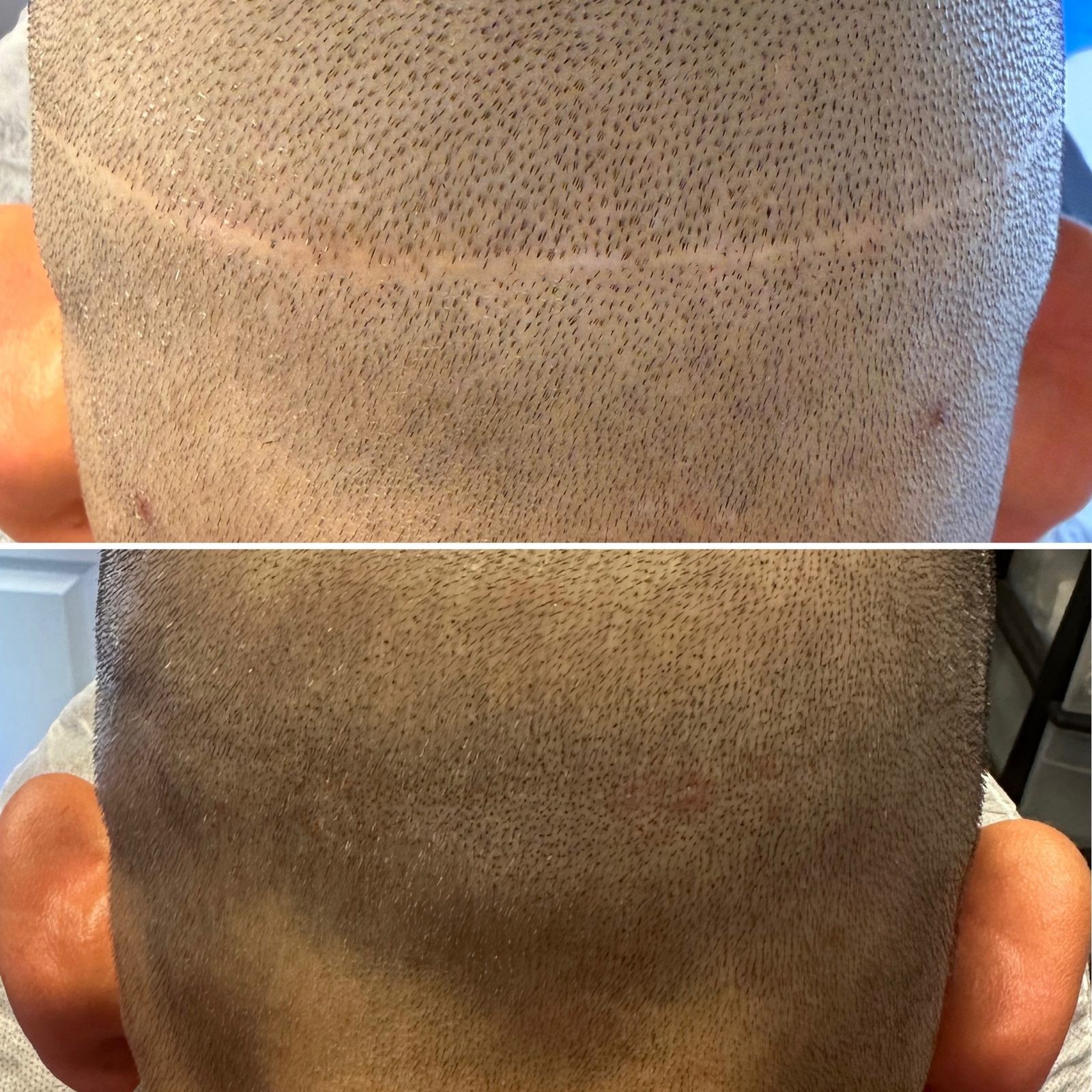
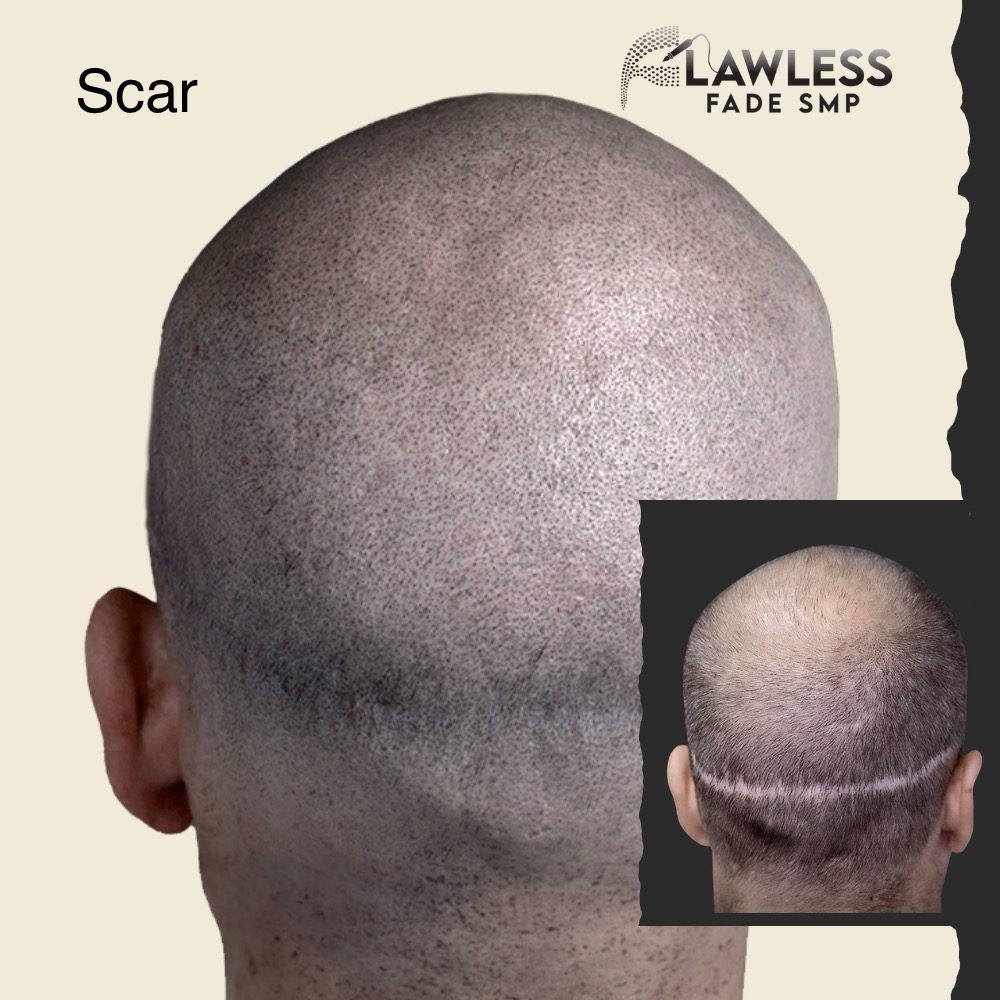
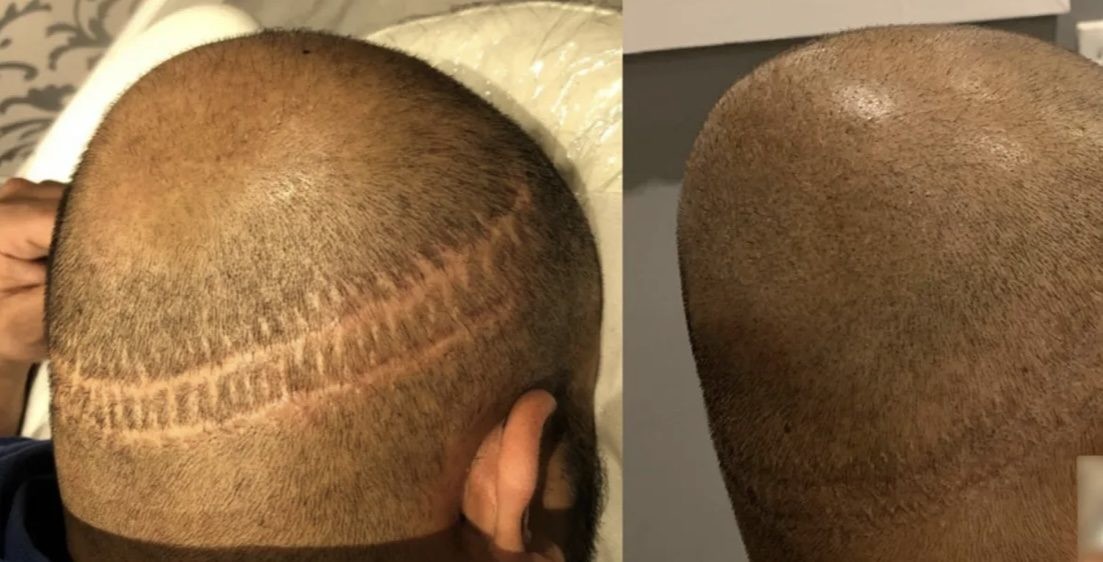
No two scars are the same, but most transplant scars fall into a handful of patterns. The table below is my summary of how each is usually approached and what a realistic outcome looks like. Session counts start from the published range of two to four sessions for SMP generally (Rassman and colleagues, 2015) and lean higher for scar tissue for the reasons above.
| Scar type | SMP approach | Sessions | Realistic result |
|---|---|---|---|
| Scattered FUE dots | Even density across whole donor zone | 2 to 4, plus touch-up | Dots blend into stubble at short lengths |
| Overharvested FUE (patchy) | Rebuild density across thin patches | 3 or more | Patchiness much less obvious; texture may remain |
| Thin, flat FUT line | Break up the edge, blend into stubble | 2 to 4 | Line hard to spot at a short cut |
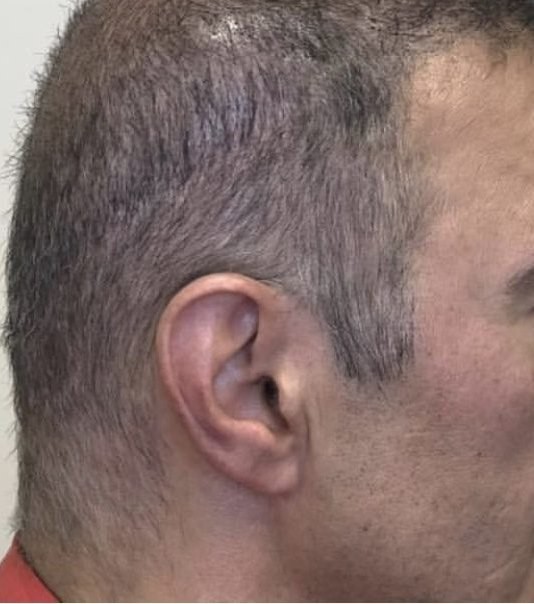
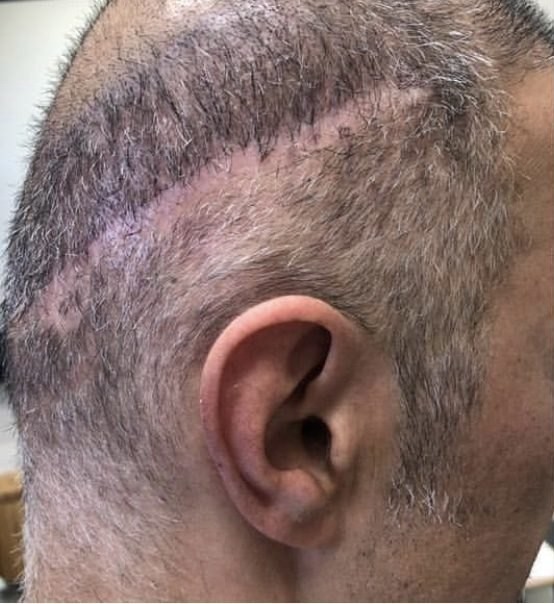
| Wide or stretched FUT line | Gradual build-up, often after surgery or grafts | 3 or more | Softened, may still show in harsh light |
| Raised or keloid scar | Not suitable for SMP | None | See a dermatologist first |
What "realistic" means here
SMP changes color, not shape. A flat scar can disappear into stubble. A sunken or shiny scar can lose its contrast but may still catch light at certain angles, because, as the ISHRS FUE guidelines note, scarred skin reflects light differently. Ask any artist to show you healed results on scars like yours, not just fresh photos under studio lights. Our before and after guide explains how to read those photos.
Scars from injury, surgery and burns
Transplant scars are the most common reason people ask about scar SMP, but they are not the only one. Rassman and colleagues list scars from neurosurgery and head trauma among the scalp problems SMP can conceal, and the ISHRS notes that once burns or scarring hair loss have healed, SMP can help restore a more natural look.
The same rules apply, often more strictly. Surgical and injury scars are frequently wider, thicker or more irregular than a donor scar, so the tissue is less predictable. Wait until the scar has matured, get your doctor's agreement if it came from surgery or a medical condition, and expect a slower build with more touch-ups.
For scarring hair loss conditions such as lichen planopilaris or frontal fibrosing alopecia, the ISHRS page advises that the condition should be stable and inactive for 2 to 3 years before SMP, while the 2026 study above required at least 6 months of inactivity. That gap is a good reason to have a dermatologist confirm your condition is settled before you book.
Other ways to deal with a transplant scar
SMP is not the only tool, and for some scars it is not the first one. Here is what else is on the table, and where each one fits.
Scar revision surgery
A surgeon cuts out the scar and closes the wound again, ideally under less tension so the new scar heals thinner. The ISHRS FUT guidelines describe resection with double-layered stitches and newer methods such as a "punching-out" technique that perforates the scar with a 1 mm punch before closing it. They also warn that, because of the stretch-back phenomenon, a revised strip scar may widen again over time, "resulting in minimal improvement." The ASPS is clear that no revision erases a scar completely.
FUE grafts into the scar
Hair can be transplanted directly into scar tissue so that real hair grows through it. The ISHRS comparison of strip and FUE calls camouflaging linear donor scars with FUE "another excellent use of the technique." The catch, according to the FUT guidelines, is that it uses valuable donor hair that you might want for the front or crown. One surgeon has published a letter describing beard hair used instead: about 1,200 beard hairs placed into a strip scar left it no longer visible at 10 months (Umar, 2012).
Trichophytic closure
This is prevention, not a fix. During strip surgery, the surgeon trims a narrow step of skin, about 1 mm wide and deep, along one edge of the wound so that hairs grow up through the scar once it heals. The ISHRS says it can help camouflage the linear scar and limit stretching. It only helps if it is done at the time of the strip surgery or a revision, so ask about it before surgery, not after.
Tricopigmentation
Tricopigmentation uses the same dot technique with pigment designed to fade. Providers commonly say the pigment fades over about 12 to 18 months. For a scar, that can be a way to test the look before committing. Our SMP vs tricopigmentation comparison covers the trade-offs in full.
Keeping the hair longer
The cheapest option is a haircut. The FUT guidelines put the cover length for a strip scar at 2 to 3 cm, and the FUE guidelines list keeping the hair longer as a management option for dot scars. They also say patchy harvest zones may show at lengths below about 10 to 12 mm. If you are happy at that length, you may not need anything else.
| Option | What it does | Best for | Main trade-off |
|---|---|---|---|
| SMP | Adds follicle-like dots over and around the scar | Short hair, flat mature scars | Color only; scar tissue fades faster |
| Scar revision | Removes scar, recloses the wound | Wide strip scars | Surgery; scar can stretch back |
| FUE into scar | Grows real hair through the scar | People with spare donor hair | Uses grafts needed elsewhere |
| Trichophytic closure | Lets hair grow through a new strip scar | At the time of FUT or revision | Prevention only, not a fix |
| Tricopigmentation | Temporary pigment dots | Testing the look first | Fades; repeat cost |
| Longer hair | Covers the scar | Anyone happy at 2 to 3 cm | Rules out short styles |
Combining SMP with other scar treatments
These options are not either/or. The ISHRS guidance itself describes several of them working together, and the order you do them in matters.
Common combinations and the order they usually run
- Revision first, SMP second: reduce the width surgically, let the new scar mature, then pigment what remains.
- Grafts first, SMP second: put hair into the scar, wait for it to grow in, then use SMP to fill any gaps between the grafts.
- SMP during a new FUE session: the ISHRS describes pigment applied in the same procedure to cover an old strip scar and the shaved donor area while hair regrows.
- SMP alongside a transplant: the ISHRS SMP page describes pigment adding the look of density where transplanted hair is still below the patient's goal.
The rule underneath all of these is simple: pigment goes last. Surgery and grafts change the skin, and anything you pigment before them may be cut out, stretched or covered. If you are weighing surgery against pigment for the hair loss itself, our SMP vs hair transplant guide covers that decision.
Does SMP over a scar hurt?
Scars are unpredictable here too. The ISHRS FUT guidelines note that strip surgery can leave altered sensation or even temporary loss of feeling above the incision, so some people feel less over and around a donor scar. That does not make scar work painless, though.
In the 2026 scarring study, a third of patients reported pain one week after treatment, falling to one patient at two weeks and none at three months. The team used an injected local anesthetic for the procedure itself. That is a scarred-scalp group treated by doctors, so it is not a direct guide to a transplant scar, but it shows scar tissue can stay tender for a while. Our guide to whether SMP hurts covers what makes it worse and what numbing products can and cannot safely do.
Shaved head or longer hair after scar SMP?
You do not have to shave your head to have a scar camouflaged. Rassman and colleagues note that SMP can be done with the hair kept long or on a shaved scalp. What changes is the goal.
If you want to wear it short or shaved
The pigment has to match the stubble pattern across the whole donor area, so the work usually extends well beyond the scar. This is the look most transplant scar clients are chasing, because the scar was the only thing stopping them from going short.
If you want to keep some length
The pigment only needs to make the scar read as normal scalp showing through hair. That is often a lighter job. The ISHRS does warn that SMP is generally a poor fit for a fully bald patch sitting next to longer, well-covered hair, so a large bare area may still need grafts.
Questions to settle about hair length before session one
- What is the shortest length you want to be able to wear, with a number on the guard?
- Will the rest of your hair keep thinning, and would you go shaved later if it did?
- Do you want the scar hidden at that length in daylight, or in all lighting?
My honest view is that the guard number you plan to wear is the single most useful thing to tell your artist. It sets the dot size, the density and how far past the scar the work needs to go.
How long scar camouflage lasts
SMP is long-lasting, not permanent. Cleveland Clinic says results usually last four years or longer, and the ISHRS SMP page puts well-placed SMP at 5 to 10 years, with some people choosing a yearly touch-up to keep the look fresh.
Scar tissue sits at the shorter end. Rassman and colleagues report that pigment bleeding and color change are common in work by inexperienced practitioners, and that UV exposure can speed up color change. In the 2026 scarring study, 72% of patients showed some color change by six months and every patient needed a touch-up. Plan for the scar to be the first area that needs refreshing.
| Source | Skin type | Finding |
|---|---|---|
| Cleveland Clinic | General SMP | Usually lasts 4 years or longer |
| ISHRS | Well-placed SMP | 5 to 10 years; sun speeds fading |
| 2026 study, 18 patients | Scarred scalp | Fading in all; touch-ups needed in all |
Our guides on how long SMP lasts and SMP touch-ups go into timing and what a refresh involves.
What scar SMP costs
Scar work is usually quoted separately from a full scalp; see our SMP cost guide for what a quote should include.
Questions to ask an artist before scar work
Scar camouflage is where the gap between artists shows most. Rassman and colleagues point out that results depend heavily on the operator's skill, and the ISHRS calls scars the hardest situation for SMP. These questions help you find out quickly whether someone is ready for yours.
Ask these before you book
- How many transplant scars like mine have you treated, and can I see healed results, not just fresh ones?
- Will you do a test area first to see how my scar takes pigment?
- How far past the scar will you work to blend it, and what length is that designed for?
- How many sessions do you expect, and what is included if the scar needs extra?
- What will you do if part of the scar does not hold pigment?
- Do you need a letter or clearance from my surgeon or doctor before starting?
- What do touch-ups cost after the main sessions?
Red flags in a scar consultation
- A promise that the scar will "disappear" completely.
- No questions about how old the scar is or how it healed.
- Happy to work on a raised, red or growing scar.
- No healed scar photos to show, only fresh results.
Our guide on how to choose an SMP artist covers training, hygiene and portfolios in more depth.