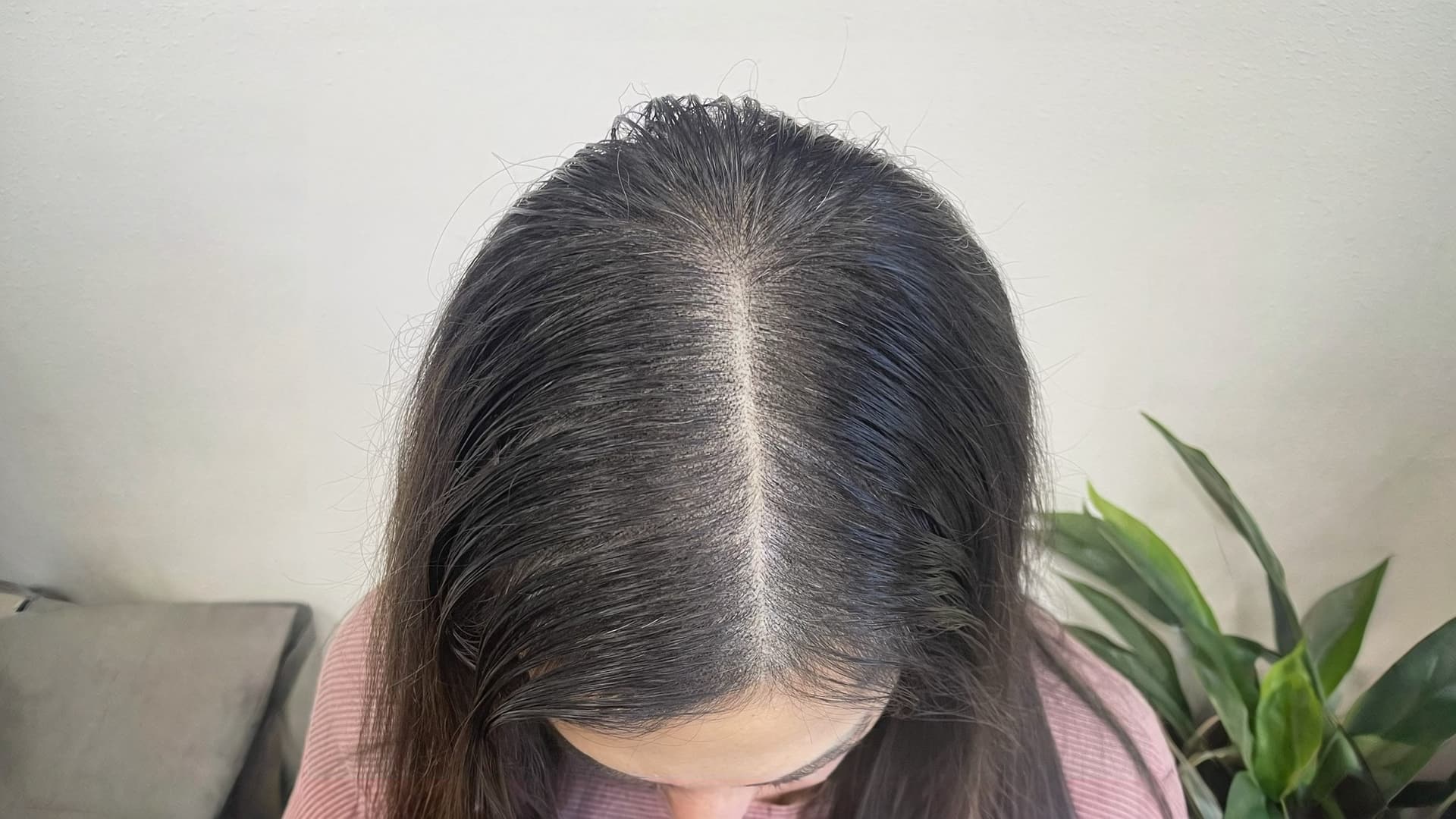
Thinning hair hits women differently. Few women are warned it can happen, the products aimed at them promise volume rather than answers, and most SMP photos show men with shaved heads. There are two questions here: first why the hair is thinning, then whether pigment can help. This guide takes them in that order, because the order matters. If SMP is new to you, start with our complete guide to scalp micropigmentation.
For context on where my view comes from: I have spent 17 years in scalp micropigmentation and permanent makeup. I am not a doctor, so every medical point below comes from the medical sources listed, and everything that is my own judgement is marked as such.
How common hair loss in women really is
Hair loss in women is not rare and it is not niche. A 2018 review in the International Journal of Women's Dermatology gathered the prevalence data for female pattern hair loss, the most common type, and the numbers climb steadily with age (Fabbrocini et al.).
| Age | Share of women affected |
|---|---|
| By 29 | About 12% |
| By 49 | About 25% |
| By 69 | About 41% |
| By 79 | More than 50% |
The American Academy of Dermatology (AAD) calls female pattern hair loss the most common cause of hair loss in women and says it usually begins in the 40s, 50s or 60s, though it can start earlier (AAD). The NHS gives the baseline: losing 50 to 100 hairs a day is normal and usually goes unnoticed (NHS).
So if your part looks wider than it used to, you are in very large company. The point I want you to take from those figures is practical: because hair loss in women is common and has several causes, the first job is working out which one you have.
The main types of hair loss in women
These conditions can look alike in the mirror and behave very differently over time. That difference decides whether SMP makes sense now, later, or not at all.
Female pattern hair loss and the Ludwig scale
Female pattern hair loss is hereditary, can come from either parent, and is progressive, so it tends to continue without treatment, according to the AAD. The part widens, the top thins, and sometimes the hair near the temples recedes. Unlike many men, women rarely lose all the hair in the affected area.
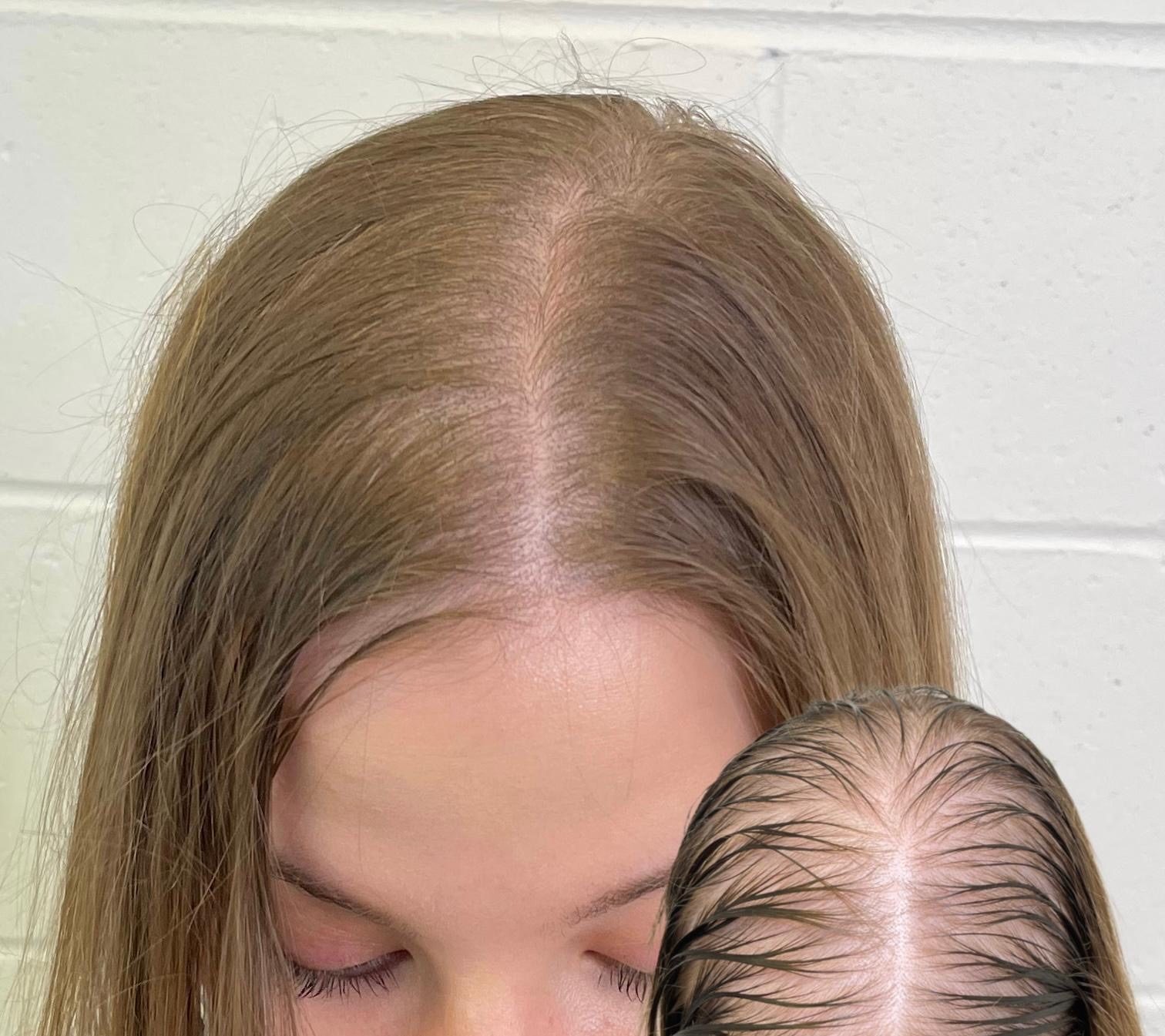
Clinicians grade it on scales. The best known is the Ludwig scale, published in 1977. A 2020 review in the Indian Dermatology Online Journal describes its three grades: grade 1 is perceptible thinning on the crown, starting 1 to 3 cm behind the front hairline; grade 2 is pronounced thinning within that same area; grade 3 is full baldness within it (Bhat et al.). The front hairline is usually kept. A second pattern, described by the Olsen scale, looks like a Christmas tree: thinning runs along the central part and opens into a triangle at the front.
If you have read our Norwood scale guide, Ludwig is the female counterpart. The difference matters for SMP. Men on the Norwood scale often lose the hairline, so their work starts there. Women on the Ludwig scale usually keep it, so the work is about density behind it.
Telogen effluvium
Telogen effluvium is a temporary shed triggered by a stressor or a change in the body. Cleveland Clinic lists triggers including high fever, childbirth, severe infection, major surgery, thyroid problems, stopping birth control pills, crash diets low in protein and some medications (Cleveland Clinic). Shedding usually starts two to three months after the trigger.
The acute form lasts under six months, about 95% of acute cases resolve, and hair often grows back within three to six months without treatment. A chronic form lasts longer than six months, affects the whole scalp, sometimes has no clear cause and is more likely in women aged 30 to 60. It does not cause total baldness.
Postpartum shedding
After birth, falling estrogen pushes many hairs into the shedding phase at once. The AAD says noticeable shedding starts a few months after delivery, peaks around four months, and most women have normal growth back by their child's first birthday (AAD). Dermatologists class it as telogen effluvium, and the AAD describes it as temporary rather than true hair loss.
Menopause
The NHS lists hair thinning or hair loss among the symptoms of menopause and perimenopause (NHS). The AAD notes that female pattern hair loss becomes more common after menopause, so hormones may play a role. In practice, menopause is often when pattern loss becomes visible, rather than a separate condition of its own.
Traction alopecia
Traction alopecia comes from hairstyles that pull. The AAD names cornrows, locs, tight braids, tightly pulled buns and ponytails, extensions and weaves (especially on relaxed hair) and rollers worn most of the time (AAD). Warning signs include pain, stinging or crusts, tenting of the scalp, broken hairs around the forehead and a receding hairline. Once the scalp looks shiny and bald, the AAD says the hair cannot grow back, which is why early action matters.
Alopecia areata
Alopecia areata often starts as a round or oval bald patch and is unpredictable. The AAD says hair may regrow on its own within about a year, but many people relapse within a year of regrowth and most relapses happen within five years (AAD). There is no cure, though treatment helps many people regrow hair.
Frontal fibrosing alopecia
Frontal fibrosing alopecia (FFA) mostly affects women after menopause, with most noticing it 2 to 12 years after menopause begins. It looks like a receding band along the front and sides of the hairline, and the AAD reports that 80% to 95% of women with FFA have lost some or all of their eyebrows (AAD). It scars and destroys follicles, so the loss is permanent, but early treatment by a dermatologist can stop further loss.
| Type | Typical look | Outlook | SMP timing |
|---|---|---|---|
| Female pattern | Wider part, thin top | Progressive | Good fit once diagnosed |
| Telogen effluvium | Diffuse shed | Usually regrows | Wait |
| Postpartum | Shed peaks near 4 months | Temporary | Wait past the first year |
| Traction | Thin edges, hairline | Can become permanent | After pulling stops |
| Alopecia areata | Round patches | Relapses common | Only when stable |
| FFA | Receding band, brows | Permanent, scarring | Only once inactive |
Why diagnosis comes before pigment
SMP does not treat hair loss. It is a cosmetic tattoo that reduces the contrast between hair and skin. If the cause underneath is still active, the pigment stays where it was placed while the hair around it keeps changing, and the result can stop matching within months.
The AAD says other conditions can look like female pattern hair loss, so a dermatologist should confirm the cause. The NHS advises seeing a GP before considering a commercial hair clinic. The 2018 review describes how clinicians use history, examination and trichoscopy (a magnified scalp exam) to tell pattern loss from telogen effluvium, and check for hormone problems when there are signs of excess androgens.
What a good hair loss assessment covers
- Your history: when it started, births, illness, surgery, diet changes, new medication, stopping the pill.
- The pattern: part line, crown, temples, front hairline and eyebrows.
- A close look at the scalp for redness, scaling, shine or scarring.
- Blood tests where your doctor thinks they are needed, for example thyroid or iron.
- Referral to a dermatologist if a scarring or autoimmune condition is suspected.
I will be plain about roles. A dermatologist is a medical doctor who can diagnose disease, take a biopsy and prescribe. For anything that looks scarring, inflamed or patchy, you want the dermatologist, and nothing in this guide is a substitute for that appointment.
How SMP for women differs from SMP for men
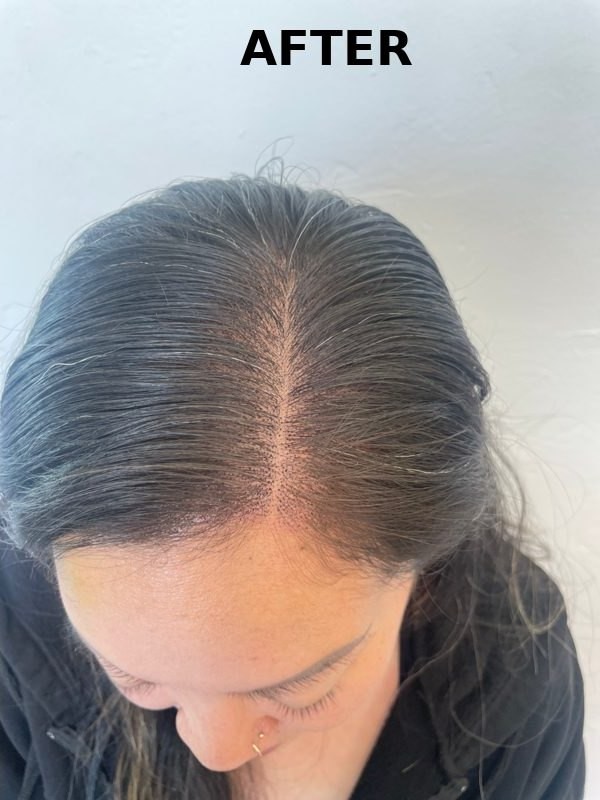
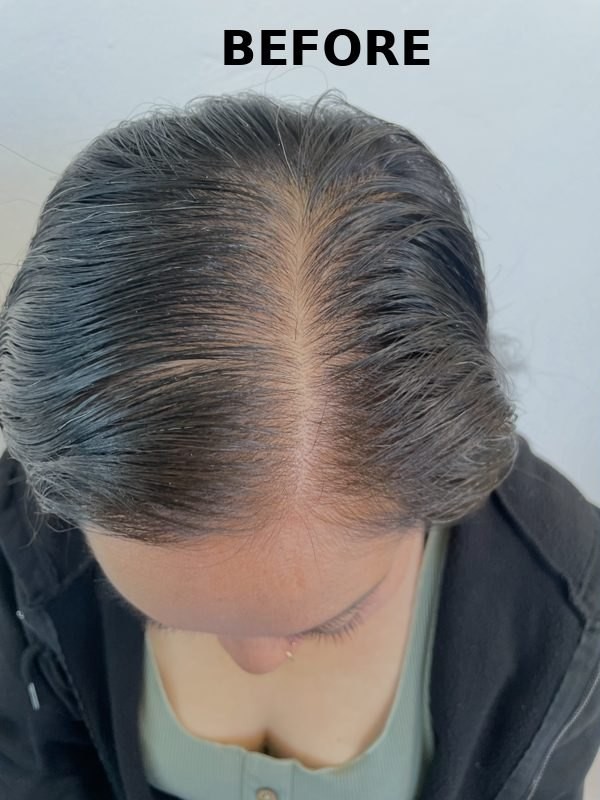
Most SMP you see online is the shaved-head look: a full scalp of dots that mimics stubble. For most women that is not the goal. The aim is to cut the contrast between hair and skin so the part and crown look denser, while your own hair stays long.
A 2015 paper in the Journal of Clinical and Aesthetic Dermatology notes that SMP can be done with the hair left long to give the illusion of thicker hair, and it says patients should understand that some scalp showing through the hair is normal (Rassman et al.). That expectation is the single most important thing to agree with your practitioner before the first dot.
Density behind long hair
Pigment dots sit in the skin between your existing hairs. When hair falls over them, the scalp reads darker and the eye sees fullness instead of skin. Nothing is added to the hair itself, so volume and length still come from what you have.
No shaving
You keep your hair. The practitioner works by parting it section by section. This is slower and more exacting than work on a shaved head: dots must sit between hairs at a density that suits your natural pattern, and too many dots in one place reads as a shadow rather than hair.
The part line
The part is where women usually notice thinning first, and where SMP often makes the clearest visible difference. I suggest deciding before treatment where you wear your part and whether you switch sides. More than one part line can be treated, but the plan should be agreed up front, not guessed on the day.
The crown and the hairline
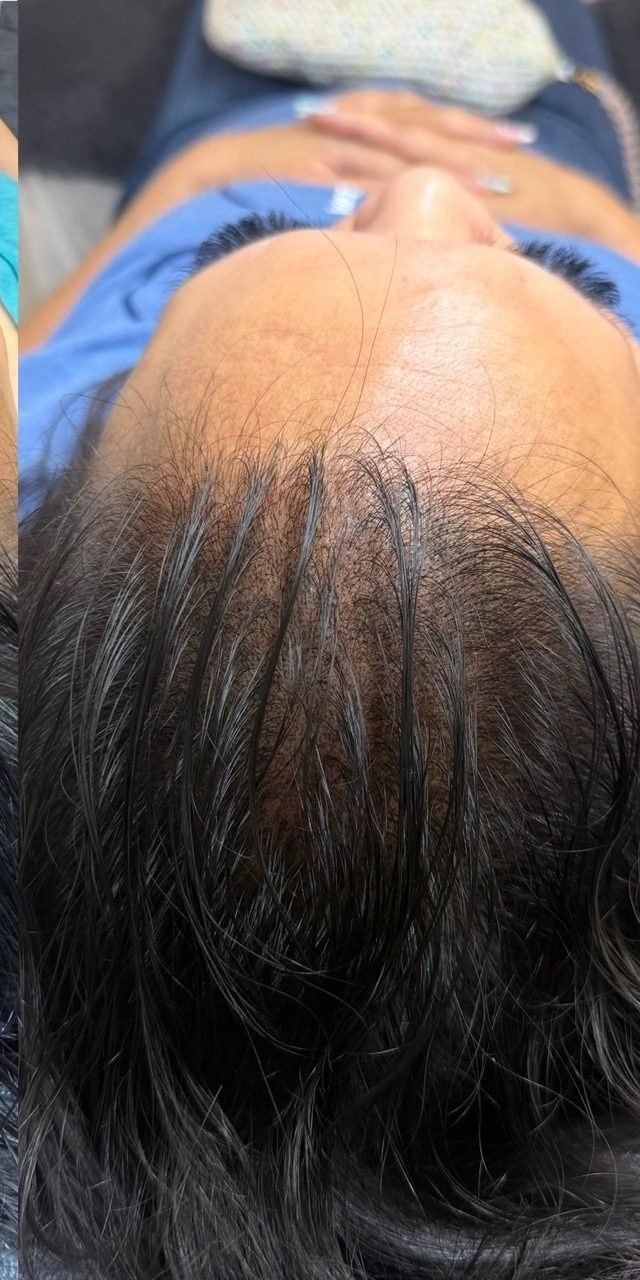
The crown can be treated the same way. The front hairline usually needs little or nothing in female pattern loss, because the Ludwig pattern tends to keep it. Where the front edge is involved, as in traction alopecia or FFA, the work becomes soft reinforcement along the edge, and that depends on the medical status first.
| Feature | Typical men's SMP | Typical women's SMP |
|---|---|---|
| Hair length | Shaved or buzzed | Kept long |
| Main target | Hairline and full scalp | Part line and crown |
| Goal | Stubble look | Less scalp contrast |
| Hairline work | Common | Rare, soft if any |
Who it suits and who should wait
The clearest published evidence on choosing SMP in female pattern hair loss is a 2024 retrospective study from Seoul in the Journal of Cosmetic Dermatology. It reviewed 40 women who had a hair transplant (23) or SMP (17). Hair density at the part line was the strongest deciding factor: the authors recommend SMP when density is at least 104.6 hairs per square centimeter, and a transplant when it is 96.17 or lower (Park et al., 2024).
That fits how the technique works, because long-hair SMP needs existing hair to blend with. It is a small, single-clinic study, so I treat the numbers as a guide rather than a rule. The principle holds, though: the more hair you still have, the better long-hair SMP tends to perform. If your density is low, ask about a transplant as well; our SMP vs hair transplant guide compares them.
Usually a good candidate
- Diagnosed female pattern hair loss that is stable or under treatment.
- Enough hair left to fall over the treated area.
- Dark or medium hair with clear contrast against the scalp.
- A realistic goal: less shine, not a new head of hair.
- Willing to keep up touch-ups over the years.
Better to wait and get medical advice first
- A shed that began in the last few months, including after childbirth.
- Patches that come and go, until your dermatologist says they have been stable.
- Redness, itching, scaling, burning or shiny skin on the scalp.
- A history of keloids, which Cleveland Clinic lists as a reason to avoid SMP.
Cleveland Clinic lists alopecia areata, chemotherapy hair loss and hair loss in women among the conditions SMP can disguise (Cleveland Clinic), and the 2015 paper includes scarring alopecias. So the second list is not a set of automatic no's. It is a list of reasons to time SMP with your doctor rather than ahead of them.
Sessions and what to expect
Plans differ by practitioner and by scalp, but published figures give the shape. Cleveland Clinic says a session can last up to five hours and most people need three or more, spaced several weeks apart. The 2015 paper says many patients need two to four. In a small 2021 study of 22 patients, 6 of them women with female pattern hair loss, everyone had three sessions a week apart plus a touch-up a month later (Seyhan and Kapi).
The usual path
- Consultation: history, photos, part line, shade discussion and confirmation of your diagnosis.
- First session: a light base layer of dots in the thinning zones.
- Healing: mild redness for a few hours, and Cleveland Clinic advises keeping the scalp dry and away from sun, sweat, heavy exercise and hot steamy showers for several days. Our aftercare guide has the detail.
- Second and third sessions: building density and adjusting shade as earlier layers settle.
- A review some weeks later, with a final top-up if needed.
How much it hurts varies from person to person; our guide to whether SMP hurts covers what affects it. The 2015 paper also notes that some surface ink washes out at the first hair wash, two to three days after a session, which is expected and not the treatment failing.
Satisfaction data specific to women is thin. In the 2021 study, all six women reported being very satisfied at least six months on. That is encouraging, but six people are far too few to promise anyone a result.
Pigment and shade for lighter or gray hair
SMP works through contrast. A dark dot under dark hair on a pale scalp disappears into the hair. A dark dot under blonde, red or gray hair can show as a dot, and that is the main risk to manage.
The 2015 paper warns patients that dots can take on a blue or green tint. A proper SMP pigment is carbon based and does not change color over time; that blue or green look comes from the wrong product, such as tattoo ink or a permanent makeup pigment, or from carbon placed too deep, where it reads blue under the skin the same way veins do. In my view that makes shade choice and depth the biggest technical decisions in women's SMP, and the place a test patch earns its keep.
Shade rules for lighter hair
- Match the pigment to the shadow your hair casts on the scalp, not the color of your ends.
- Start lighter and build: adding pigment is far easier than taking it away.
- Test a small area and judge it healed, in daylight, before committing.
- Remember the dots will not go gray with you, so plan for the hair you will have in five years.
- If your hair is very light and your scalp pale, accept that the visible gain may be modest.
Gray hair needs particular honesty. Pigment that blends with salt-and-pepper hair today may look darker than the hair around it once the gray takes over. A soft, slightly understated result that ages well is safer than a strong one that dates quickly.
How it looks wet, in sun and under bright light
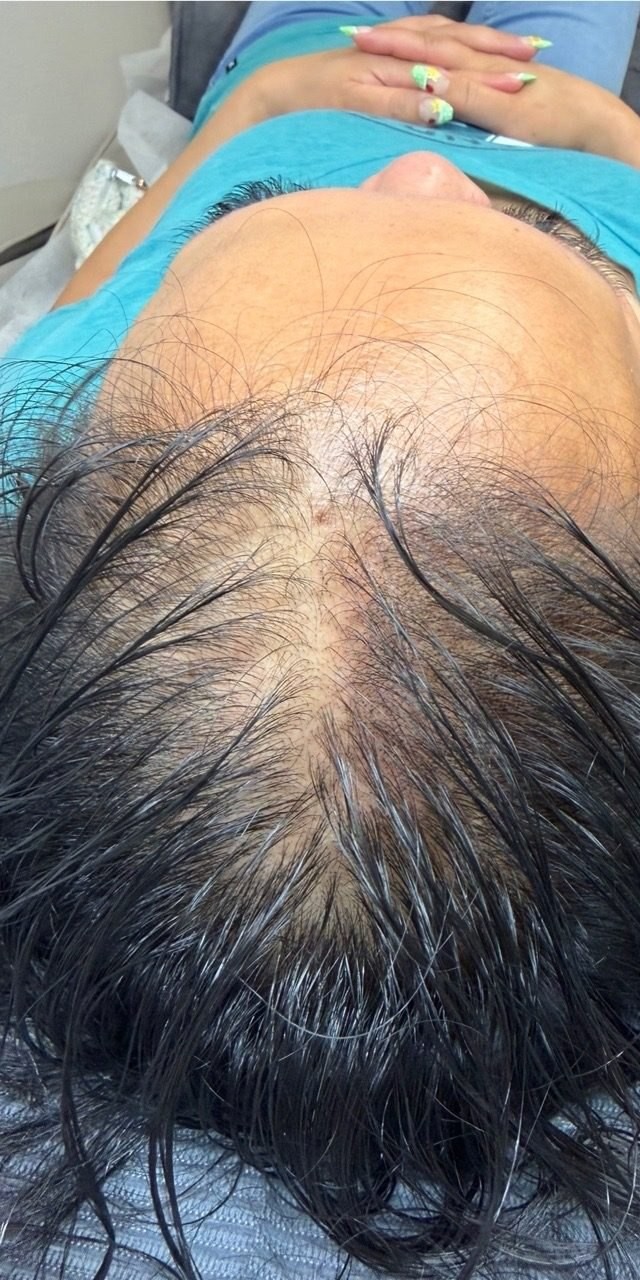
Dry, styled hair hides a lot. Wet hair clumps and separates, which exposes more scalp, and that is when SMP does the most work and when a poor shade choice shows most. When you look at a practitioner's portfolio, ask for healed photos of women with wet or swept-back hair, not only blow-dried ones.
Sunlight is the other test. The 2015 paper notes that ultraviolet exposure can speed up changes in the dots, and Cleveland Clinic advises keeping out of the sun while healing. Once you are healed, I suggest a hat or scalp-safe sunscreen on the part line on strong days, which protects the pigment and the skin.
Overhead lighting in offices, elevators and bathrooms is the harshest light for any thinning part. A good result reduces the shine there; it will not make the scalp invisible, and nobody should promise you that it will.
Maintenance and touch-ups
SMP lasts a long time but it is not fixed forever. Cleveland Clinic says results usually last four years or longer. The 2015 paper explains the fading: skin renews itself, pigment placed too shallow can disappear within weeks, and sun speeds up change. Touch-ups are part of the plan, not a sign something went wrong.
For women there is a second reason to return: if pattern loss progresses, the area that needs density can grow beyond what was treated. Medical treatment slows that, which is one reason I like the two working together. Our guides on how long SMP lasts and touch-ups cover timing and what to expect.
Combining SMP with medical treatment
SMP hides; medicine treats. They do different jobs, and for pattern loss I think using both makes sense. The AAD calls minoxidil the most recommended treatment for female pattern hair loss and says it is FDA approved for women in 2% and 5% strengths. It can cause extra shedding in the first 2 to 8 weeks, takes about 6 to 12 months of continuous use to show its effect, and the benefit fades if you stop.
Other options are prescription only. The AAD lists pills such as spironolactone that are used off label for female pattern hair loss, can cause birth defects, are not an option in pregnancy and require birth control for premenopausal women. Finasteride is not approved for women in the US. The AAD says a dermatologist may still prescribe it off label for female pattern hair loss, but it can cause birth defects, so it is not an option during pregnancy or when planning one, and the NHS advises women not to use it. The AAD also says women who are pregnant, planning pregnancy or breastfeeding should avoid minoxidil. These are decisions for you and your doctor.
| Stage | What happens | SMP |
|---|---|---|
| Weeks 2 to 8 of minoxidil | Possible extra shedding | Hold off |
| Months 6 to 12 | Effect becomes clear | Plan to match density |
| Ongoing use | Gains maintained | Adds visual density |
| Treatment stopped | Gains fade, shedding rises | Expect more work later |
Why wait for the result? If you start minoxidil and SMP in the same month, an early shed can leave the pigment looking too strong, and later regrowth can leave it looking unnecessary in places. Matching the pigment to the hair you will actually keep gives a result that sits right for longer.
What it costs, in brief
Insurance does not cover SMP because it is elective, according to Cleveland Clinic. Prices vary with the area treated, the number of sessions, the practitioner and the city, and touch-ups are an extra cost later. Our SMP cost guide has dated, sourced US price ranges as of 2026.
When you compare quotes, compare the whole plan: the number of sessions included, whether a shade test is part of it, and what a touch-up will cost in a few years. Get those terms in writing before you pay a deposit.
Questions to ask before you book
Who does the work matters. A 2024 study of 120 people who needed correction after unsatisfactory SMP found that 76 of them were women, and the fixes included laser removal, repeat SMP and hair transplant surgery (Park et al., revision study). Poor SMP happens to women too, and undoing it is harder than doing it carefully once.
Questions I would ask any practitioner
- Do you work on long hair without shaving, and how many women have you treated this way?
- Can I see healed photos of women, wet and dry, in daylight, at least a year after treatment?
- Will you ask about my diagnosis, and will you tell me to wait if it is not settled?
- What shade will you use for my hair and skin, and will you test it first?
- How many sessions, how far apart, and what will a touch-up cost later?
- How will you handle my part if I switch sides?
- What would make you say no to treating me?
A practitioner who answers question 7 clearly is usually one who takes the rest seriously. For a fuller checklist, see how to choose an SMP artist, and for what goes wrong when people rush, read SMP regrets.
A decision table for women considering SMP
Use this as a starting point for a conversation with your doctor and practitioner, not as a diagnosis.
| Your situation | My suggestion |
|---|---|
| Diagnosed pattern loss, stable, dark or medium hair | A good time to consult |
| Pattern loss, just started minoxidil | Wait for the result, about 6 to 12 months |
| New shed after illness, stress or birth | Wait: most cases regrow |
| Patches that come and go | Dermatologist first, SMP only when stable |
| Receding front band or lost brows | Dermatologist first, as FFA needs treatment |
| Very light or gray hair, pale scalp | Shade test, expect a modest change |
| Very low density at the part | Ask about a transplant as well |