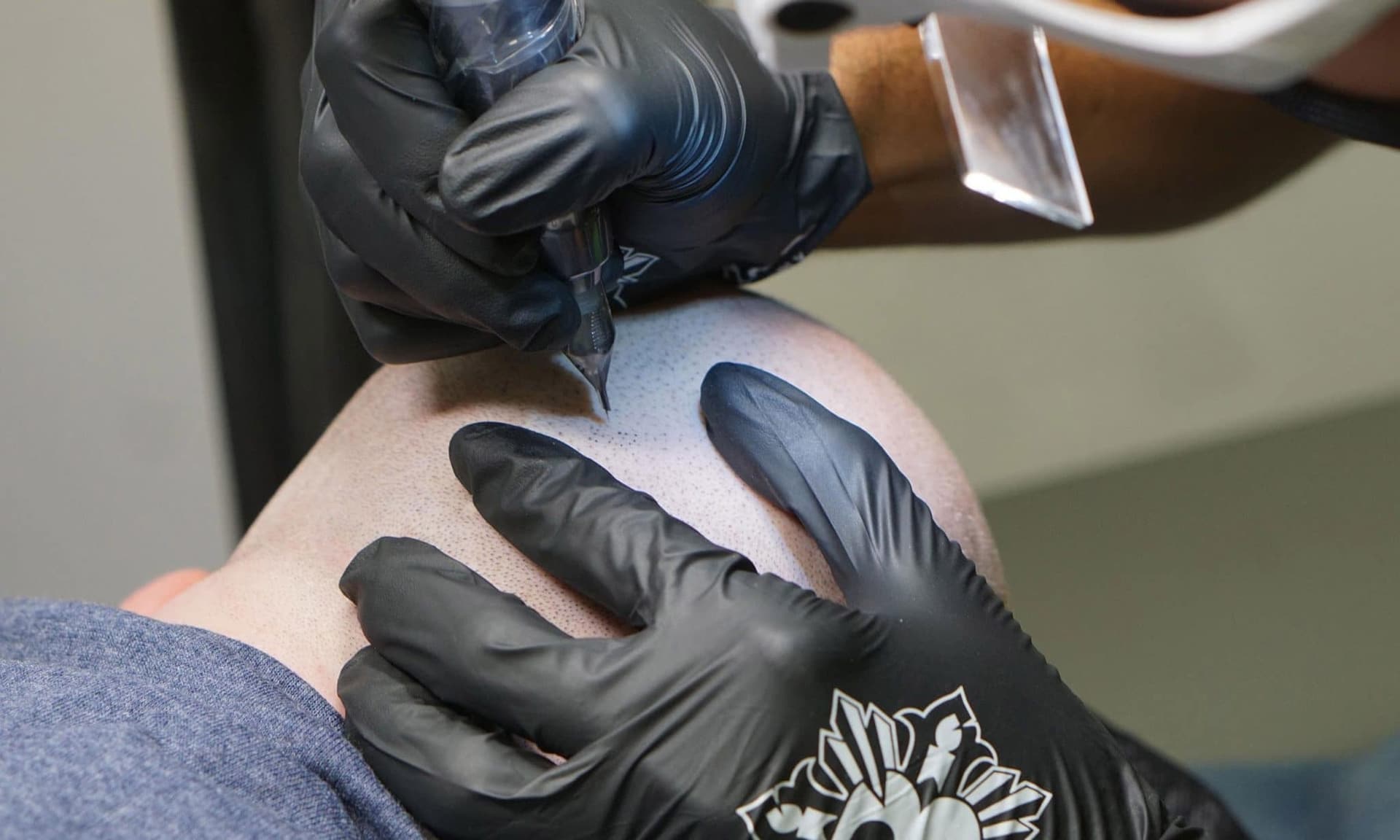
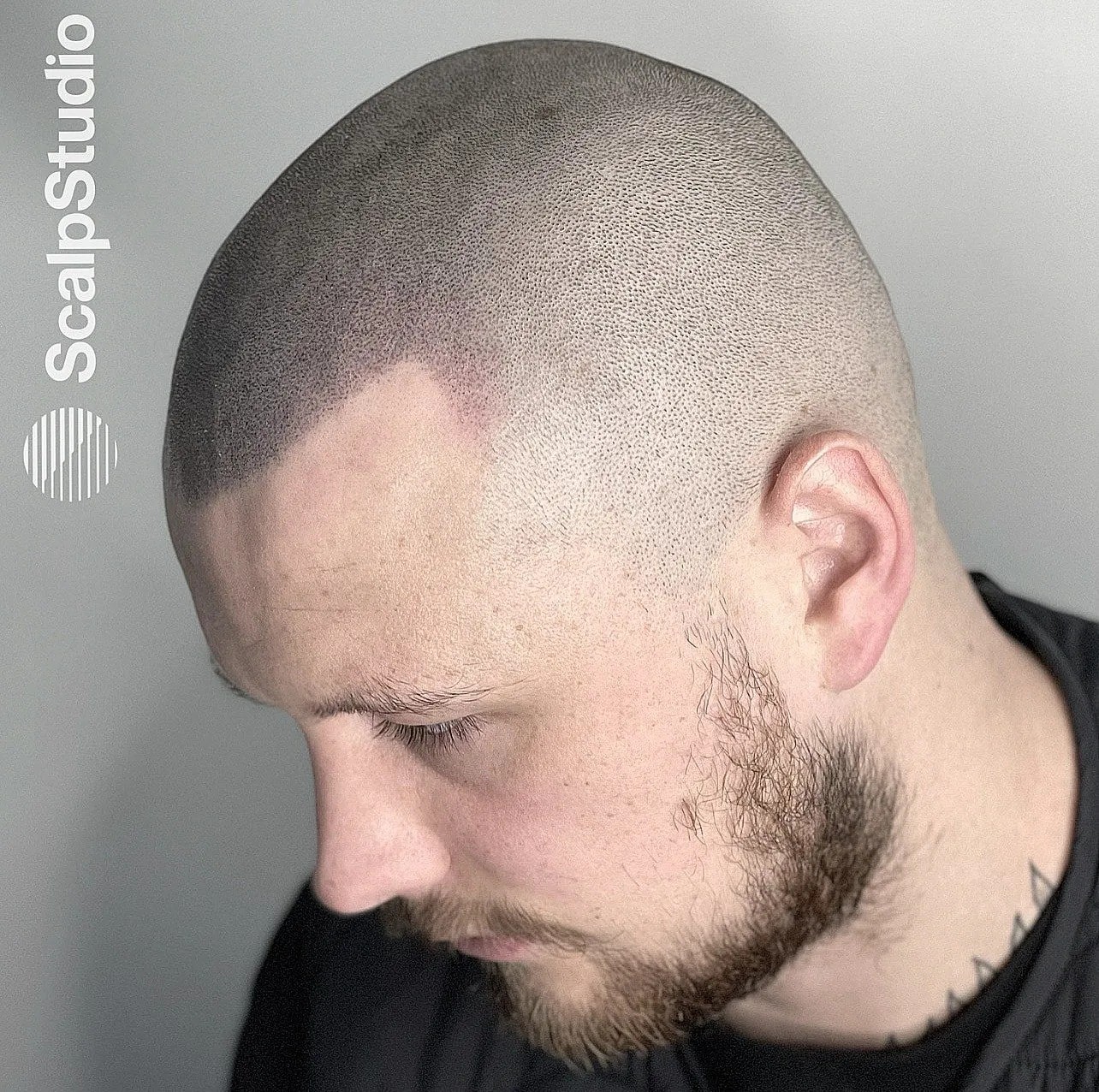
I think every SMP client should hear one thing before the first session: the dots you walk out with will not look exactly the same in five years. That is not a flaw in the treatment, it is how pigment in skin behaves. This guide covers both kinds of touch-up, how to tell when you need one, what happens in the session, and how to keep the gap between them as long as possible. If you are new to SMP, start with the complete guide to scalp micropigmentation and come back here.
The two kinds of SMP touch-up
People use the word "touch-up" for two very different appointments. Mixing them up is the most common reason clients feel misled about price, so it is worth getting straight before you book anything.
The follow-up session inside your first course
SMP is built in layers. Cleveland Clinic says most people need three or more treatments, spaced several weeks apart, with each one adding pigment. Many artists then book one more short session after the last main one to fix any dots that healed lighter or patchy. That is the first kind of touch-up: part of the original job, not maintenance.
The research shows the same pattern. In a 2021 study in The Journal of Craniofacial Surgery, all 22 patients had three sessions and then a fourth touch-up one month after the last session (Seyhan and Kapi, 2021). A 2026 study of SMP over scarring alopecia scheduled touch-ups at two weeks, one month, or both, where needed, and every patient needed one (JCAS, 2026).
The maintenance touch-up years later
The second kind comes after the dots have faded, softened or shifted color. The ISHRS says well-placed SMP lasts 5 to 10 years, with some patients preferring a touch-up session yearly. A 2022 review in Skin Appendage Disorders puts it plainly: fading occurs over time, requiring touch-ups (Nguyen et al., 2022).
| Question | Follow-up session | Maintenance touch-up |
|---|---|---|
| When | Weeks to months after the main sessions | Years later, when fading shows |
| Why | Fix dots that healed light or patchy | Refresh faded or shifted dots |
| Usually paid? | Often included in the price | Usually paid per session |
| Who does it | Your original artist | Original artist or a new one |
Signs you need a touch-up
SMP rarely fails overnight. It drifts, slowly enough that you stop noticing, and then one day a photo in harsh light shows it. Charles Medical Group's July 2026 maintenance guide names the main signs as overall pigment lightening, blurring of the dot-like appearance and uneven fading across the scalp. I would add a few more from what the studies record and what pattern hair loss does over time.
Touch-up checklist
- Fading. The whole treated area looks lighter or less dense than your stubble at the sides and back.
- Patchiness. Some zones, often the crown or a scar, have faded faster than the rest, so the coverage looks uneven.
- Hairline softening. The front edge has lost its crispness and the individual dots read as a smudge rather than follicles.
- Color shift. The dots look blue, green or bluish gray. A 2017 study recorded black pigment looking bluish gray within six months (Dhurat et al., 2017), and the Rassman paper warns patients there may be a blue or green tint. A proper carbon SMP pigment does not change color, so this usually means the wrong product (a tattoo ink or a permanent makeup pigment) or carbon placed too deep, where light scattering makes it look blue. That points to a correction rather than a refresh.
- New hair loss outside the treated area. Your natural hair has thinned beyond the edge of the work, so the border between SMP and real scalp is visible.
- Mismatch with your hair. Your stubble has grayed or lightened, and the SMP now looks darker than the hair around it.
The last two matter more than people expect. Cleveland Clinic describes male pattern baldness as gradual: follicles shrink and, over time, the hairs stop growing at all (Cleveland Clinic). SMP covers the scalp as it was on the day it was done. If you are still losing hair, the work may need extending, not just refreshing. The Norwood scale guide helps you track where you are.

When touch-ups happen
This is the table most people come here for. Every interval below comes from a named source, with its date. These are what clinics, studios and guides state publicly, not guarantees, and your own timing can land outside them.
| When | What is done | Source and date |
|---|---|---|
| One month after the last main session | Fourth, touch-up session in a study of 22 patients | Seyhan and Kapi (study), 2021 |
| Within weeks or a year of the main sessions | Settling session for light or patchy dots | Cost Insight Hub (cost guide), May 2026 |
| Every 3 to 5 years | Touch-up | Jae Pak MD Medical (clinic), Mar 2023; Kopelman Hair (clinic), Jan 2025 |
| Every 3 to 6 years | Maintenance refresh | Cost Insight Hub (cost guide), May 2026 |
| Every 3 to 6 years | Refresh | Charles Medical Group (clinic), Apr 2026 |
| Every 4 to 6 years | Refresh in New York City | Dida Hair Studio (studio), Jan 2024 |
| Year 4 to 6 | Refresh as contrast softens | Eureka Health (health resource), Jun 2024 |
| Four years or longer | Appearance usually holds | Cleveland Clinic, 2022 |
| 5 to 10 years | Well-placed SMP lasts | ISHRS, accessed Nov 2026 |
| Yearly, by choice | Optional refresh for a fresh look | ISHRS, accessed Nov 2026 |
What decides the price of a touch-up
ThePricer's September 2026 guide says touch-up prices depend on how much pigment must be refreshed and whether you are returning to the original artist. Charles Medical Group's April 2026 guide also prices by the area refreshed.
In practice, four things move the number: how much scalp needs work, whether it is a light refresh or a real rebuild, whether the artist knows your work, and your city. A hairline-only refresh with your original artist sits at the low end. A full scalp with a new artist who has to study someone else's work sits at the top, or turns into a correction (more on that below).
How often, by source
Published intervals vary because skin, sun and technique vary. Cleveland Clinic says SMP usually keeps its appearance for four years or longer. Cost Insight Hub says results typically last 4 to 6 years before a refresh. Two hair restoration clinic pages, from Jae Pak MD Medical (2023) and Kopelman Hair (2025), both put touch-ups at three to five years. ThePricer notes that clinics market intervals of roughly three to five years or longer, but these are not guarantees. Our guide to how long SMP lasts goes deeper into the fading research.
What happens in a touch-up session
A good touch-up is not "go over it again, darker". The 2022 review explains why: pigment placed too shallow is shed with the outer skin and washed away, while pigment placed too deep can spread and look patchy and blotchy (Nguyen et al., 2022). Pushing harder or darker to fix fading is how clean work turns into blurred work.
How a touch-up session usually runs
- Assessment in good light. The artist looks at where the fading is, whether any dots have spread, and how the color reads now.
- Shade check. The pigment shade is matched to your hair and stubble as they are today, not as they were years ago.
- Hairline review. You decide together whether the hairline stays where it is or needs adjusting for your age and face.
- Prep. The scalp is shaved and cleaned. Cleveland Clinic notes that numbing medicine is applied beforehand to make you more comfortable.
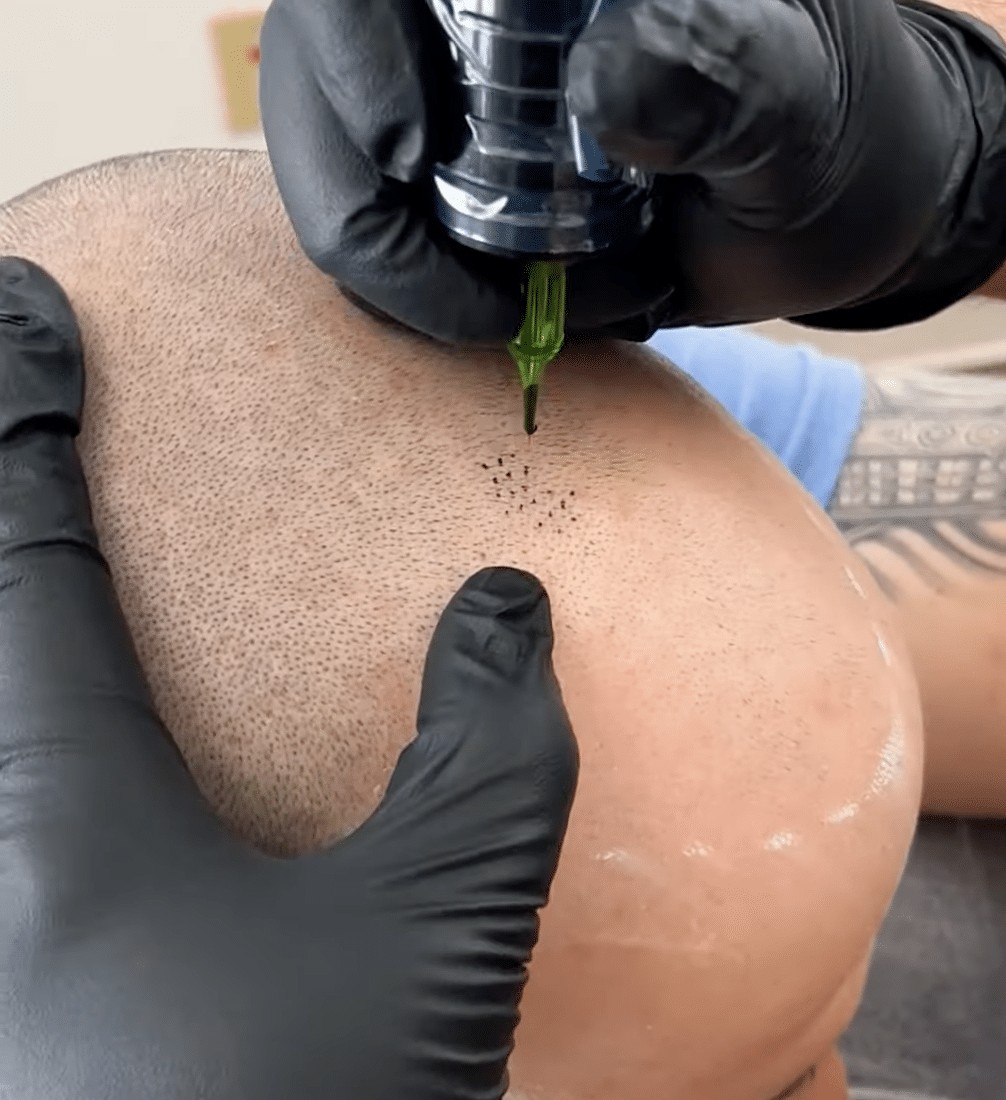
- Re-dotting. New dots go into the gaps between faded ones, rebuilding density without stacking pigment on old dots.
- Aftercare briefing. You go home with the same healing rules as your first sessions.
The hairline is the part of a refresh I would watch most closely. A hairline that was right at 30 can look too sharp at 45. A touch-up is a chance to soften it slightly so it keeps looking like it grew there, rather than copying the old line exactly.
How long a touch-up takes
No source I could find publishes a standard length for a touch-up, because it depends entirely on the area. What is published is the length of full sessions. Cleveland Clinic says a treatment may take up to five hours, depending on the size of the treatment area. Kopelman Hair, a hair restoration clinic, says in a January 2025 page that sessions last 2 to 4 hours, depending on whether you treat a small patch or the whole scalp. Ziering Medical's 2021 clinic page puts its sessions at 2 to 3 hours on average.
For smaller jobs, Cost Insight Hub says scar work may take only 60 to 90 minutes. Charles Medical Group's July 2026 maintenance guide says maintenance sessions typically require only one appointment. Put together, a refresh is normally a single visit, shorter than your first session, and a hairline-only refresh shorter still. ThePricer notes that some studios bill returning clients by the hour, which makes the time and the price the same question, so ask for an estimate in hours.
Does a touch-up hurt?
A touch-up is normally shorter than your first session and you know what to expect, both of which work in your favor. It is still needles in skin, though. In the 2026 scarring alopecia study, a third of patients reported pain at first, with some recurrence during touch-ups, and swelling returned in 16.7% of patients after touch-up sessions (JCAS, 2026). That was a small study over scarred skin, so treat it as a sign that touch-ups are not always painless, not as a prediction.
The things that make any session worse apply here too: turning up tired, hungover or sunburned. The full breakdown of pain by scalp area and what helps is in our guide on whether SMP hurts.
Aftercare after a touch-up
A touch-up is a new set of small wounds, so the aftercare clock goes back to day zero. People skip this because "it is only a top-up", and it is the easiest way to lose part of what you just paid for. Our day-by-day aftercare guide applies in full.
After a touch-up, the rules that matter most
- Keep it dry and untouched for the first days, exactly as you did after your first session.
- Skip the gym. Charles Medical Group's July 2026 maintenance guide advises avoiding intense training for the first 7 to 10 days, because heavy sweating during healing disrupts pigment retention.
- Stay out of pools and hot tubs. Ziering Medical's 2021 clinic page advises avoiding saunas, swimming, hot tubs and chlorinated water, as the chemicals can speed up fading.
- Shade, not sunscreen, while healing. Cleveland Clinic lists applying sunscreen among the things to avoid until a tattoo is fully healed, so use a loose hat and stay out of strong sun until your artist says you are healed.
- Hold off on actives. No exfoliating acids, retinoids or scrubs on the treated area until you are fully healed.
Ziering Medical's 2021 page advises avoiding prolonged sun exposure for six weeks after treatment. After that, sun protection becomes the main job, which I cover below.
Touching up someone else's work
Plenty of people want a refresh from a different artist, because they moved, or the original studio closed, or they were not happy. That is fine when the original work is sound and simply faded. It is a different job when the work has problems.
Touch-up or correction?
A touch-up adds pigment to work that is in the right place, the right shade and the right size, but lighter than it was. A correction deals with work that is wrong: blurred or spread dots, a blue or green cast, a hairline in the wrong place, or density so heavy it reads as a painted helmet. The Rassman paper describes an increasing number of problems caused by novices, including pigment bleeding and color changes from poor pigment choices, and shows a case treated with a Q-switched laser before the SMP was redone (Rassman et al., 2015).
| Question | Touch-up | Correction |
|---|---|---|
| State of the work | Sound, just faded | Blurred, blue, misplaced or too dense |
| Laser first? | No | Often lightening or removal first |
| Sessions | Usually one | Laser sessions, healing, then new SMP |
ThePricer calls fixing a poor result the largest hidden SMP expense and notes correction may need laser treatment before new SMP can begin. Charles Medical Group's April 2026 guide says botched SMP correction is significantly more expensive than the original treatment. On the laser side, the ISHRS says a tattoo removal laser can remove SMP in as little as a single session, but some cases need more if the pigment was applied repeatedly or sits deeper.
If you think your SMP has gone wrong rather than just faded, read our guide to botched SMP before you book anyone.
Touch-ups for women
SMP for women is usually density work: dots placed between existing hair to reduce the contrast between hair and scalp, rather than recreating a shaved look. The Rassman paper lists women who are thinning and not responsive to minoxidil or other medical treatments as candidates, and says SMP can camouflage diffuse or regional thinning.
Touch-up timing for women follows the same logic as for men, but two things deserve attention. First, because the dots sit under longer hair, I would watch the part line, where scalp shows most, as the first place fading will be visible. Second, hair color changes over time, especially with graying, so a refresh is a good moment to check the shade still blends. If you use minoxidil for the hair you have, do not stop it on your own because a studio's aftercare sheet says so. Cleveland Clinic notes regrown hair falls out when the medication stops, so talk to your doctor and your artist together. Our guide to SMP for women covers the treatment itself.
Touch-ups over scars
Scars are where touch-ups are most predictable, in the sense that you should predict needing one. The ISHRS says pigment placed into a scar often spreads, fades and changes color in unpredictable patterns. The Rassman paper says scars retain pigment very differently from normal scalp skin.
The 2026 study gives the clearest numbers. Of 18 patients with scarring alopecia, half kept more than 50% of their pigment at six months, and touch-ups were required in all instances (JCAS, 2026). Results varied by condition: both patients with frontal fibrosing alopecia kept a favorable result, but only one of five with morphea did.
What to expect if your SMP covers a scar
- Plan on extra sessions. Build at least one touch-up into the plan from day one, rather than treating it as a surprise.
- Expect uneven healing. The scar may hold pigment less well than the skin around it, so the two may need different amounts of work.
- Check the cost basis. Cost Insight Hub's May 2026 guide says scar repair is priced by scar size, texture and location. Ask whether touch-ups on the scar are priced the same way.
Our SMP for scars guide covers which scars respond well and which are harder.
How to make SMP last longer between touch-ups
You cannot stop fading, but you can slow it. Most of it comes down to the sun and what you put on your scalp. The ISHRS says ultraviolet light fades SMP pigment more quickly than otherwise, so sun protection for the head is essential. Charles Medical Group's July 2026 maintenance guide calls UV radiation the number one external cause of SMP fading, and Cleveland Clinic says UV rays can give tattoo ink a "washed out" look.
Sun protection that actually works on a shaved head
Once you are fully healed, the American Academy of Dermatology advises a sunscreen with SPF 30 or higher that is broad-spectrum and water resistant, reapplied every two hours and immediately after swimming or sweating (AAD, 2025). For thinning hair, the AAD suggests sunscreen on the scalp or a wide-brimmed hat.
Hats are not equal. The Skin Cancer Foundation says the ideal sun hat has a wide brim and tightly woven fabric, that mesh offers minimal scalp protection, and that a hat labeled UPF 50+ gives protection similar to SPF 50 sunscreen. It also notes baseball caps cover only about a quarter of your head.
Skin care and habits
Charles Medical Group's July 2026 maintenance guide advises against AHAs, retinols and alcohol-based products on the scalp, and says sulfate shampoos accelerate surface-level pigment loss. It also claims oily skin accelerates fading, though we found no published evidence for that. The FDA adds a separate reason to be careful with AHAs: in one study, volunteers' sensitivity to UV-induced cellular damage doubled on average after four weeks of use, and the FDA advises sunscreen while using them and for a week afterwards (FDA).
Habits that stretch the gap between touch-ups
- Daily SPF 30+ on the treated scalp, reapplied when you sweat or swim.
- A tightly woven, wide-brimmed hat for long days outside, not a mesh cap.
- A gentle, sulfate-free cleanser on the scalp.
- No exfoliating acids, retinoids or scrubs on the treated area unless a doctor has prescribed them for a reason.
- Rinse off after chlorinated pools.
- If your scalp is oily, ask your artist and a dermatologist how best to manage it.
Budgeting for touch-ups
A touch-up is easier to live with when it is planned. Budget for at least one future refresh rather than assuming the result will never need maintenance, and get today's touch-up price in writing. For the full cost of SMP, including the first treatment, see our SMP cost guide.
Questions to ask about a touch-up policy before booking
The time to understand touch-ups is before you pay a deposit, not five years later. Get the answers in writing, in the quote or the booking confirmation.
Touch-up questions for any SMP artist
- Is a follow-up session included, and within what time window?
- What exactly does that included session cover: settling only, or adjustments too?
- What does a maintenance touch-up cost today, and is it a flat price or billed by the hour?
- Is there a lower rate for returning clients?
- How long do you expect my results to last before a refresh, given my skin and lifestyle?
- If my hair loss progresses, how do you price extending the work beyond the original area?
- Do you touch up other artists' work, and how do you decide between a touch-up and a correction?
- Can I see healed photos of your work from several years ago, not just fresh results?
For the rest of what to check before you commit, our guide to choosing an SMP artist has the full list.