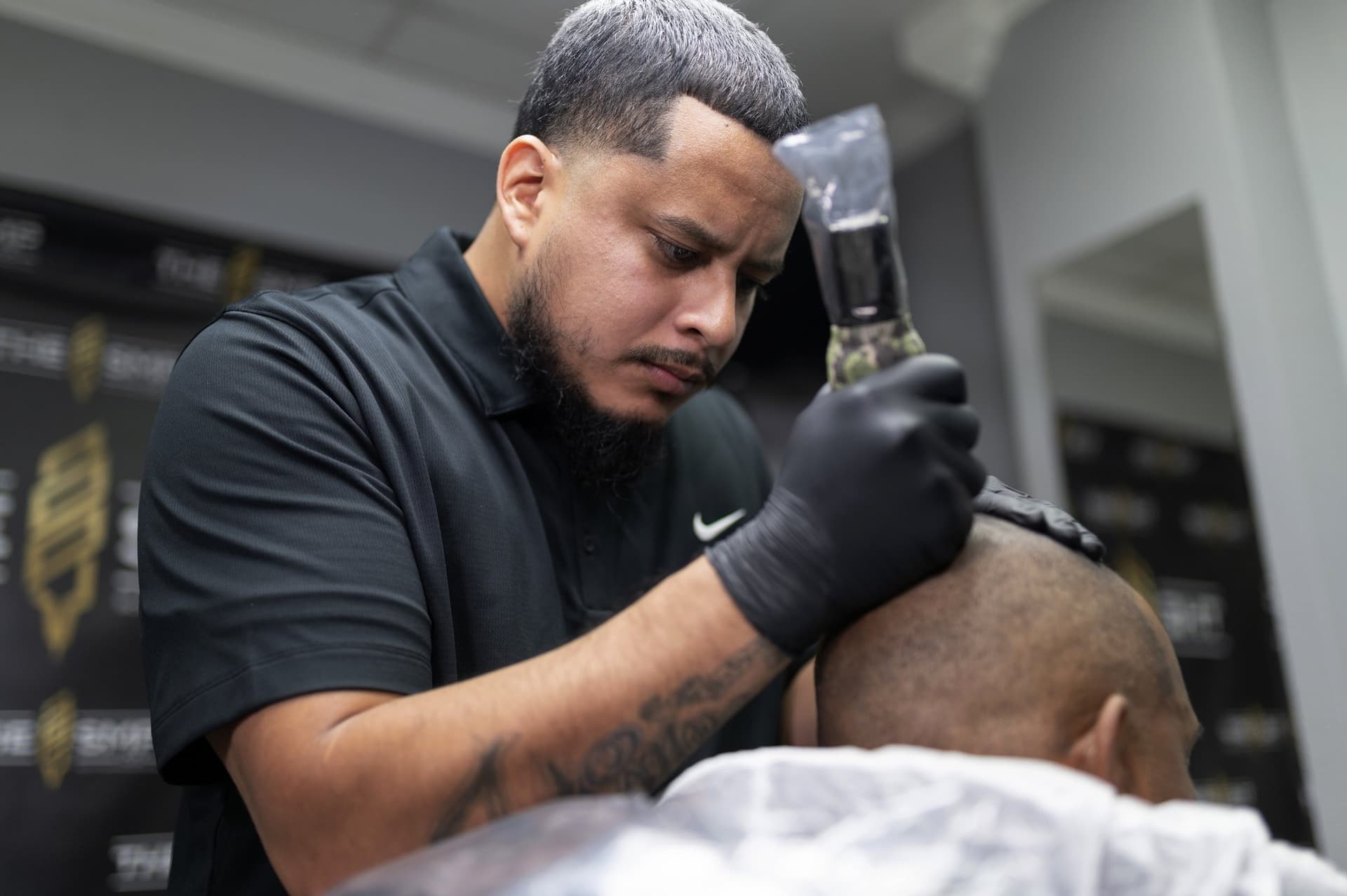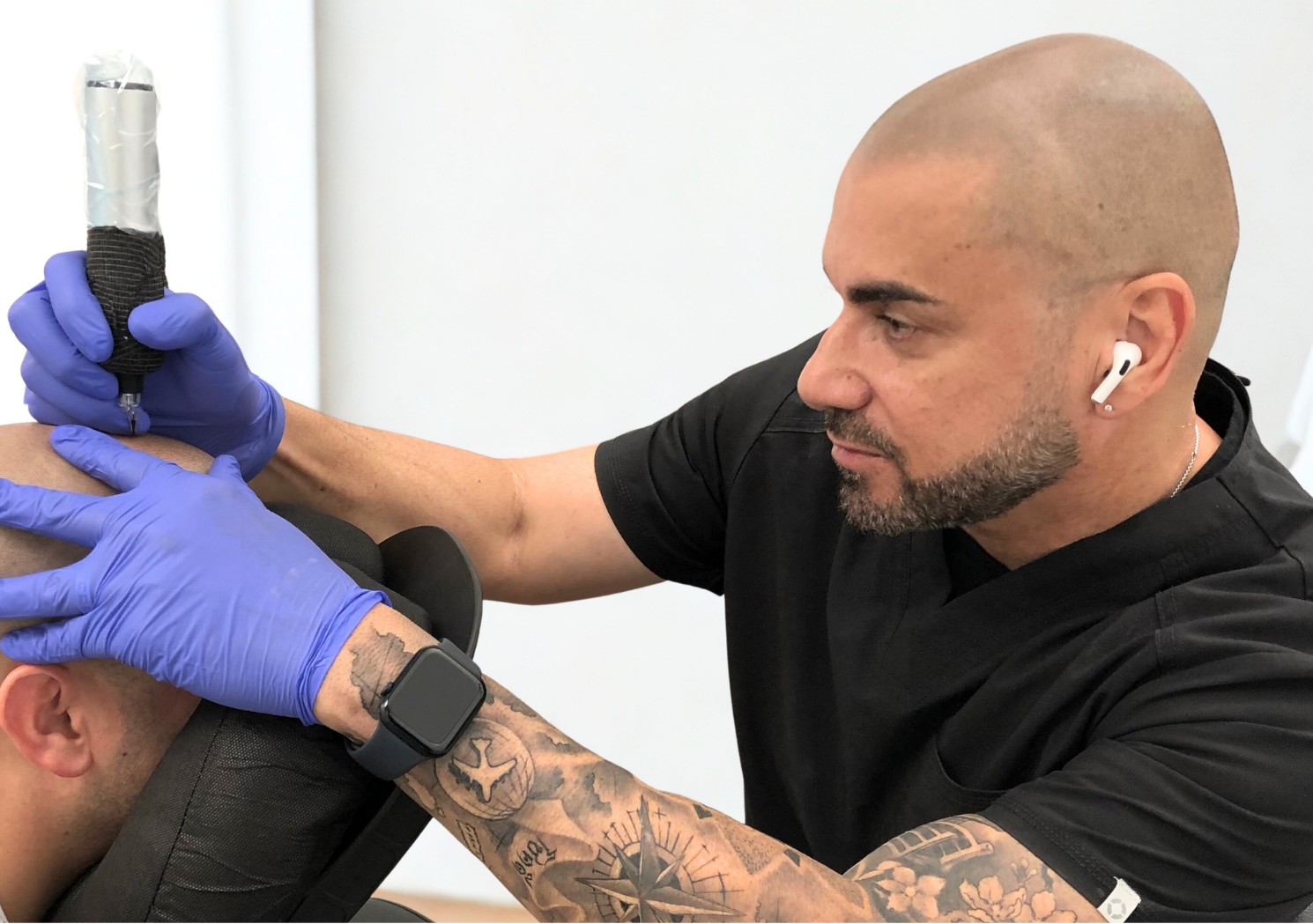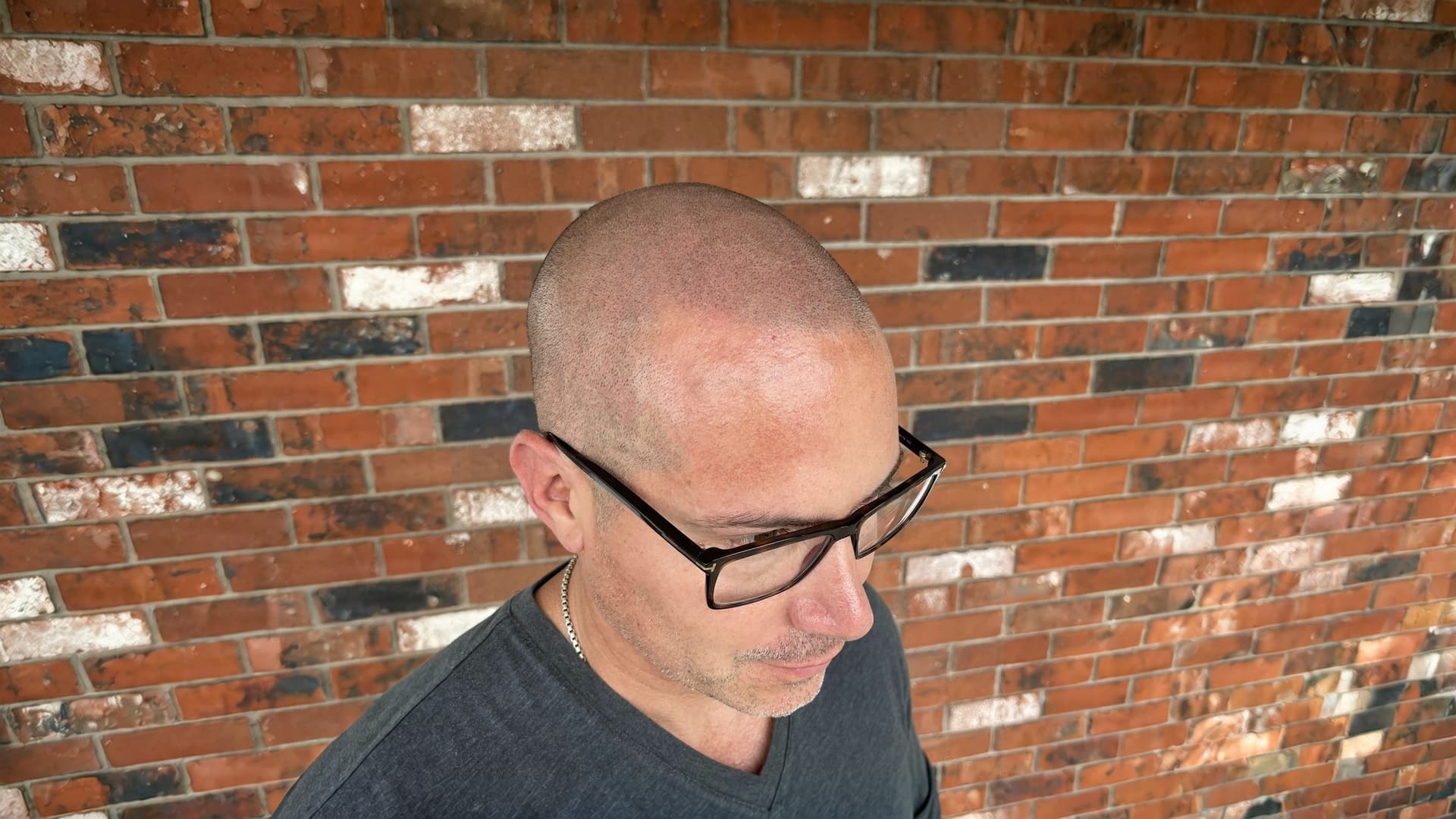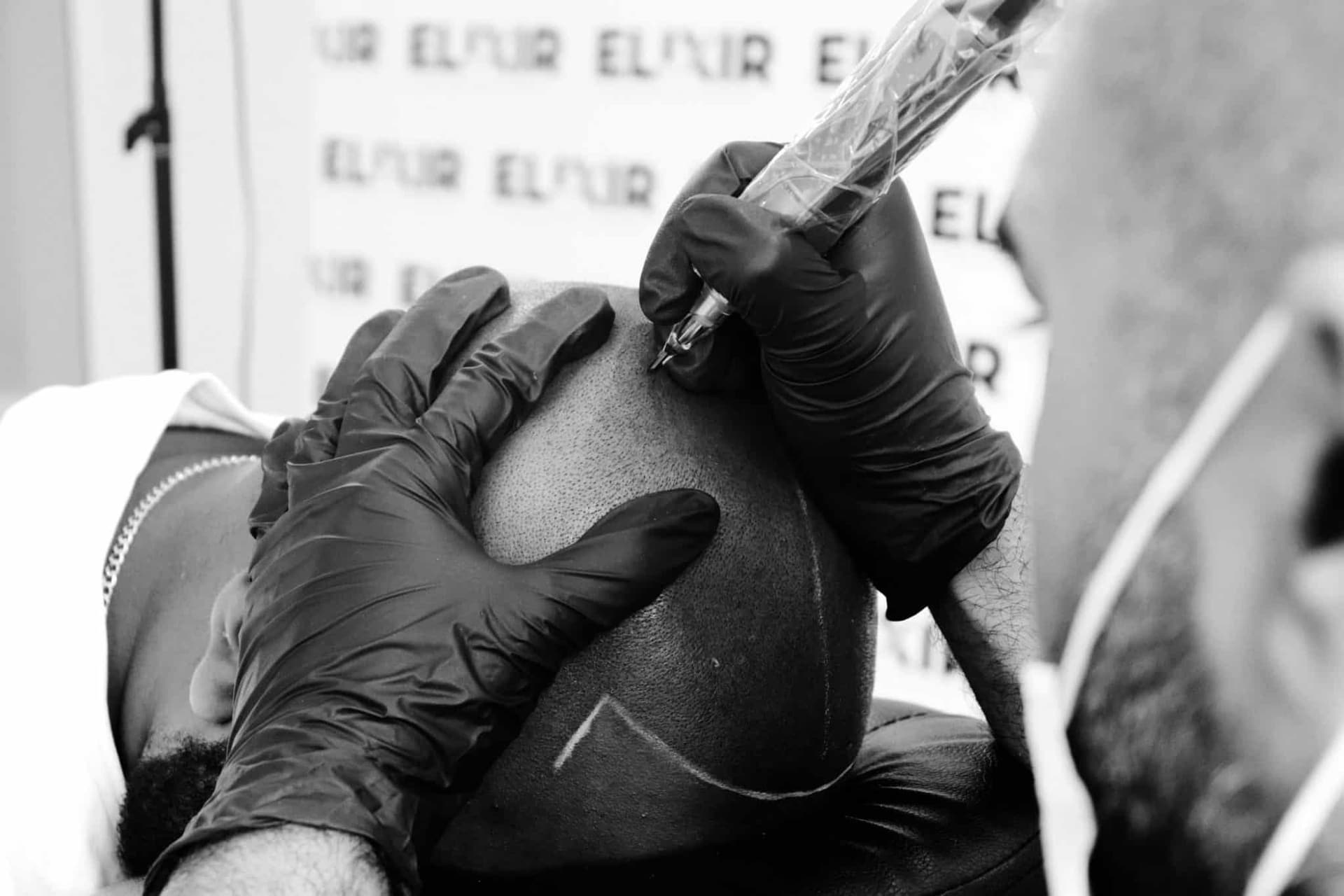
The appointment is the easy part. The days after it decide how your dots heal, how sharp they stay and how much of your first session survives to the second. In 17 years in scalp micropigmentation and permanent makeup, the aftercare questions I have heard are almost always the same: when can I wash, when can I train, when can I shave and is this normal. This guide answers them in the order you will actually meet them, day by day.
Two ground rules before we start. First, your own artist's instructions come first, because they know the pigment, needle and depth they used on you. Second, this is general information, not medical advice: if something looks wrong, see a doctor or a dermatologist rather than waiting it out. If you are still deciding on treatment, start with the complete guide to scalp micropigmentation.
How a tattooed scalp heals
Scalp micropigmentation is a tattoo, just a very fine and very repetitive one. A 2022 case report in Skin Appendage Disorders describes SMP pigment sitting in the upper dermis (Nguyen et al., 2022). The same report notes that pigment placed too shallow is lost with the outer layer of skin, and pigment placed too deep can spread and look blotchy. Aftercare cannot fix depth, but it can stop you losing good pigment for bad reasons.
Each dot is a tiny puncture, and a full session can mean a lot of them: one SMP paper describes more than 40,000 needle points in a session (Rassman et al., 2015). Your scalp treats all of that as a wound. It goes red, it may swell a little, it weeps a small amount of clear fluid, then it forms fine crusts that flake away as new surface skin grows over the pigment.
What the SMP research describes
The Rassman paper gives a useful picture of the early course. Redness appears on the day of treatment and settles within 1 to 2 days. Some surface ink washes out at the first hair wash, at 2 to 3 days. Pigment then gathers in the dermis between days 7 and 13, and at one month some ink is still being cleared out through the upper skin. The 2022 case report adds that pain, swelling and redness can last several days.
Why body tattoo timelines still matter
For deeper healing, the general tattoo guidance applies. Cleveland Clinic says the top layer of skin is usually healed by around two months, while deeper layers can take several more months (Cleveland Clinic, 2026). Your scalp will look and feel normal long before that, but the skin underneath is still settling. That is why I treat the first month as the strict period and the next few months as the careful period.
The first seven days, day by day
This is the table most people come looking for. It assumes a standard SMP session on a shaved or closely cut scalp. If your artist's sheet says something different, follow the sheet. A 2023 study of 700 American tattoo aftercare instructions found they varied tremendously in content (Liszewski et al., Dermatology, 2023), so differences between artists are normal and not a sign anyone is wrong.
| Day | Do | Avoid | Normal |
|---|---|---|---|
| Day 0 (session day) | Go home with a loose, clean hat if you need shade. Sleep on a fresh pillowcase. | Water, sweat, touching, tight hats | Redness, mild swelling, tenderness, dots look dark and crisp |
| Day 1 | Keep the scalp dry. Blot any weeping with clean tissue. | Gym, direct sun, scratching | Redness fading, tight feeling |
| Day 2 | Stay dry. Wash your hands before any touch. | Showering your head, steam, hot baths | Fine crusts start forming on the dots |
| Day 3 | First gentle rinse, if your artist allows: lukewarm water, fragrance-free cleanser, pat dry. | Scrubbing, hot water, medicated shampoo | A little pigment rinses off in the first wash |
| Day 4 | Gentle wash once a day. Water-based moisturizer only if tight and your artist agrees. | Picking, pools, heavy sweat | Itch and light flaking |
| Day 5 | Light activity that keeps you cool, if your artist agrees. | Razor on the treated area, sun | Flakes lifting from the dots |
| Day 6 | Keep washing gently. Change your pillowcase. | Sauna, steam room, hot tub | Dots look patchy as crusts drop |
| Day 7 | Ask your artist about shaving and training. | Exfoliants, retinoids, tanning | Flaking settling, dots softer and lighter than day 0 |
The core aftercare steps
If you only remember one part of this guide, make it this list. It applies after every session, not only the first.
The core aftercare steps
- Keep the treated scalp dry until your artist clears your first wash.
- Wash your hands before you touch your scalp, every single time.
- Blot any fluid with clean tissue. Never wipe or rub.
- Make each early wash gentle: lukewarm water, a mild fragrance-free cleanser, fingertips only, then pat dry.
- Keep sweat, steam, pools, hot tubs and the sea away from your scalp until it has healed.
- Keep the sun off with a loose, clean hat or shade, and put no sunscreen on unhealed skin.
- Leave every crust and flake to fall off on its own.
- Keep razors off the treated area until flaking has finished and your artist agrees.
- Keep exfoliating acids, retinoids, petroleum jelly and scented products off your scalp until it has healed.
- Watch for signs of infection or allergy, and see a doctor promptly if any appear.
- Once healed, wear broad-spectrum SPF 30 or higher, or a hat, every time your scalp is outdoors.
The surprising one for many people is step 2. The 700-instruction study found that few aftercare sheets told people to wash their hands before touching a healing tattoo (Liszewski et al., 2023). Your hands touch everything. Your fresh scalp should not have to deal with all of it.
Washing: when, how and with what
This is where SMP differs most from body tattoo advice. Cleveland Clinic's tattoo aftercare tells you to wash a new tattoo twice daily with a mild, fragrance-free soap and warm water, then pat dry. SMP aftercare usually delays that first wash for a few days, and the Rassman paper describes the first hair wash at 2 to 3 days. The reason is practical: the dots are small and the pigment near the surface is easily lifted while the skin is still open.
The first wash
When your artist gives the go-ahead, keep it short and gentle. Lukewarm water, not hot. A small amount of mild, fragrance-free cleanser with no dyes, worked in with fingertips, never nails. Let the water run over your head rather than aiming a strong shower jet at it. Pat dry with a clean paper towel or a fresh towel kept for your head only.
Some pigment in the rinse water is expected. The Rassman paper notes that surface ink washes out at the first hair wash. That is the shallow ink you were always going to lose, not your result disappearing.
Days 4 to 14
From here a gentle daily wash keeps the area clean and stops crusts building up. Cleveland Clinic also advises a simple moisturizer for healing tattoos to stop drying and cracking. On the scalp, I would only add one if your skin feels tight or itchy and your artist agrees. If you do, the American Academy of Dermatology suggests a water-based lotion or cream for dry tattooed skin and warns that petroleum-based products can fade ink (AAD, caring for tattooed skin).
What to wash with
What I look for in a healing-scalp cleanser
- Mild and fragrance-free, with no perfumes or dyes, which is the standard Cleveland Clinic gives for healing tattoos.
- No exfoliating acids, such as glycolic, lactic or salicylic acid, while the skin is healing.
- No medicated dandruff actives until healed, unless a doctor has prescribed them for a scalp condition.
- A formula you have used before without irritation, so a fresh scalp is not the first test.
Sweat, the gym and swimming
These are the questions people ask most, because they are the habits people least want to give up. The rules are short, and the logic behind them matters more than the exact day count.
Sweat and training
Sweat is salty, sits right on the treated skin and arrives at exactly the time you are told not to wash your head. That is the whole problem. I tell people to avoid anything that makes them sweat hard for roughly the first week, and to check with their artist before returning to full training.
Gentle walking in cool conditions is usually fine. Hot classes, heavy lifting, running in the heat and sports where you wear a helmet are the ones to pause. If you do sweat by accident in the first days, blot your scalp with clean tissue, do not rub, and mention it to your artist if irritation follows.
Swimming, baths and hot tubs
Cleveland Clinic advises against submerging a healing tattoo in hot tubs, bathtubs or pools until it is fully healed. I apply the same rule to the sea and lakes. Long soaks in water soften the crusts before they are ready to come off, and the water itself is not clean. Saunas and steam rooms belong in the same group, because heat and moisture together do the same job as sweat.
Once you are healed and back in the water, sunscreen matters more than ever. The AAD advises reapplying immediately after swimming or sweating (AAD, how to apply sunscreen).
Sun and SPF
Sun is the long-term enemy of SMP. The Rassman paper notes that ultraviolet exposure can speed up color changes. A proper carbon SMP pigment does not change color over time; a blue or green look comes from the wrong product, such as tattoo ink, or from pigment placed too deep, and sun makes any fading or blurring show sooner. A shaved scalp is one of the most sun-exposed parts of the body, so this section is the one that protects your result for years.
While you are healing
Do not put sunscreen on unhealed skin. Cleveland Clinic says not to apply sunscreen to a tattoo until it has fully healed, and a 2020 dermatology editorial on tattoo aftercare says the same, describing a healing period of 1 to 3 weeks (Gonzalez et al., 2020). Instead, stay in the shade and use a loose, clean, breathable hat when you have to be outside.
Once you are healed
From that point, protect your scalp every day it is outdoors. The AAD recommends a broad-spectrum, water-resistant sunscreen with SPF 30 or higher on a thinning or bare scalp, and notes that powder or spray sunscreens are easier to apply there (AAD, how to treat dandruff).
Sun habits that protect SMP
- SPF 30 or higher, broad-spectrum and water-resistant, as the AAD recommends.
- Applied about 15 minutes before you go outside, so it is on before the sun is.
- Reapplied every two hours, and straight after swimming or sweating.
- A wide-brimmed hat when you will be out for long stretches, which the AAD lists as an alternative for thinning hair.
- No tanning beds or sunlamps; the AAD says they can fade tattoo ink.
Shaving after SMP
Most SMP clients keep their head shaved or closely clipped, so this matters. A razor dragged over fresh crusts pulls them off early, and a crust pulled off early can take pigment with it.
My rule is simple: no blade on the treated area until the crusts and flakes have come off on their own and your artist has cleared you. For many people that lands somewhere around the end of the first week or into the second, but your skin decides, not the calendar. If your hairline area is still flaking, it is not ready.
How I tell people to shave the first time
- Start with clippers or a foil shaver, not a blade.
- Use clean equipment and a fresh blade when you do return to razors.
- Shave with the grain, with light pressure and a simple, fragrance-free shave gel.
- Stop if the skin stings, bleeds or looks raw, and give it more days.
- Rinse with cool water and pat dry, then leave the scalp alone.
Short hair growing through your SMP is not a problem during healing. Keeping the look matched is a job for later, once the skin is calm. If you are unsure how your hair length affects the look, the how long SMP lasts guide covers that.
Sleeping and hats
Nights are when people scratch without knowing it, and pillowcases collect oil, sweat and skin. Neither is a disaster, but both are easy to manage in the first week.
Sleeping
Use a fresh, clean pillowcase on the night of your session, and change it often for the first week. A dark pillowcase saves stress, because slight weeping in the first days can mark the fabric and Cleveland Clinic lists slight oozing among the normal signs of healing. If you can, sleep on your back to limit rubbing. If you are a side sleeper, do not panic; just avoid pressing your face into the pillow and rolling the treated area.
Hats
A hat is your best sun protection while sunscreen is off limits, so it is a tool, not a risk. The rule is loose, clean and breathable. Cleveland Clinic advises loose, breathable fabric over a healing tattoo and avoiding tight clothing until healed. I read that as no tight beanies, compression caps or helmets for the first week or so, and a freshly washed cotton cap if you need one.
Products to keep off a healing scalp
A healing scalp has one job, and most of your bathroom cabinet makes that job harder. Here is what I would put away, and why.
| Product | Why it waits | When to restart |
|---|---|---|
| Exfoliating acids (glycolic, lactic) | Shed surface skin and raise UV sensitivity | After full healing, with daily sun protection |
| Retinol and other retinoids | Dryness, peeling; not for broken or irritated skin | After full healing; ask your doctor if prescribed |
| Petroleum jelly | Can block pores; petroleum products may fade ink | Not needed for SMP |
| Coal tar shampoo | Can make the scalp more sun sensitive | After healing, with good sun cover |
| Fragranced or dyed products | Common irritants on fresh skin | After healing, if they never bothered you before |
| Sunscreen | Not for unhealed tattoo skin | As soon as you are fully healed, then daily |
Exfoliants
The FDA describes alpha hydroxy acids, mainly glycolic and lactic acid, as products that cause shedding of the surface skin. Its cited studies found that after four weeks of use, sensitivity to UV reddening rose by 18 percent and sensitivity to UV cell damage roughly doubled on average, with the effect wearing off about a week after stopping (FDA, alpha hydroxy acids). On a fresh SMP scalp that is two problems at once: deliberate shedding of the layer that is healing, and more sun sensitivity on skin that already needs protecting.
Retinoids
Cleveland Clinic lists dry, irritated, peeling skin and sunburn among retinol's side effects, says it makes skin more sensitive to sunlight, and advises avoiding retinol products on sunburned, broken or irritated skin (Cleveland Clinic, retinol). A fresh SMP session is broken skin by definition. If a doctor prescribed a retinoid or medicated scalp treatment for you, ask them how to time it around your sessions rather than simply stopping on your own.
Petroleum jelly and heavy ointments
Cleveland Clinic suggests avoiding petroleum jelly on healing tattoos because it can block pores and may increase bacteria and inflammation. The AAD separately notes that petroleum-based products can fade ink. On a scalp, a heavy ointment also traps sweat and oil under a film. If your artist recommends a specific aftercare product, use theirs and nothing extra.
What is normal and what is not
Most people worry about normal healing and miss the signs that matter. The two lists overlap in places, so the useful question is not "is it red?" but "is it getting better or worse?"
| Sign | Usually normal | Get it checked |
|---|---|---|
| Redness | Early, then fading | Darkening, spreading, or red streaks |
| Swelling | Mild, over the first several days | Increasing after the first week |
| Fluid | Slight clear weeping early on | Pus, odor or heavy drainage |
| Itch and flaking | Common in the first two weeks | Worsening itch, bumps, blisters |
| Pain | Tender, improving each day | Getting worse instead of better |
| How you feel | Well | Fever, chills or skin hot to touch |
What normal looks like
Cleveland Clinic lists itching, flaking, scabbing, slight oozing, soreness and redness as normal signs of healing, especially in the first two weeks. UPMC adds that swelling and redness are expected after ink is injected (UPMC HealthBeat, 2024). On a scalp, you can add one more: dots that look darker and sharper at first, then lighter and patchier as crusts fall, then more even as the skin settles.
Signs of infection
The AAD says an infection can show immediately or days to months later, and lists redness that darkens or spreads, worsening pain, itchy red painful bumps, fever, chills, pus and open sores (AAD, tattoo skin reactions). Cleveland Clinic adds skin that feels hot, odor or significant drainage, and red streaks running from the area. UPMC notes that symptoms getting worse after two weeks instead of better may point to infection. The Rassman paper also lists non-tuberculous mycobacterial infections, linked to contaminated inks or unsafe practice, among possible SMP complications.
If you see these signs, see a doctor or board-certified dermatologist promptly, not just your artist. The AAD says earlier treatment limits damage to both your health and your tattoo.
Signs of an allergic reaction
Allergic reactions to tattoo pigments are rare, according to the FDA, but they can be hard to deal with because pigment is hard to remove (FDA fact sheet). The AAD lists redness, swelling, itch, bumps, scaly patches, deep lumps, blisters, crusting and watery fluid, and notes that red ink is most often the culprit. A 2014 review found blue, green and black pigments cause allergy less often than red (Bassi et al., 2014), which is reassuring for SMP's carbon black pigment, though less often does not mean never.
For a mild or moderate reaction, the AAD says to tell your artist and see a board-certified dermatologist if it lasts more than 1 to 2 weeks. Reactions can also appear years later, so a change in an old SMP area is worth showing a dermatologist too.
Emergency signs: call 911 or your local emergency number
- Trouble breathing or tightness in the chest.
- A racing heart, dizziness or a sudden stomachache.
- Intense swelling, flushing or hives spreading across the face or body.
- Severe pain that comes on fast.
Weeks 2 to 4
By the second week most people feel normal and want their life back. Mostly they can have it, with three exceptions that run until the skin has fully healed: water you soak in, sun on unprotected skin, and anything that exfoliates.
| Week | Do | Avoid | Normal |
|---|---|---|---|
| Week 2 | Normal gentle washing. Clippers, training once flaking ends and your artist agrees. | Pools, hot tubs, sea, sun on bare scalp | Dots lighter, softer or uneven |
| Week 3 | Back to your usual shave with clean equipment if the skin is calm. Moisturize if dry. | Scrubs, peels, retinoids, acids | Some dots faded more than others |
| Week 4 | Ask your artist if you are healed for swimming and daily SPF. Confirm your next session. | Tanning beds, sunburn | Healed look settling; judge the result now |
Why the dots look uneven now
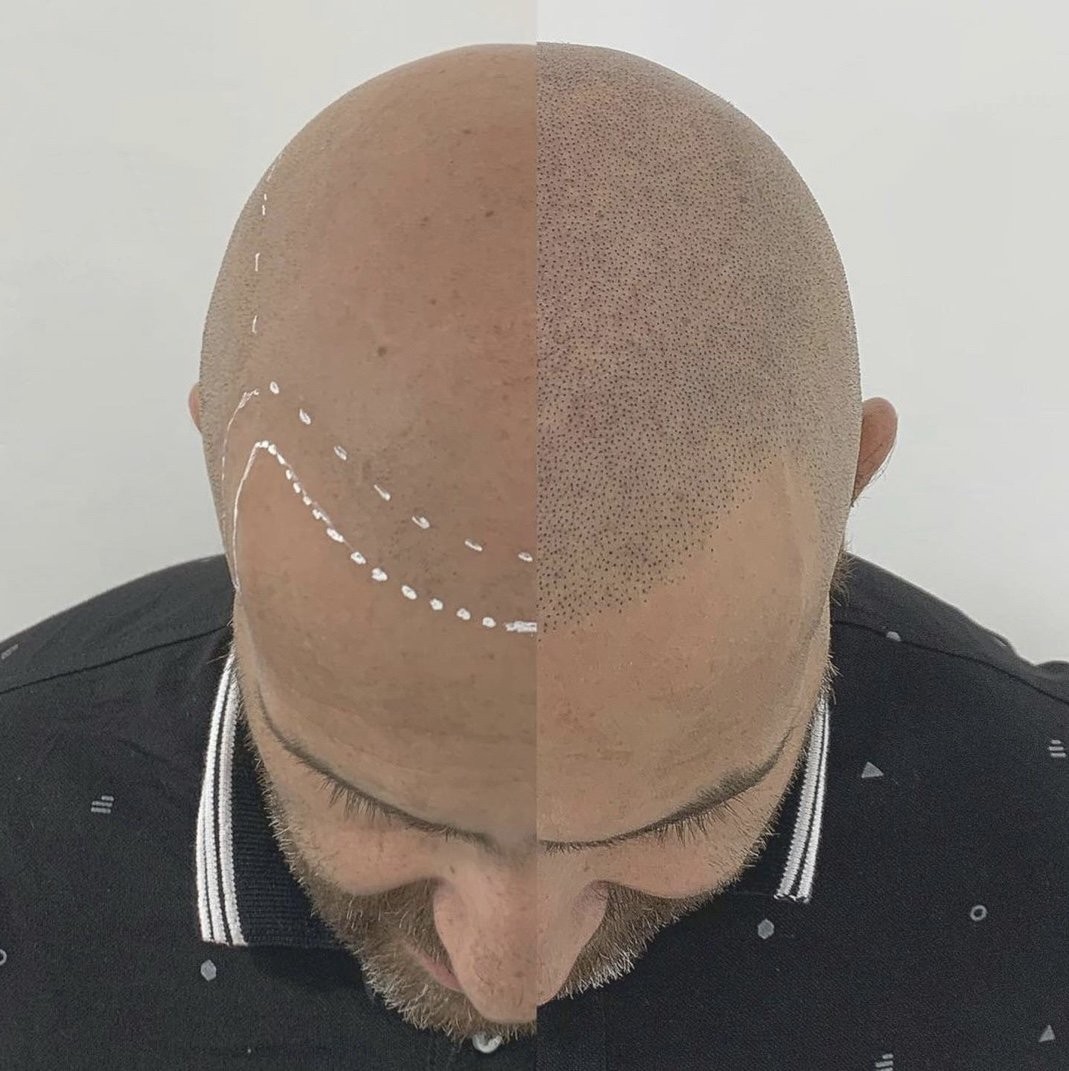
Weeks 2 and 3 are when people panic, because the scalp can look patchy. Some dots kept more pigment than others, and some surface pigment has been shed. That is why SMP is planned as a series: the Rassman paper says many patients have two to four sessions before the process is complete. That patchiness is what the next session is for.
Aftercare between sessions
SMP is usually a series, not a single visit, and the Rassman paper describes follow-up touch-ups as an important part of the service. Each session is a new wound, so the full aftercare starts again from day 0 every time.
Between sessions, I tell people to
- Repeat the full first-week routine after every session, even if the second one feels lighter.
- Keep the scalp out of the sun completely, because UV can fade and soften the dots and your artist will be matching to what they see.
- Avoid starting any new scalp product, so a reaction is easy to trace.
- Note anything odd, such as a single area that healed very light or a spot that stayed red, and tell your artist.
- Turn up to the next session with a healthy scalp: no sunburn, no active irritation, no fresh shave cuts.
Your artist sets the gap between sessions based on how you healed, so I will not give you a number here. What I will say is that a scalp that is sunburned, peeling from an exfoliant or freshly nicked is a poor surface to work on. If you are unsure whether you are ready, ask. For what a top-up involves later on, the SMP touch-ups guide goes into detail.
Long-term care to slow fading
Once you are fully healed, aftercare becomes maintenance. SMP fades over time, which is why the Rassman paper treats touch-ups as part of the service. Your habits decide how fast that happens and how even it stays.
Sun is the big one
Every point in the sun section still applies, for life. The AAD warns that UV light can fade some inks and recommends broad-spectrum, water-resistant SPF 30 or higher, reapplied at least every two hours. For a shaved head, the simplest habit is a powder or spray sunscreen kept by the door and a hat in the car or bag.
Skin care and scalp health
Once healed, you do not need to avoid every active forever. But regular exfoliating acids increase sun sensitivity, as the FDA notes, so if you use them on your scalp, your sun protection has to keep up. If you have a scalp condition such as dandruff or psoriasis, treat it with your doctor's advice; a healthy scalp holds a better-looking result than an inflamed, flaking one. The AAD notes that tattoos can make it harder to spot early skin cancer, so check your scalp, or have someone check it, and show a dermatologist anything new.
Medical scans
The FDA reports that some people with tattoos or permanent makeup have had swelling or burning in the area during an MRI, which is rare and appears to have no lasting effects. Do not avoid a scan you need. Tell the radiologist or technician about your SMP beforehand, and the AAD advises asking them to stop if you feel burning or stinging.
If your result fades fast or unevenly despite good care, that can point to technique rather than aftercare. The guides on how long SMP lasts and botched SMP explain what to look for. And if you are reading this before your first session and wondering about the needle itself, see does SMP hurt.
Aftercare checklist
Here is the whole guide as one checklist.
SMP aftercare checklist
- Day 0 to your first wash: scalp dry, hands clean, no touching, no sweat.
- First wash: lukewarm water, fragrance-free cleanser, fingertips, pat dry.
- Every day of week one: fresh pillowcase, loose hat for shade, no picking.
- Until your artist clears you: no gym sweat, sauna, steam or helmets.
- Until fully healed: no pools, hot tubs, baths or sea.
- Until fully healed: no sunscreen on the scalp, so shade and a hat instead.
- Until flaking finishes: no razor; start with clippers or a foil shaver.
- Until fully healed: no acids, retinoids, petroleum jelly or scented products.
- Every day: is it better than yesterday? If worse, see a doctor.
- After every session: start the list again from the top.
- For life: SPF 30 or higher or a hat, reapplied every two hours outdoors.