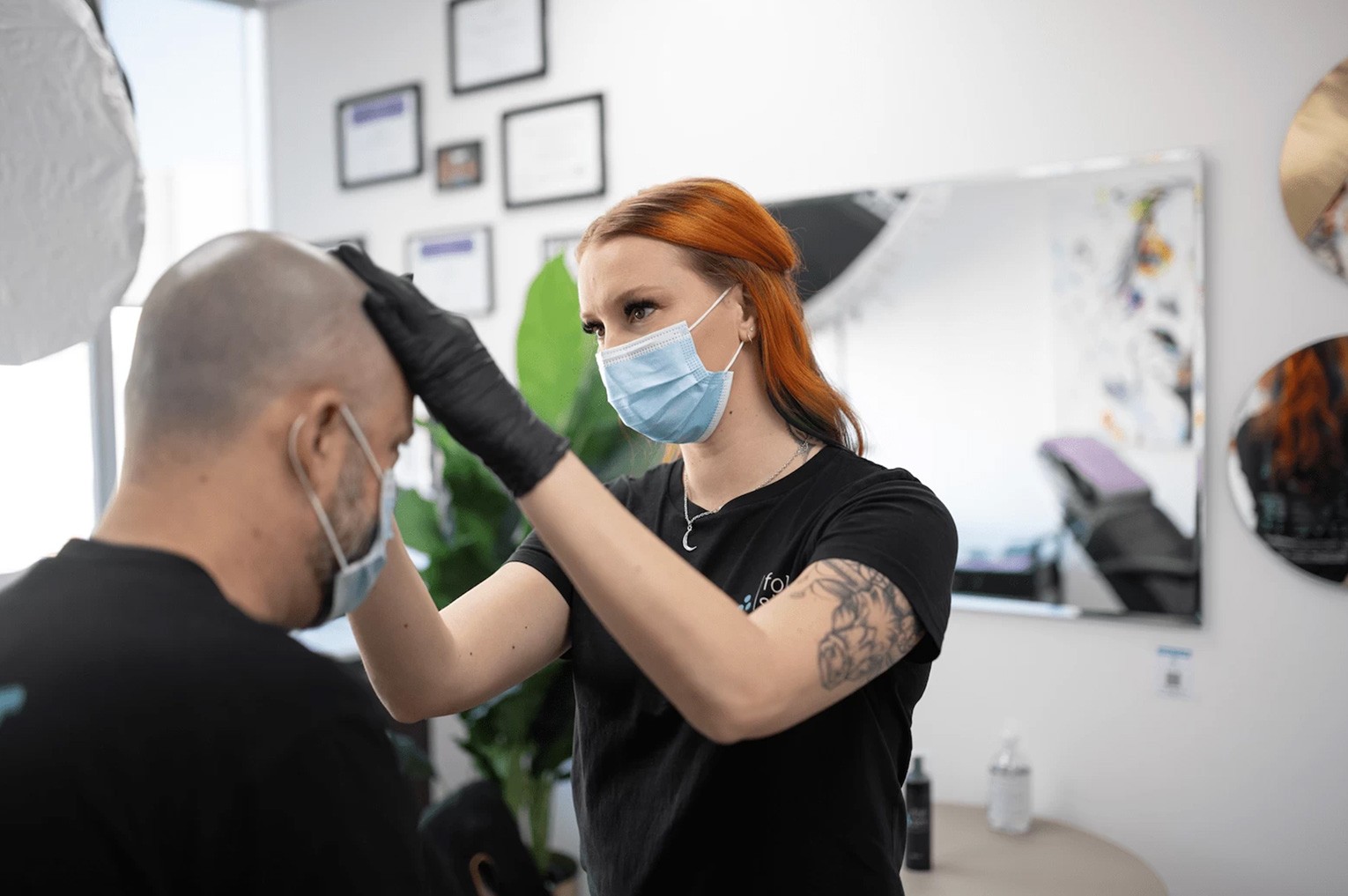
When SMP goes wrong, it rarely goes wrong quietly. Dots that are too big, a color that has drifted blue, a hairline that sits like a line drawn with a ruler: you see it every time you pass a mirror. I have spent 17 years in scalp micropigmentation and permanent makeup, so this guide covers what botched work looks like, what causes each problem, and what can realistically be done about it. Most of it can be improved. Not all of it can be erased.
What botched scalp micropigmentation looks like
Good SMP should read as a close shave from a normal talking distance. Botched SMP reads as a tattoo, a shadow or a helmet. The problems below are the ones people most often describe, and each one has a different cause and a different fix, which is why naming the problem correctly is the first step.
The common signs of botched SMP
- Dots too large: each impression is clearly bigger than a real hair follicle, so the scalp looks dotted rather than shaved.
- Blowouts and spreading: dots have blurred at the edges or merged, giving a smudged, soft-focus look up close.
- Too dark: the treated area is darker than the hair around it and looks painted on.
- Blue or green shift: the dots have taken on a cool tint that real stubble never has.
- Wrong or unnatural hairline: too low, too straight, too sharp, or the wrong shape for the face.
- Patchiness: uneven density, with thin areas or blotches that stand out.
- Visible lines or grids: dots placed in rows, so you can see a pattern when the light catches it.
- Mismatch with real hair: the SMP and the hair you still have look like two different colors or two different lengths.

Size, spreading and darkness are linked
These three often show up together. Dermatologists at the University of Miami described healthy SMP on trichoscopy (a magnified scalp exam) as gray to black round dots that are evenly spaced and appear larger than the neighboring hair follicles (Nguyen et al., Skin Appendage Disorders, 2022). So even good dots are a touch larger than follicles under magnification. The trouble starts when they are visibly larger at arm's length, because bigger dots also read as darker.
Hairline and pattern problems
A hairline is design, not ink. A hairline has to suit the face, the age and the way the hair would have receded naturally. A hairline that is too low or too straight looks wrong even when every dot is perfect. Grids and rows are the same kind of error: the dots may be fine, but the placement gives the game away.
Healing or botched? Give it time before you judge
A lot of panic happens in the first two weeks, and some of it is misplaced. Fresh SMP always looks darker and sharper than healed SMP. The 2015 paper by Rassman and colleagues explains that surface ink washes out at the first hair wash, around 2 to 3 days in, and that the result keeps changing over the following weeks and months (Rassman et al., 2015). The same paper notes that many patients need two to four sessions before the process is complete, so an unfinished first session can look patchy by design.
That said, some things are not healing and will not settle. The table below separates the two.
| What you see | Usually normal healing | Likely a real problem |
|---|---|---|
| Darkness | Dark for the first days, then softens | Still darker than your hair once healed |
| Patchiness | Uneven after session one of several | Patchy after the final session |
| Blurring | Slight softness as skin settles | Dots merging or spreading wider |
| Color | Fresh dots look very black | Healed dots look blue, green or reddish |
| Skin | Mild redness for a few days | Not healing, rash, pus or fever |
If your concerns are about appearance and your next session is already booked, raise them with your artist at that appointment. The deeper look at how SMP changes over time is in how long SMP lasts.
Why SMP goes wrong: the causes
SMP looks simple from the outside: dots on a scalp. In practice it depends on depth, needle, pigment, design and aftercare all being right at once. Get one of them wrong and you see it in the healed result.
Needle depth
Depth is the big one. Rassman and colleagues describe how the needle must pass through the epidermis into the upper dermis (Rassman et al., 2015). Too shallow, and the pigment leaks out within days, so the work fades or looks patchy. Too deep, and the pigment diffuses outside the area where it was placed, which is the blurred, spreading look people call a blowout. The same paper notes that depth is judged by feel and by eye, which is exactly why experience matters.
Needle size and dot size
Dot size is a choice, not an accident. Rassman's paper notes that dot size varies with the artist's judgment and that dot size controls how dark the result looks. A needle that is too large for the hair it is copying, or a heavy hand, gives you oversized impressions that read as dots rather than stubble. Scalp skin also varies: what is right on the crown may be too much at a soft hairline.
Pigment choice
Color problems usually trace back to the product or the depth. Rassman's paper states plainly that color changes from poor pigment choices are common, warns that there may be a blue or green tint, and notes that some pigments can change color with direct ultraviolet light. A proper SMP pigment is carbon based (carbon black in a carrier), the ISHRS says the preferred SMP pigment is carbon only, and it does not change color over time. A broader review of micropigmentation in the Indian Dermatology Online Journal notes that iron oxide pigments can produce undesirable reddish or bluish tones (Kerure et al., 2023), and iron oxide pigments belong to permanent makeup, not SMP. So a blue, green or reddish cast usually means the wrong product (a tattoo ink or a permanent makeup pigment) or carbon placed too deep, where light scattering makes it look blue. Pigment that is too dark or not diluted for your skin tone is another route to the painted-on look.
Design and technique
This is where hairlines, grids and mismatches come from. A good artist designs the hairline before touching a needle, matches the shade to your existing hair, and places dots irregularly so no pattern shows. Rushed or formulaic work skips those steps. In my view, technique can be learned far faster than judgment about faces and hairlines.
Who did the work
Two Korean studies hint at where problems come from, though neither can show that salon work goes wrong more often than clinic work. In a 2024 series of 120 SMP corrections from clinics in Seoul, 107 of 120 patients (89.2%) had their original SMP done at a tattooing or cosmetic facility at a beauty salon, 12 (10.0%) at another clinic and one at an oriental medicine clinic (Park et al., International Journal of Dermatology, 2024). Rassman and colleagues wrote in 2015 that there were no formalized training programs and reported an increasing number of problems caused by novices, including pigment bleeding and color problems.
A 2025 survey of dermatology outpatients in South Korea found only five people who had had SMP, all in non-medical settings. One or two of the five were dissatisfied (the paper gives both figures), and two reported a change in the shape and color of the tattoo (Kim and Kim, Annals of Dermatology, 2025). Five people is far too few to draw a rate from, and the authors say so, but it fits the wider picture.
Healing problems
Aftercare matters too. Rassman's paper lists poor post-procedure follow-through alongside poor pigment choice as a cause of color changes, and names infection, allergic reactions and granulomas among the risks. The micropigmentation review describes blurring from color leaking out of the original site as a late effect. Picking, sun and sweating into a healing scalp all raise the odds of a poor result. Our SMP aftercare guide covers the healing window in detail.
| Finding | Number | Share |
|---|---|---|
| Original SMP done at a salon or tattoo facility | 107 | 89.2% |
| Corrected with hair transplant surgery | 74 | 61.7% |
| Hair transplant plus new SMP | 25 | 20.8% |
| Laser removal, then SMP redone | 16 | 13.3% |
| Laser removal only, no new SMP | 5 | 4.2% |
| Average patient satisfaction after correction | 4.5 out of 5 | n/a |
Note that these categories overlap in the published abstract, so they do not add up neatly to 120. The point that matters is the conclusion: the authors found that satisfactory results can be achieved through appropriate revisions by highly experienced medical professionals.
The fix-by-problem table
This is the part most people want. Each problem has a usual cause and a usual route to correction. The table is a starting map, not a diagnosis: the right plan depends on how dark, how big and how widespread the problem is on your scalp, and a correction specialist needs to see it in person.
| Problem | Likely cause | How it is corrected | Realistic outcome |
|---|---|---|---|
| Dots too large | Needle too big, too much pressure or pigment | Laser lightening, then finer dots added between | Often much improved; several sessions |
| Blowouts, spreading | Needle too deep | Laser lightening or removal, then redo | Improves; some blur may remain |
| Too dark overall | Pigment too dark or too dense | Laser lightening | Usually good once lightened |
| Blue or green shift | Wrong product (tattoo ink or PMU pigment), or pigment placed too deep | Laser lightening, then redo with a carbon SMP pigment | Often good; can take several sessions |
| Hairline too low or harsh | Poor design | Laser the front edge, then redesign | Good when the new line is placed well |
| Hairline too high or thin | Too cautious design | Add new work to bring it forward | Usually good, no laser needed |
| Patchy density | Unfinished sessions, poor healing | Extra SMP session to even out | Usually very good |
| Visible lines or grids | Dots placed in rows | Irregular dots added; laser if dense | Good if the rows are light |
| Mismatch with real hair | Wrong shade or style for your hair | Lighten, re-match shade, or change haircut | Varies with the hair you have |
Why lighter pigment cannot cover darker pigment
People often ask why their artist will not just go over the bad work. SMP pigment is not paint on a wall. New dots sit beside old dots in the skin, not on top of them, so lighter pigment cannot hide darker or bigger impressions. That is why anything too dark, too big, blurred or blue usually needs lightening first. Adding more work is a fix only for problems of too little: thin density, a hairline that is too high, or gaps between rows.
Correction option 1: laser lightening or removal
Laser is the main tool for taking pigment out. Cleveland Clinic explains that lasers heat ink particles and break them into smaller fragments, which the body then clears, and that the skin needs time between sessions to flush out ink and heal (Cleveland Clinic).
Q-switched and picosecond lasers
Two families of laser come up in SMP correction. Q-switched lasers (also called nanosecond lasers) have been used on SMP for years: Rassman and colleagues describe pigment bleeding that may need correction with a Q-switched laser before the next phase, and show a case treated with a Q-switched laser and then redone.
Picosecond lasers fire much shorter pulses. In 2020 a laser dermatology practice in San Diego reported four patients with undesirable SMP treated with a 1064 nm picosecond Nd:YAG laser after local anesthesia. Clearance was achieved within 1 to 3 sessions in all four, with no unexpected adverse events, and patients were reviewed 3 to 4 weeks after each session (Wu, Lasers in Surgery and Medicine, 2020). The author concluded that it typically needs fewer sessions than traditional tattoo removal. Four patients is a small series, so treat that as encouraging rather than a guarantee.
How many sessions
SMP is usually a single dark color placed in small dots, which helps. Cleveland Clinic notes that blue and black inks respond well because they absorb laser light better. For tattoos in general, UCSF Health says some patients finish in 5 to 10 sessions, many need more, and some need up to 20, with sessions usually 6 to 8 weeks apart (UCSF Health). Cleveland Clinic gives six to 12 visits and sometimes more. SMP removal in the small picosecond series above was faster, but nobody can promise your number before a test area.
Risks of laser removal
Laser is not risk free, and anyone selling it as such is not being straight with you. Cleveland Clinic lists swelling, blistering and temporary changes in skin color, and says superficial scarring or permanent discoloration can sometimes develop. UCSF Health names incomplete removal as the most common side effect and warns that some inks turn black immediately after treatment, which adds sessions. The FDA notes that it does not know the short or long term effects of how pigments break down after laser treatment, and that some removal procedures may leave permanent scarring and fail to remove the tattoo completely (FDA).
| Question | What the sources say |
|---|---|
| SMP sessions, picosecond series | 1 to 3 sessions in all 4 patients (Wu 2020) |
| General tattoo sessions | 5 to 10, up to 20 (UCSF); 6 to 12 (Cleveland Clinic) |
| Gap between sessions | Usually 6 to 8 weeks (UCSF) |
| Common side effects | Swelling, blistering, temporary skin color change |
| Less common risks | Scarring, permanent discoloration, incomplete removal |
Lightening versus full removal
You do not always need to go back to bare skin. If the plan is to redo the SMP, the goal is often lightening: taking dark, oversized or blue dots down far enough that new, finer work can be placed on a cleaner base. Full removal makes sense when you want to stop having SMP altogether, or when the old pattern is so far off that working around it would compromise the redo. In the Park series, more people had laser removal followed by new SMP than removal alone (see the table above).
Correction option 2: blending, redesign and density work
Not every botched job needs a laser. When the problem is too little rather than too much, an experienced artist can often correct it with new work.
Fixing patchiness and thin areas
Patchy density is the most fixable problem on the list. It is often simply an unfinished treatment, since SMP is normally built up over two to four sessions according to Rassman's paper. A further session to even out the density usually solves it. If the patches came from poor healing, the artist should check the skin has fully settled before adding more.
Breaking up grids and rows
Light grids can be broken up by placing dots irregularly between the existing rows, so the eye stops picking up a pattern. Dense or dark rows are harder, because adding more dots between them raises the overall darkness. In that case lightening first and then filling in tends to work better.
Redesigning a hairline
A hairline that is too high or too timid can be brought forward with new work, with no laser needed. A hairline that is too low, too straight or too sharp is a different job: the old front edge has to be lightened before a softer, better placed line can go in. In my view the redesign matters more than the removal: lightening only clears the ground, and the new line is what people see.
Matching your existing hair
When SMP and your real hair look like two different colors, the fix might be lightening and re-matching the shade, or it might be as simple as changing your haircut. SMP is designed to mimic a close shave, and side hair kept longer than the SMP can never match it. A clipper length that sits with the dots is part of the result.
Correction option 3: hair transplant over or in front of SMP
The most common correction in the Park series was not a laser at all but hair transplant surgery (see the table above). Growing real hair in front of or over the old pigment can hide a poor hairline and give you a look that is not dependent on staying shaved.
That route depends on your donor hair, your pattern of loss and your budget, and it is surgery, so it needs a hair restoration surgeon to assess you. If you are weighing the two approaches, our comparison of SMP vs a hair transplant sets out the tradeoffs.
When correction is not possible, or not worth it
Correction has limits, and you deserve to hear them before you spend money. UCSF Health is blunt that it may not be possible to remove all the ink, and that complete removal is difficult in many cases, including for people with darker skin. Cleveland Clinic says it is relatively common for removal to be incomplete and that some pigment sits too deep for lasers to reach.
Situations where a full fix is unlikely
- Deep, heavily spread pigment: blowouts placed very deep may only lighten, not clear.
- Scarring from the original work or from removal: scar tissue changes how pigment and laser behave.
- Darker skin tones: UCSF notes that complete removal is harder, so lightening may be the realistic target.
- Unstable skin conditions: the micropigmentation review warns that conditions such as vitiligo, lichen planus or psoriasis may flare at a treated site if not stable first.
- No donor hair: if laser cannot clear it and a transplant is not an option, the plan becomes making it look as natural as possible.
Sometimes the best answer is good enough. A lightened scalp with well placed new dots will not look like your scalp before SMP, but it can look like a natural shaved head, which is what you paid for in the first place. If you are deciding whether SMP was the right call at all, our guide to SMP regrets covers that question.
Timelines and costs of fixing botched SMP
Corrections are slow, mainly because laser sessions need weeks between them. The table pulls together the timings the sources give.
| Stage | Typical timing | Source |
|---|---|---|
| Review after picosecond SMP removal | 3 to 4 weeks after each session | Wu 2020 |
| Gap between tattoo laser sessions | 6 to 8 weeks | UCSF Health |
| SMP removal sessions, small series | 1 to 3 | Wu 2020 |
| SMP sessions to rebuild | 2 to 4 | Rassman et al. 2015 |
Put together, a correction that involves laser lightening and then new SMP usually runs over months rather than weeks. Hair transplant surgery adds its own growth time on top.
On cost, I can only give you what is published. The American Society of Plastic Surgeons notes that the fee for laser tattoo removal is only part of the total and that most health insurance does not cover cosmetic surgery or its complications (ASPS). Your total depends on how many sessions you need, where you live and who treats you, so get a written quote. For what new SMP costs on top, see our SMP cost guide.
What to do first if you think your SMP is botched
The urge is to fix it fast. That is how people end up with a second bad job on top of the first. Slow down and work through it in order.
Your first steps
- Rule out a medical problem. If the area is not healing or you have a rash, pus, fever, chills or sweats, see a doctor before anything else.
- Let it heal. Judge the healed result, not the fresh one. Surface pigment washes out in the first days and the look keeps changing for weeks.
- Photograph it properly. Take clear photos in daylight and indoor light, front, sides, top and crown, from the same distance each time.
- Get your records. Ask your artist for the pigment brand, color and lot number, the number of sessions done and any notes. The FDA recommends asking for brand, color and lot if you have a reaction, and it helps a correction specialist too.
- Talk to your original artist, once. If you are still in the session plan, some problems such as patchiness may be part of an unfinished job. If you have lost confidence in them, you are not obliged to let them correct it.
- Stop adding pigment. Do not book another session elsewhere just to darken or cover the problem. More pigment on top of a dark or blurred result usually makes correction harder.
- Get two or three correction opinions. Compare the plans, not just the prices.
- Report any reaction. If you had a skin reaction, the FDA asks consumers to report it, with as much detail about the ink and the reaction as possible.
How to choose a correction specialist
Correction is harder than first time SMP. You are working with someone else's pigment, someone else's depth and sometimes scarred skin. You may need two different people: a laser provider for lightening and an SMP artist for the redo. The Park series is a reminder that the good results came from highly experienced medical professionals, mostly through hair transplant surgery and laser removal.
Questions to ask a correction specialist
- How many corrections have you done, and can I see healed results? Healed photos, not fresh ones, on problems like yours.
- What exactly do you think went wrong on my scalp? A good specialist names the cause: depth, dot size, pigment or design.
- Do I need lightening first, or can this be fixed with new work alone? Be wary of anyone who wants to go straight over dark or blurred dots.
- Which laser will be used, and by whom? Ask whether it is Q-switched or picosecond, and who is qualified to operate it where you live.
- How many sessions do you expect, how far apart, and what does each cost? Get it in writing.
- Will you do a test area first? It shows how your pigment and skin respond before you commit.
- What are the risks for my skin type? Scarring, color change and incomplete removal should all come up without you prompting.
- What does the finished result look like, realistically? You want an honest answer, including what may not clear.
- What pigment will you use for the redo, and why? Listen for how they will avoid the original color problem.
- What happens if it does not go to plan? Ask about follow-up sessions and touch-ups.
If you want a fuller checklist for judging any SMP artist, our guide on how to choose an SMP artist has 15 questions and the red flags that mean you walk out.
How to avoid botched SMP in the first place
If you have not had SMP yet, or you are planning a redo, prevention is cheaper than any correction. Most of the causes above come down to who does the work and how carefully it is planned.
Habits that prevent most botched SMP
- Choose on healed work. Fresh photos flatter every artist. Ask for results months after the final session, on skin and hair like yours.
- Insist on a design conversation. The hairline should be drawn and agreed before any needle touches you, and it should suit your face and age.
- Ask about pigment and dilution. A good artist explains why a shade suits your skin and hair.
- Expect more than one session. Building density gradually is how SMP is done, so be wary of a one session promise.
- Follow aftercare to the letter. Sun, sweat and picking in the first weeks cause avoidable damage.
- Plan for touch-ups. SMP softens over time, and a touch-up is maintenance, not a sign something went wrong. See our guide to SMP touch-ups.
Certificates and titles are easy to collect, and none of them matters to you as much as the work itself. Judge any artist on healed results and straight answers. For the full picture of what SMP is, who it suits and how the process works, start with our complete guide to scalp micropigmentation.