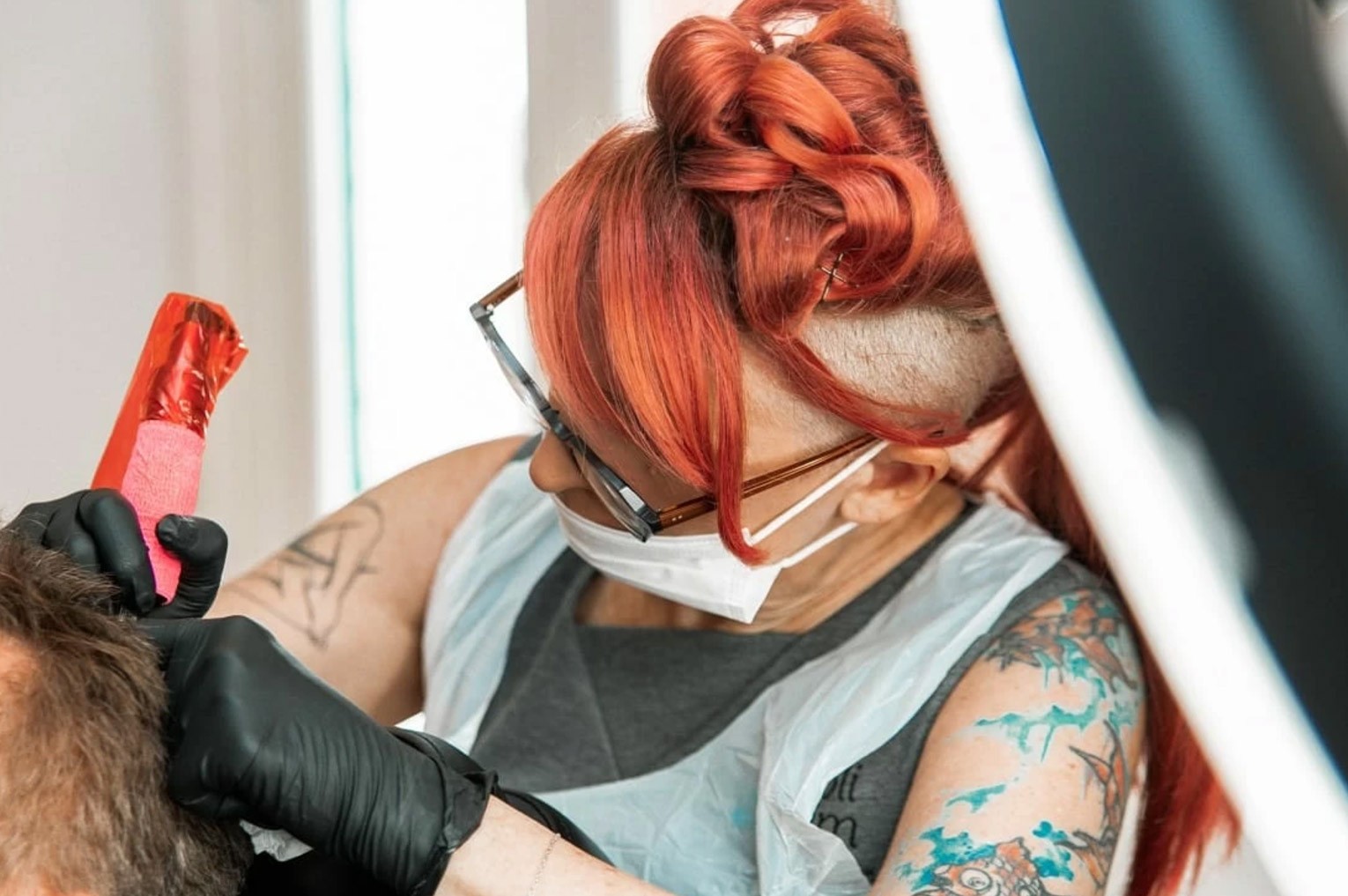
Every regret in this guide is cheaper to prevent before the first session than to fix after it. I have spent 17 years in scalp micropigmentation and permanent makeup, and in my view most regrets trace back to decisions made before the needle ever touched the scalp. This guide goes through every common regret, why it happens, what the published research says, and the checks that stop it happening to you.
Why people end up regretting SMP
SMP is a cosmetic tattoo: thousands of tiny dots placed in the upper skin to look like the shadow of a buzz cut or to add density under thin hair. If you are new to it, the complete guide to scalp micropigmentation covers the basics. What matters here is simple. It is permanent, it is done by hand, and every result depends on judgment calls made by one person.
That person may not have much formal grounding. The dermatologists who first described SMP in a medical journal noted that no formal training programs existed and that many practitioners learned by copying what they saw in videos (Rassman et al., Journal of Clinical and Aesthetic Dermatology, 2015). Today the ISHRS still says there is no international licensing body for SMP practitioners (ISHRS).
The clearest data on what happens when it goes wrong comes from a study in South Korea of 120 people who needed corrective treatment after unsatisfactory SMP. Of those, 107 (89.2 percent) had their original treatment at a beauty salon or cosmetic tattoo facility offering permanent makeup (Park et al., International Journal of Dermatology, 2024). Rules on who may tattoo differ between countries, so read that as a pattern, not a law: the setting and the skill behind the needle shape the outcome.
| Correction method | Patients | Share |
|---|---|---|
| Hair transplant surgery alone | 74 | 61.7% |
| Hair transplant plus new SMP | 25 | 20.8% |
| Laser removal, then SMP again | 16 | 13.3% |
| Removal only, nothing added | 5 | 4.2% |
Look at what that table says about the cost of a bad result. More than four in five of those patients ended up having surgery to hide or replace the SMP. Patients rated their corrected results at 4.5 out of 5 on average, which is good news, but every one of them paid twice.
How common is SMP regret?
Honestly, nobody knows. I could not find a published study that measures what share of all SMP clients regret it, and I will not invent a number. The Korean correction study counts people who came in for a fix; it cannot tell you how many were happy and never came in.
The small numbers that do exist cut both ways. A 2025 survey of 131 hair loss patients at a Korean dermatology clinic found only 5 who had ever had SMP; of those 5, two reported a change in the shape and color of the tattoo, and one or two were dissatisfied (the paper gives both figures) (Kim and Kim, Annals of Dermatology, 2025). Five people is far too few to draw a rate from. On the other side, a clinic series of 80 men with advanced hair loss reported average patient satisfaction of 4.8 out of 5, with two cases of mild blurring at the edges (Park, You and Kim, International Journal of Dermatology, 2018). That series was written by the practitioners who did the work.
Regret by cause: the quick table
Here is every common regret on one screen. Each one gets its own section below, with what the research says and what I would check.
| Regret | Usual cause | How to avoid it |
|---|---|---|
| Hairline too low | Designed for a younger face | Agree a mature hairline in writing |
| Hairline too straight or sharp | No soft, irregular front edge | Ask for healed hairline close-ups |
| Dots too big or dark | Wrong needle, overpacking, too much in one session | Build density over several sessions |
| Blurring and spreading | Pigment placed too deep | Choose an SMP specialist, check healed work |
| Blue or green tint | Pigment placed too deep, or tattoo ink or PMU pigment instead of carbon SMP pigment | Ask for a carbon SMP pigment by name |
| Patchy fading | Uneven retention, skipped sessions | Complete every session and touch-up |
| Mismatch with real hair | Wrong shade or wrong candidate | Test color; check remaining hair density |
| Shaved head for life | Commitment not thought through | Live with a buzz cut first |
| Disappointment | Unrealistic expectations | Ask what it will not do |
| Looks worse in 10 years | Hair loss kept going | See a doctor, design for later loss |
Hairline regrets: too low, too straight, too sharp
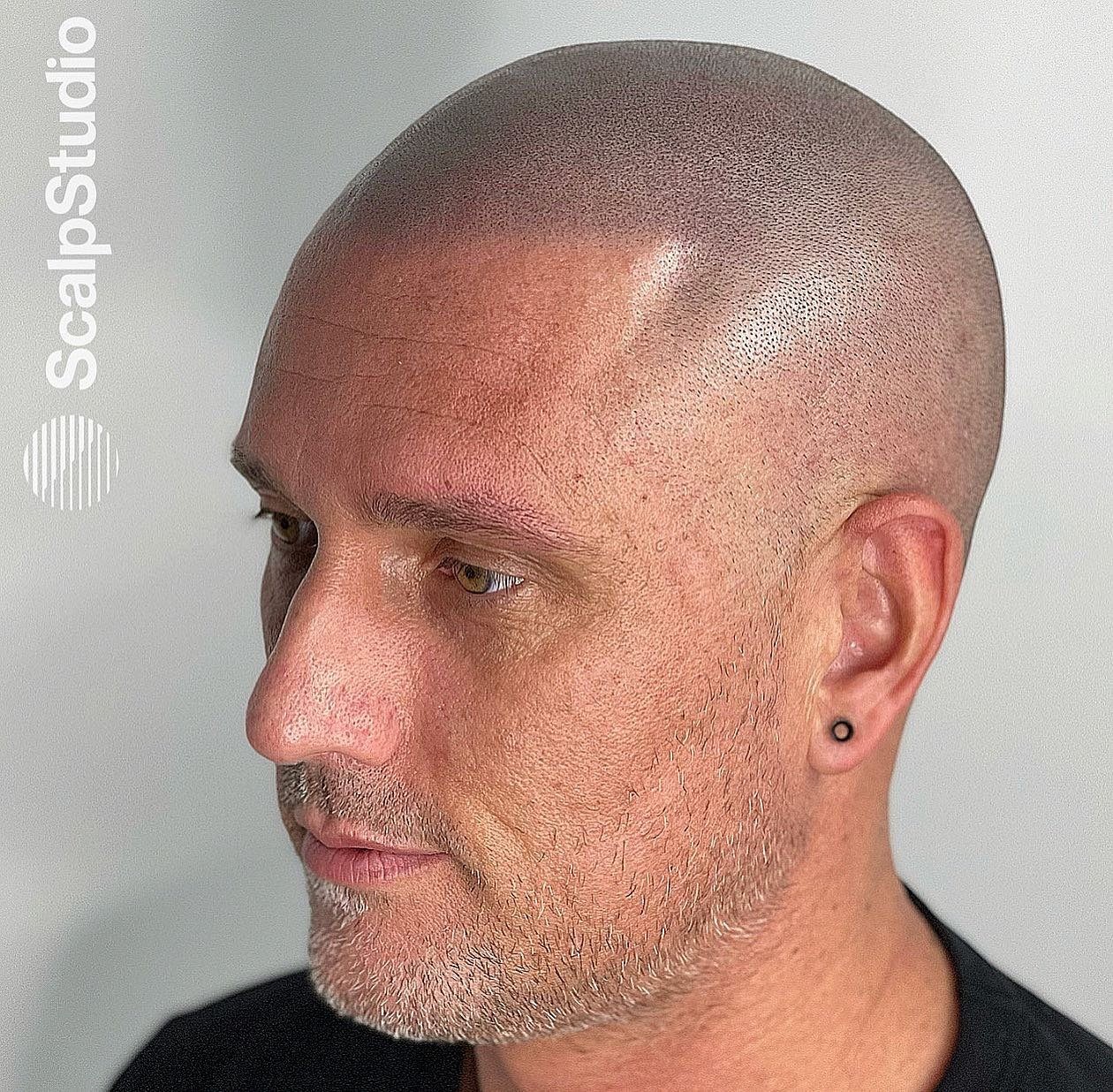
The hairline is where SMP lives or dies. It sits on the front of your face, it frames everything, and it is the first thing people see. A mistake on the crown can hide; a mistake at the front cannot.
Too low
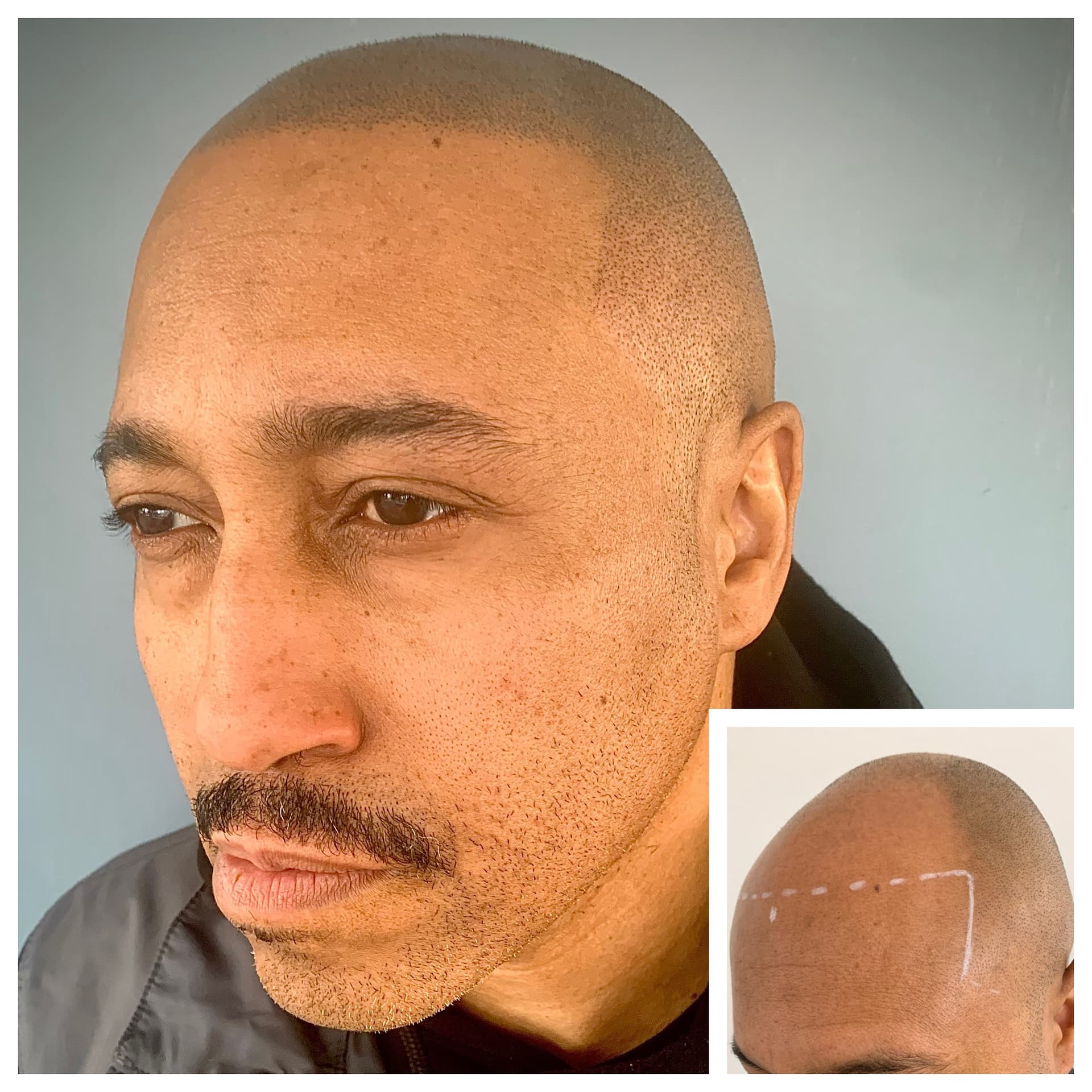
A low hairline is the classic regret. Clients ask for the hairline they had at 19, and an artist who wants to please says yes. The problem is that a teenage hairline on a 45-year-old face looks fake, and it looks more fake every year as the face ages around it.
Male pattern hair loss usually starts above both temples and pulls the hairline back into an M shape, with thinning at the crown as well (MedlinePlus Genetics, 2023). A mature hairline accepts some of that recession. A natural-looking SMP hairline usually sits where a man of your age would plausibly have one, not where you had one in school.
Too straight
Real hairlines are not ruler lines. They wander, they have small peaks and dips, and the front edge is made of single, finer hairs before the density builds behind them. A perfectly straight line, or perfectly symmetrical temples, reads as drawn on. This is one of the first things I look at in anyone's healed portfolio.
Too sharp
A hard, dense front edge is the third version of the same problem. Natural hairlines fade in from skin to hair over a short zone. If the first row of dots is as dark and tight as the middle of the scalp, you get a helmet look, especially in strong light. Ask the artist how they build the transition, and look for it in close-up photos.
Designing for the face you will have later
The ISHRS describes a hybrid approach for people who want a younger look now: a temporary pigment at a lower front edge, with more permanent pigment placed at the mature hairline behind it, so the youthful line can fade back over time (ISHRS). Not every artist offers that, but the principle is the right one. Ask any artist where your hairline will look right at 60, not just next month. Our guide to SMP for a receding hairline covers the design choices in more detail.
Hairline questions to settle before any needle touches you
- Where exactly does the line start, measured from your eyebrows, and why there?
- How will the temples be shaped, and will they be left with some natural recession?
- How soft is the front edge, and how many rows does the transition take?
- Will the line be drawn on you and photographed for your approval first?
- What happens to this line if your hair loss progresses?
Dots too big, too dark, or blurred
Good SMP dots are small, sit at the right depth, and stay separate. Over time the most common technical failure I see described is the opposite: dots that look like freckles, or that spread into a gray smudge.
Why dots spread
Depth is the big one. The ISHRS says needle depth is usually shallow, at around half a millimeter, and that pigment pushed too deep can spread and look blotchy (ISHRS). Rassman and colleagues described the same mechanism: pigment placed too deep diffuses beyond where it was put, and they noted bleeding of pigment is common among less experienced practitioners. They added that bleeding in a session may have to be treated, possibly with a laser, before more work is done (Rassman et al., 2015).
The Korean shaved-style series advised avoiding deep needle work in the early sessions for the same reason, because it can make the ink spread (Park, You and Kim, 2018). A review of micropigmentation also notes that blurring from pigment leaking out of the original site is uncommon but can appear 3 to 6 weeks after treatment (Kerure et al., Indian Dermatology Online Journal, 2023). That timing matters: a result that looks crisp on day one can soften by week six.
Why dots end up too dark
Overly dark SMP usually comes from rushing. Trying to reach full density in one long session means packing dots tightly with a strong shade, and there is no undo button. A careful plan starts lighter and builds density over several sessions, which is why most clinical descriptions talk about 2 to 4 sessions or more rather than one (Rassman et al., 2015; Cleveland Clinic). Lighter can always be darkened later. Darker cannot be lightened without removal.
How to avoid it
- Ask to see healed results at least several months old, close up, in daylight.
- Ask what needle setup the artist uses for your skin and why.
- Ask how they decide the shade and density for session one.
- Be wary of anyone promising a finished result in a single visit.
Blue or green color shift
This is the regret people find hardest to explain to friends: dots that were charcoal on the day now look blue or greenish in daylight. It is not a myth and it is not always the client's fault.
Rassman and colleagues told patients plainly that a blue or green tint may appear. They linked it partly to the way skin absorbs and scatters light over dark pigment, the same effect that makes blood vessels look green under the skin, and noted that sun exposure can also change pigment color (Rassman et al., 2015). That scattering, called the Tyndall effect, gets stronger the deeper the pigment sits. The ISHRS adds that conventional tattoo ink, especially when placed deeper or with a larger needle, can spread and shift from black or brown to unnatural shades (ISHRS).
Pigment choice is the part you can influence. A proper SMP pigment is carbon based (carbon black, listed as CI 77266) and does not change color over time. Pigments built on iron oxides or titanium dioxide are permanent makeup pigments, and like tattoo inks they have no place in SMP. The ISHRS says its preferred SMP pigment is carbon-only, which lets the artist create grayscale dots that blend with many hair colors, including as hair goes gray. In the small Korean survey, two of the five people who had SMP reported a change in its shape and color (Kim and Kim, 2025).
Sun is the part you control afterward. The American Academy of Dermatology notes that ultraviolet light can fade some tattoo inks and recommends a broad-spectrum, water-resistant sunscreen of SPF 30 or more (AAD). A shaved scalp takes more sun than almost any other skin you have. Our SMP aftercare guide covers sun care in detail.
Patchy fading
Some fading is normal: SMP is a tattoo, and the body slowly breaks down and moves pigment. Patchy fading is different. It is when some areas hold and others drop out, leaving the scalp looking blotchy.
Part of this is built into the process. Rassman and colleagues described how the even look after the first session changes as it heals, and reported cases with almost complete loss of pigment within a few weeks of the first treatment (Rassman et al., 2015). That is why a plan has several sessions: later sessions fill what did not hold. In the Korean shaved-style series, patients needed an average of 4.34 sessions, ranging from 2 to 7 (Park, You and Kim, 2018).
Over the longer term, the ISHRS says well-placed SMP lasts 5 to 10 years, and that some people choose a touch-up every year (ISHRS). Cleveland Clinic says SMP usually keeps its appearance for four years or longer (Cleveland Clinic). The micropigmentation review also notes that pigment taken up by nearby lymph nodes may contribute to fading at the treated site (Kerure et al., 2023).
What causes patchy fading, and what you can do
- Skipping or delaying planned sessions: book the full course before you start.
- Sun on a shaved scalp: sunscreen and a hat, every time.
- Picking, scratching or exfoliating during healing: follow aftercare to the letter.
- Oily or scarred skin that holds pigment differently: ask how the artist adjusts for it.
- No touch-up plan: get the touch-up policy in writing before you pay.
For timelines and what touch-ups involve, read how long SMP lasts and our guide to SMP touch-ups.
Mismatch with your remaining hair
SMP has to sit next to real hair: the sides and back on a shaved head, or the hair you still have when it is done for density. When the two do not match, the eye picks it up immediately.
The ISHRS warns against SMP where a completely bald area sits next to longer, relatively dense hair, because the mix of shaved-look dots and real hair length looks unnatural (ISHRS). Shade is the other half. A dot that matches your hair today may not match it in ten years when your stubble comes through gray, which is one reason the ISHRS favors grayscale carbon pigment over mixed colors.
If you have had a hair transplant, timing matters. The ISHRS suggests waiting at least a year after a transplant before SMP, while the new hair settles in unevenly. If you are still choosing between the two, see SMP versus hair transplant.
Density SMP under longer hair is a different job from the shaved look. Rassman and colleagues noted SMP can be done with the hair kept long or on a shaved scalp (Rassman et al., 2015). This is common for women, and our guide to SMP for women explains how it differs.
Regretting a shaved head for life
This one is not a technical failure. The work can be perfect and you can still regret it, because you have signed up to a haircut for life.
The Korean shaved-style paper puts it bluntly: patients must accept that they need to keep the hair on the sides and back short for the rest of their life, and should be told and consent to that at the consultation (Park, You and Kim, 2018). The dots are designed to look like stubble. Let your real hair grow out and the illusion goes, because the dots stay the same while your hair does not.
In my view, the most useful thing you can do before booking is free: shave your head to the length you would keep it and live with it for a few weeks. See how often you need to clip it to keep that look, how you feel about it at work, in photos, in winter. If that feels like a chore or a disguise, SMP's shaved style will feel the same way, only permanently.
Unrealistic expectations
SMP does a specific job very well. It does not grow hair, it does not add texture you can run your hand through, and on density work it does not make thin hair look thick from every angle. It creates the impression of hair or of a fuller scalp, mostly from normal viewing distance.
Rassman and colleagues advised setting realistic goals at the first consultation, noting that some visible scalp through the hair is normal for density work and that some patients want more density than is realistic (Rassman et al., 2015). The micropigmentation review lists unrealistic expectations as a reason not to treat at all (Kerure et al., 2023).
I think a good artist will tell you what SMP will not do before they tell you what it will. If a consultation feels like a sales pitch with no downsides, that is your answer. Our before and after guide shows how to read result photos so your expectations are set by healed work, not marketing.
Cheap or untrained artists, and skipped consultations
Most of the regrets above trace back to one place: who did the work and how much thought went in before they started. Cleveland Clinic says the main risks of SMP come from an unlicensed or inexperienced practitioner, and lists an unnatural or undesirable appearance among them, alongside allergic reaction and infection (Cleveland Clinic).
Pigment is part of it too. The FDA says it has not approved any pigments for injection into the skin for cosmetic purposes, and that ink can be contaminated even when the container is sealed or labeled sterile. If you react, it asks you to get the brand, color and lot number from the artist (FDA, 2024). An artist who cannot tell you what is going into your scalp is not one to trust with your hairline.
Skipping the consultation removes every safety net in this guide. It is where the hairline gets drawn and agreed, where color is tested, where your hair loss history comes up, and where you find out whether you are a good candidate at all. The micropigmentation review includes a patch test for pigment allergy in its pre-treatment work-up (Kerure et al., 2023). Price comes last: our SMP cost guide explains what a full quote should include, and how to choose an SMP artist lists the questions that separate skill from salesmanship.
Not thinking about aging and future hair loss
SMP is permanent; hair loss often is not finished. MedlinePlus says male pattern hair loss can begin in the teens, that the risk rises with age, and that more than half of men over 50 have some degree of hair loss (MedlinePlus Genetics, 2023). If you get a full shaved-look SMP at 24 on a scalp that still has hair on top, that hair may thin around the tattoo over the next decade.
The authors of the Korean shaved-style series, whose patients were 30 to 65, said extra caution should always be used with young patients (Park, You and Kim, 2018). I agree. A young client needs a more conservative hairline and a plan for what happens if the crown or temples go further.
This is also where a medical opinion earns its place. A doctor can tell you what type of hair loss you have, whether it is still active, and whether treatment could slow it. SMP covers loss; it does not treat it. If you want to see where you are on the scale, our guide to the Norwood scale explains each stage.
Would I regret it? A self-check
Run through this before you book. If you answer no to more than one or two, I would slow down and get another consultation first.
Answer these honestly before you book
- I have lived with a buzz cut at my planned length for at least a few weeks, and I like it.
- I accept keeping my sides and back short for life if I choose the shaved look.
- I know what type of hair loss I have, and a doctor has looked at it.
- I understand my hair loss may progress, and my design allows for it.
- I want a hairline that suits my age, not the one I had at 18.
- I have seen healed results, not just fresh photos, on people with my skin tone.
- I know SMP gives the look of stubble or density, not real hair.
- I can commit to every planned session and future touch-ups.
- I am happy to protect my scalp from the sun from now on.
- I am choosing the artist on skill first and price second.
- I know that undoing SMP means laser removal, surgery or both.
The checklist: 14 checks before you book
This is the list I would want everyone booking SMP to walk in with. Each check maps to one of the regrets above. A good artist will pass most of them without you having to push; a weak one will start getting vague around number three.
Check these before you pay a deposit
- The artist does SMP as a specialty, not as a side service to body tattooing or brows.
- They show healed results, months after the final session, on people with your skin tone, hair color and pattern of loss.
- The healed photos include close-ups of the hairline in plain daylight, and the edges look soft and irregular.
- They draw your proposed hairline on you, explain its height and temple shape, and photograph it for your approval.
- They explain how that hairline will still look right if your hair loss progresses and as your face ages.
- They name the pigment brand and type, and can show you a labeled bottle with a lot number.
- They explain how they control needle depth and dot size, and why their setup suits your skin.
- The plan has several sessions, starting lighter and building density, with the spacing explained.
- They ask about your hair loss history and tell you to see a doctor if it is undiagnosed or active.
- They check whether your remaining hair, its length and its color suit SMP, and say so if they do not.
- They talk you through the shaved-head commitment, or explain clearly that your plan is density work under longer hair.
- They hold the license or registration your local health authority requires and follow bloodborne pathogen rules.
- They give you written aftercare, including sun protection, and a direct contact for questions.
- The full price, number of sessions and touch-up policy are in one written quote before you pay anything.
Take the same list to two or three artists. The comparison is where weak answers stand out.
What to do if you already regret your SMP
If you are reading this after the fact, the first thing to know is that most SMP problems can be improved, and many can be fixed. In the Korean correction study, patients rated their results after revision at 4.5 out of 5 on average, and the treating doctors rated them at 4.6 (Park et al., 2024). For examples of what goes wrong and how it presents, read our guide to botched SMP.
Let it heal before you judge it
Fresh SMP looks darker and sharper than it will once settled, and blurring can take weeks to show. Judge each session once it has healed, and judge the whole job only after the planned sessions are done. If something already looks clearly wrong at the healed stage, stop treatment there. Every extra session adds pigment that may later have to come out.
Correction by a skilled artist
Some problems can be fixed by adding: a hairline that is too high can be brought forward, thin areas can be filled, and a too-perfect edge can sometimes be softened by building a more natural transition behind and in front of it. Problems of excess usually cannot be fixed by adding. A hairline that is too low, dots that are too big or too dark, and blue or blurred pigment all need lightening or removal before anyone works on top.
Laser removal
Lasers are the main tool for taking SMP out. In a published case series of four people, a 1064 nm picosecond laser cleared unwanted SMP in 1 to 3 sessions in every case, with no unexpected adverse events (Wu, Lasers in Surgery and Medicine, 2020). The ISHRS says removal can sometimes take as little as one session, and that it is usually all or nothing, because clearing one patch leaves it mismatched with the surrounding dots (ISHRS). A 2025 case report in Dermatologic Surgery describes SMP that changed color during nanosecond laser treatment before being fully cleared with several wavelengths (Hobayan and Shipp, Dermatologic Surgery, 2025), so color changes partway through are not necessarily a sign of failure.
The American Academy of Dermatology recommends a board-certified dermatologist for tattoo removal. It says some people get light or dark spots afterward that usually fade within 6 to 12 months, and that scarring, texture changes and burns are more common without medical training (AAD, 2023). The FDA adds that some removal procedures can leave permanent scarring or fail to remove the tattoo completely (FDA, 2024).
Lightening without a laser
The micropigmentation review mentions non-laser removal systems that use a microneedling device to deliver lactic acid or other agents (Kerure et al., 2023). Treat these with caution. The AAD warns that tattoo removal creams and ointments have no evidence behind them and can cause burns or permanent scars (AAD, 2023). Never try a home removal on your scalp.
Hair transplant
Surgery was the most common fix in the Korean study: 99 of the 120 patients had a hair transplant, 25 of them with new SMP added afterward (Park et al., 2024). Real hair over or in front of the old SMP can hide it, but that only works if you have enough donor hair and are a candidate for surgery, which a hair restoration surgeon has to assess.
| Option | Best for | Watch for |
|---|---|---|
| Correction by adding | Too high, too thin, gaps | Never adds over blue or blurred dots |
| Laser removal | Too low, too dark, blue, blurred | Usually the whole area; light or dark spots |
| Laser, then new SMP | Wanting SMP, done properly | Healing time before starting again |
| Hair transplant | Hiding SMP under real hair | Needs enough donor hair; surgery |
Before you book any correction
- Photograph your scalp now, in daylight and indoor light, front, sides and top.
- Ask your original artist for the pigment brand, color and lot number in writing.
- Get at least one independent assessment from someone who does corrections often.
- For removal, see a board-certified dermatologist and ask which laser they will use and why.
- If you are considering surgery, get a hair restoration surgeon to check your donor area.
- Stop any further sessions with the original artist until you have a plan.
If a correction route ends with new SMP, treat it as a first booking: the self-check and the 14 checks above apply in full, and the artist doing the redo should be able to explain exactly why the first result went wrong.